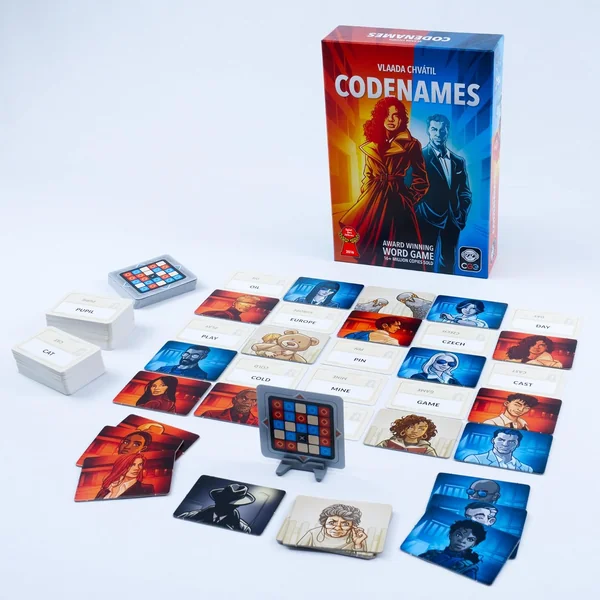
Codenames is the 2015 word-association party game from designer Vlaada Chvátil and publisher Czech Games Edition (per Wikipedia): two teams race to contact their secret agents hidden in a 5×5 grid of 25 word cards, guided only by their spymaster's one-word clues. The 2025 second edition refreshes the package with a revised word list, new art, a better insert, and a streamlined rulebook.
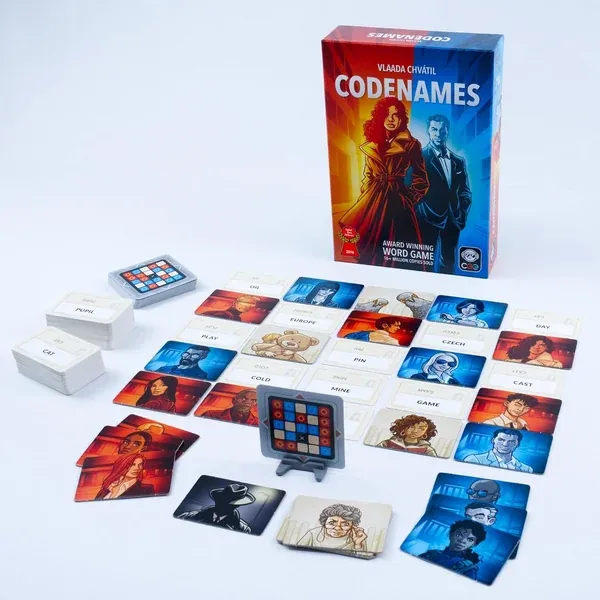
Codenames game components including cards, clue-giver device, and timer
This guide synthesizes the publisher's official rulebook, the Amazon listing, BoardGameGeek community data, and published coverage. It is not based on hands-on play.
“Codenames is the most accessible, most consistently reliable, and easiest to teach party game in my entire collection.”
What It Is
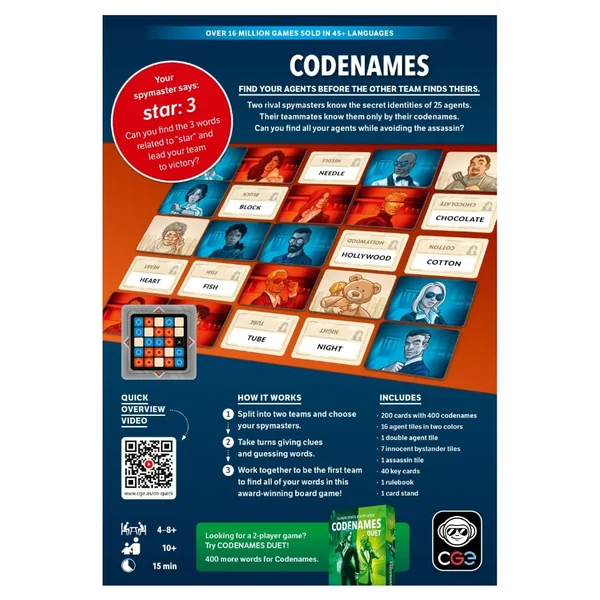
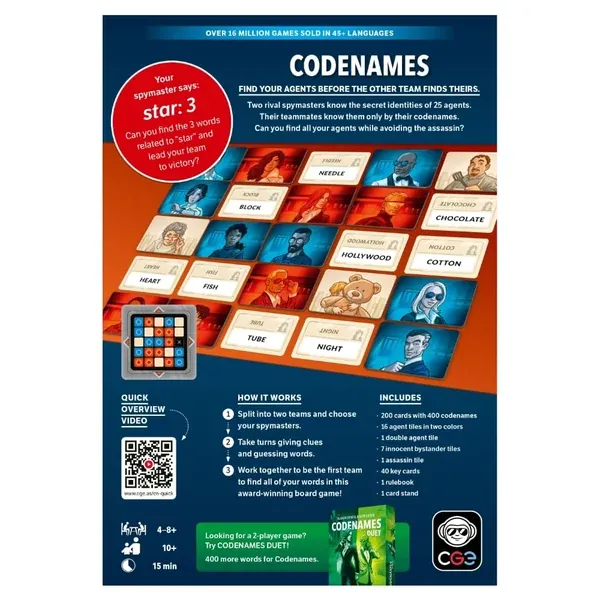
Each game deals 25 codename cards into a grid from a deck of 400 words (rulebook, p. 2). One player per team becomes the Spymaster; the Spymasters share a secret key card showing which grid words are their agents, which are innocent bystanders, and which single word is the assassin.
BGG lists a 15-minute playtime, a complexity weight of 1.3/5, and ranks Codenames #162 overall and #6 among party games, with over 182,000 users logging it as owned. Amazon buyers rate it 4.8/5 across 164 ratings.
How It Plays
Setup is fast: deal the grid, seat both Spymasters on one side with a randomly drawn key card in its stand, and give each team its stack of agent cards (rulebook, p. 2-3). The starting team, shown by lights on the key, must contact 9 agents; the other team needs 8.
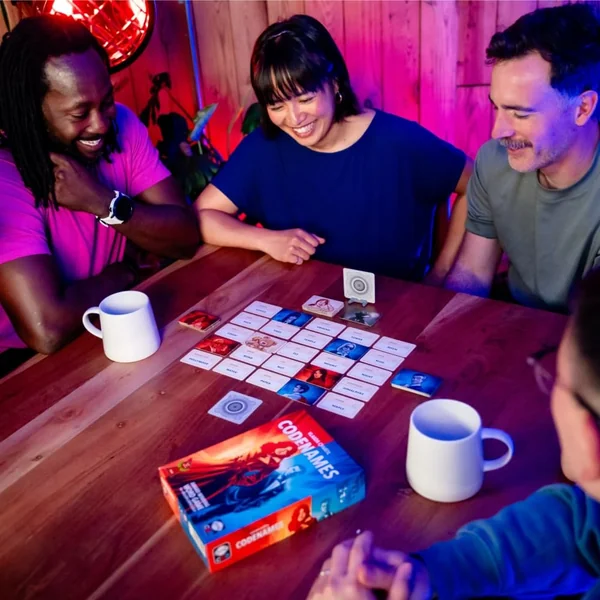
Codenames gameplay with players guiding teammates through word clues
On a turn, the active Spymaster says one word and one number — the number declaring how many grid words the clue links (rulebook, p. 4). Their Field Operatives debate openly, then commit to guesses by touching cards; a correct agent is covered and they may keep guessing, while a bystander or enemy agent ends the turn (and an enemy agent helps the other team).
The signature mechanic is the "number plus one" limit: operatives may always guess one word beyond the clue number, which exists so a team can circle back to a word it passed on from an earlier clue (rulebook, p. 5). The rulebook's own example shows a red operative converting a river: 3 clue into three hits, then reaching back for a leftover tree word.
Here's the play pattern first-timers feel immediately: a clue for a single word is perfectly legal, but a team linking one word per turn will lose to a team linking three — the starting team must find 9 agents against 8. The whole skill of the game is building bold multi-word links that never brush against the assassin, because contacting that one black key-square ends the game in an instant loss (rulebook, p. 4).
The game ends when one team has all its words covered — that team wins, and you can even win on the opponents' turn if they accidentally guess your final word (rulebook, p. 5). Reset is a fresh grid of 25 cards and a new key, with players encouraged to rotate the Spymaster role.
Complexity and Teachability
BGG's community weight of 1.3/5 places this firmly in light territory, and the core teach fits in two sentences: one word, one number, don't touch the assassin. Long-form community analyses on BoardGameGeek still dissect cluecraft in depth, which hints at a real skill ceiling under the simple rules.
> "Codenames is the most accessible, most consistently reliable, and easiest to teach party game in my entire collection." — Meeple Mountain
The genuine rules overhead lives in clue legality. Clues must be about a word's meaning, not its letters or grid position, and you cannot say any form of a visible word — until VOTE is covered, vote, voted, and voting are all off-limits (rulebook, p. 6).
Player Count: Box vs. Reality
The rulebook states the standard game needs at least 4 players in two teams of two, with variant rules for two or three players included later in the book (rulebook, p. 2). The listing leads with 4+ players, while BGG's data shows a 2-8 range — the variants reconcile the difference.
Codenames board game overview showing gameplay components and rules
BGG's player-count poll, with 1,105 votes, says the game plays best at 6. A BGG community thread shows groups asking about pushing past 8 for big parties, but that's beyond the supported range, and larger teams mostly mean more voices debating each guess.
What's New in the Second Edition
Both the listing and CGE's own page document the same refresh: a revised word list, refreshed art, a brand-new insert, and a streamlined rulebook. Neither source publishes a card-by-card changelist of which words were swapped, so owners weighing the upgrade can't compare lists directly.
BGG's version data confirms the English second edition as a 2025 printing, alongside second editions in German and Finnish. Per BGG, official themed reimplementations also exist, including Codenames: Back to Hogwarts and Codenames: Blizzard Edition, for buyers who want a flavored version.
Limitations
Coverage and the rulebook itself surface real friction. Board Game Review's second-edition revisit notes their enthusiasm is strongest "with the right crowd" and has cooled slightly since the game's early days — a group-chemistry dependency, not a mechanical flaw.
A hesitant Spymaster stalls the whole table, and the rulebook ships a sand timer for exactly this: anyone may flip it to force a slow player to decide (rulebook, p. 5). Clue legality is also a live judgment call — the rulebook spends two pages on edge cases like compound words, homonyms, and acronyms, and concedes different groups will rule differently (rulebook, p. 6-7).
Finally, BGG's language-dependence poll rates the game unplayable in another language: every clue hangs on shared vocabulary, so mixed-language tables should look at the localized editions.
Verdict
Buy it if you host game nights of four to eight people and want a party game that teaches in minutes, plays in about 15, and scales from casual family groups to competitive clue-crafters. Skip it if your group dislikes wordplay, plays mostly at two (the variant exists but the BGG poll peaks at six), or needs a game that travels across languages.


 Tap to enlarge