Patchwork is a two-player abstract game about sewing a quilt — buying odd-shaped fabric patches and fitting them onto a personal grid while racing an opponent down a shared time track. It comes from Uwe Rosenberg, the designer of Agricola, and per Lookout Spiele's publisher page it was first released in 2014. The pitch is simple: use limited time and buttons to finish a quilt that is better and more beautiful than your opponent's.
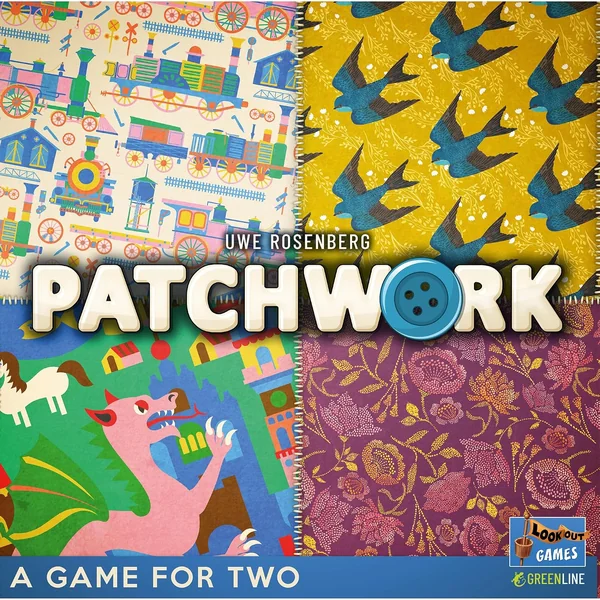
Patchwork's colorful fabric patches and game board design
This guide synthesizes the Amazon listing, Lookout Spiele's publisher page, BoardGameGeek community data, and published coverage — no hands-on play is claimed. Where the listing's component data looks odd (the listed package dimensions read like a flat-mailer entry), we flag it in prose rather than lean on it.
“a tight, precise and finely chiselled design, a bonsai of a game”
What It Is and Key Specs
The box promises 2 players, roughly 30 minutes, and ages 8+. The BGG community rates it 7.6/10 across 74,650 voters, with a complexity weight of 1.6/5 and a community age poll also landing at 8+.
BGG ranks it #148 overall and #5 among abstract games, with over 124,000 users listing it as owned. Amazon buyers' aggregate sits at 4.6/5, though from only 22 ratings — a thin sample next to BGG's numbers.
How It Plays
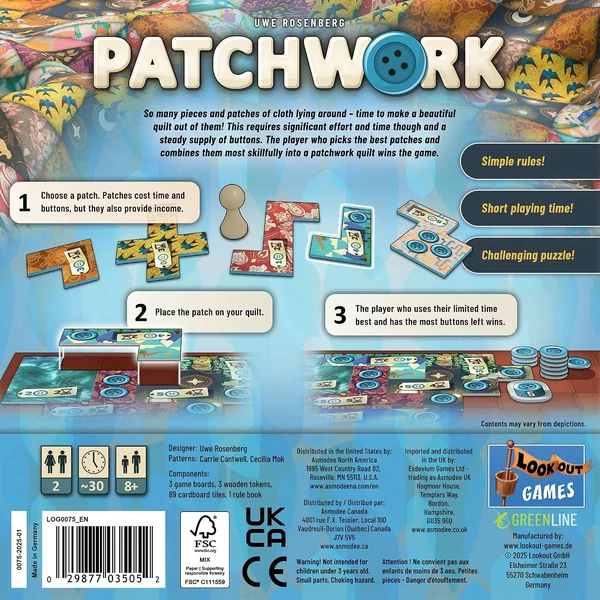
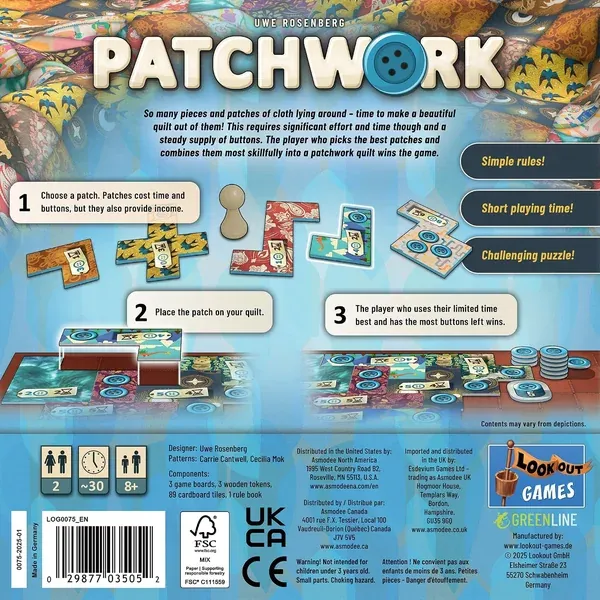
Players compete to build the highest-scoring quilt by placing tiles on their individual boards, per Dicebreaker's rules guide. On a turn you do one of two things: buy a patch from the circle around the time track, or advance your time token to just in front of your opponent's and collect buttons for the distance moved.
Patchwork game overview showing rules, components, and gameplay mechanics
The signature mechanic is the time track, listed among the game's mechanisms on BGG. Each patch costs buttons and time; the player whose token is furthest back keeps taking turns, so a string of cheap, quick patches can mean several moves in a row while your opponent is stuck ahead of you.
Buttons are both money and victory points — the central strategic tension. Some patches carry button icons that pay out income as you pass marked spaces on the track, so early income patches feel slow but fund the late game.
The first-time-player trap is buying a large, time-hungry patch that feels productive, then watching your opponent take two or three turns while you wait, button-poor. Dicebreaker's guide also documents the scoring: your final total is buttons in hand minus two points per uncovered square on your board, with a special bonus tile going to the first player to complete a 7x7 area.
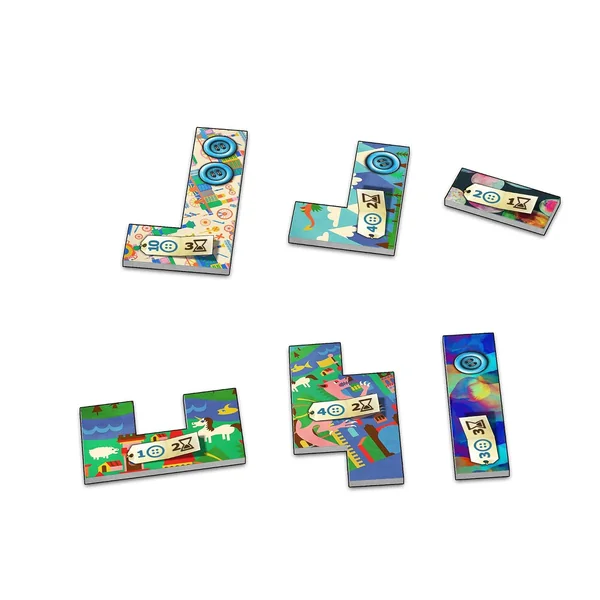
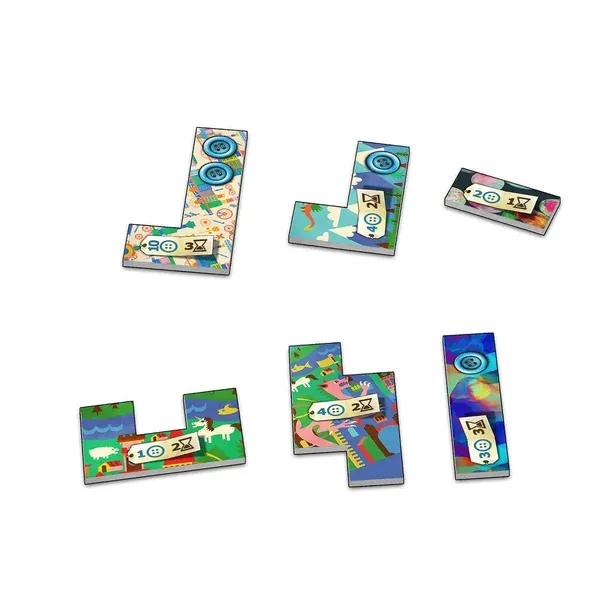
Patchwork's colorful patch tiles with varying shapes and button costs
Complexity and Teachability
Play Better Games calls Patchwork "very easy to teach," saying a five-minute rundown covers it because each turn offers only two possible actions. That tracks with BGG's 1.6/5 weight and the 15–30 minute playtime BGG lists.
BGG's language-dependence poll reports no necessary in-game text, so the box travels well across language groups. The rules floor is low; the decisions are not.
Player Count and Editions
This is a two-player game, full stop — Dicebreaker states it is "for two players (and only two players)," and BGG's poll of 630 voters says best at 2. A BGG thread from a buyer wanting to play with four to six family members shows this is the most common group-size question, and BGG lists official spin-offs — Patchwork Doodle, Patchwork Express, and Stack'n Stuff: A Patchwork Game — for shoppers in that position.
On editions: the listing describes this Revised Edition as retaining the original gameplay with "updated components, refreshed visuals, and a sleek presentation," and BGG's version data shows revised printings rolling out across languages in 2025–2026. Beyond the listing's summary, neither source publishes a detailed changelist, so buyers should not expect gameplay changes.
Reception and Limitations
Shut Up & Sit Down calls it "a tight, precise and finely chiselled design, a bonsai of a game," and Meeple Mountain argues it "stands as one of [Rosenberg's] finest achievements." A BGG user review documents the classic first impression — the author "seriously doubted" the game would interest them before it won them over.
The honest limitations are structural. Two players only is a hard ceiling with no workaround in the box, and Play Better Games flags the two-player-only format as its main downside. The minus-two-per-empty-square scoring also punishes incomplete quilts hard, which some players will read as pressure rather than tension — and the abstract quilting theme, however tidy the components, offers no narrative hook.
Verdict
Patchwork suits couples, roommates, and anyone wanting a five-minute teach with real decisions in a half-hour box — and BGG's abstract ranking suggests it earns that spot. Skip it if you regularly game with three or more; look at the BGG-listed spin-offs instead. The Revised Edition is the version in print now, and since the listing frames the changes as cosmetic, original-edition owners have little reason to re-buy.


 Tap to enlarge