
GAMES
Published by
Z-Man Games
Published
Read Time
7 min read
Amazon player rating
4.8
Share This Review
Pandemic Review: How the Co-op Classic Plays, Per Its Rules and Fans
Amazon player rating
4.8(18,839)
Pandemic is the cooperative benchmark: 2-4 players race a global outbreak clock to cure four diseases before the deck runs out. This review synthesizes the official rulebook, the Amazon listing, BGG community data, and published coverage — no hands-on play — to give a grounded read on how it works and who it suits.
Players
2–4
Best at 4 (1,339 votes)
Playtime
45 min
Complexity
2.4/5
6,312 votes
BGG rating
7.5/10
135,840 raters
BGG rank
#174
#179 Strategy Game
Age
10+
community poll (239)

Source-grounded review: synthesized from the official rulebook, the listing, community data, and published coverage — we don't claim hands-on play, and every rating shown is attributed. How we review →
 Tap to enlarge
In This Review
- What Works & What Doesn't
- What Pandemic Is
- How It Plays
- Complexity and Teachability
- Player Count Truth
- Replayability and the Wider Series
- Honest Limitations
- Verdict
What Works & What Doesn't
What Works
- Three-tier difficulty dial (4/5/6 Epidemic cards) built into setup (rulebook, p. 3)
- Seven asymmetric specialist roles make every seat's decisions matter (rulebook, p. 1)
- The Epidemic reshuffle recycles known hotspots — escalating, readable tension (rulebook, p. 1)
- Strong community reception: BGG 7.5/10 from 135,840 voters; Amazon readers 4.8/5
- Entry point to a huge series — Legacy seasons, Iberia, Hot Zone, and expansions (per BGG)
What Doesn't
- Card-flip swinginess: Board Game Quest notes setups where you can lose on turn 2, with games hinging on a single Epidemic draw
- Open table talk invites quarterbacking — the rulebook itself warns that the active player decides, hinting at the alpha-player dynamic common to co-ops
- Two-player games make Share Knowledge's co-location requirement awkward across a full world map, and BGG's poll says it plays best at 4
What Pandemic Is
Pandemic is Matt Leacock's fully cooperative board game, first published by Z-Man Games in 2008 (per Wikipedia), in which 2-4 players race to cure four diseases before outbreaks overwhelm the globe. The box lists ages 8+ and a 45-60 minute playtime; BGG lists 45 minutes flat and an owned-by count of 227,876 users, with a community rating of 7.5/10 from 135,840 voters.
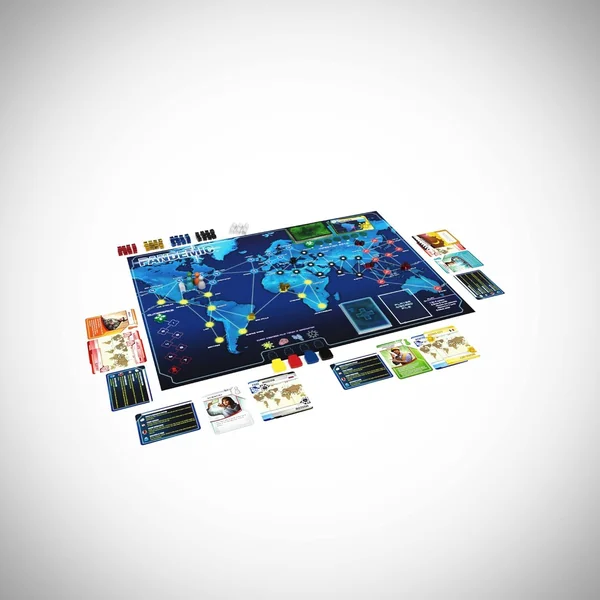
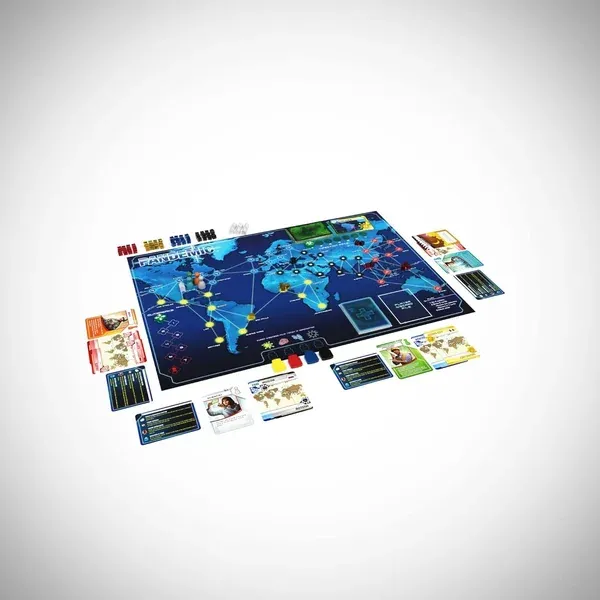
Pandemic's game board and components laid out for play
In the box you'll find a world-map board, 7 role cards, 59 player cards, 48 infection cards, 96 disease cubes in four colors, 6 research stations, and 7 pawns (rulebook, p. 1). Amazon readers rate it 4.8/5 across 18,839 ratings — a readers' aggregate, not a score from this review.
“players should freely give each other advice... However, the player whose turn it is decides what to do”
How It Plays
Setup seeds the board with 18 cubes across nine cities, deals each player a hand scaled to player count, and builds the Player Deck by shuffling one Epidemic card into each of 4-6 roughly equal piles (rulebook, pp. 2-3). The pile count is the difficulty dial: 4 Epidemics for Introductory, 5 for Standard, 6 for Heroic (rulebook, p. 3).
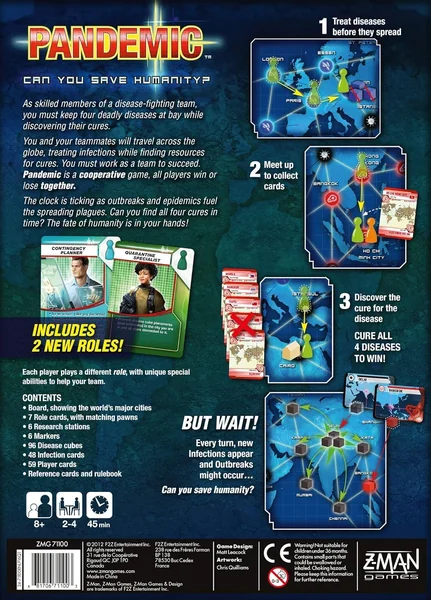
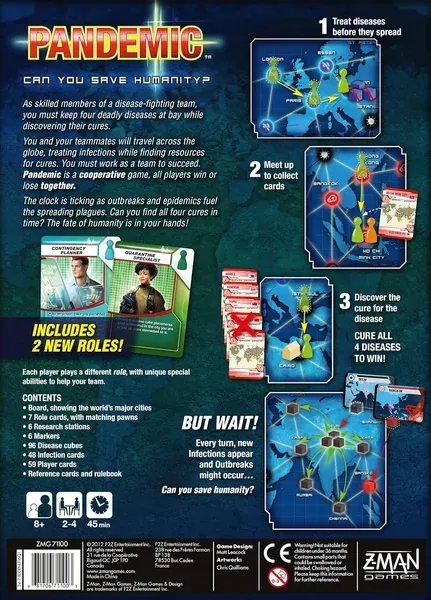
Pandemic board game box back cover with gameplay overview
Each turn has three parts: take 4 actions, draw 2 player cards, then infect cities (rulebook, p. 3). Actions include four movement types, treating disease, building research stations, sharing knowledge with a co-located player, and — at a research station — discarding 5 same-color City cards to discover a cure (rulebook, p. 4).
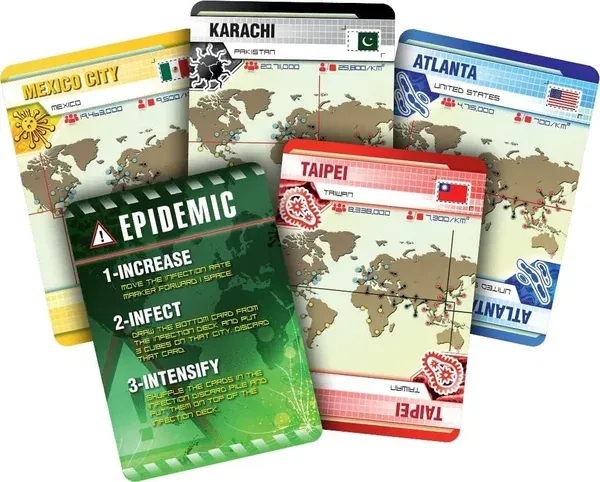
The signature mechanism is the Epidemic card. When drawn, it raises the infection rate, dumps 3 cubes on a city drawn from the bottom of the infection deck, then shuffles the infection discard pile back on top — meaning known hotspots come back around, hotter than before (rulebook, p. 1). It's an elegant doom-clock: the board telegraphs exactly where the next crisis will hit, and the team still struggles to cover it all.
There is no point scoring. The team wins by discovering all four cures, and loses if 8 outbreaks occur, if a disease's cube supply runs dry, or if the Player Deck runs out (rulebook, p. 1).
Complexity and Teachability
BGG's community weight sits at 2.4/5 from 6,312 votes — solidly mid-light. The listing's age 8+ is more generous than BGG's community age poll of 10+ (239 votes), so families with younger kids should expect an adult to quarterback the rules at first.
Roles are dealt face-up and each carries a distinct power — the Scientist cures with 4 cards instead of 5, for example (rulebook, pp. 1-2). Z-Man also hosts an official teaching video, per the rulebook itself (p. 1).
Player Count Truth
The box says 2-4, and BGG's player-count poll agrees it plays best at 4 (1,339 votes). The rulebook shows why the cap exists structurally: running out the Player Deck is a loss condition, and a Board & Card Games Stack Exchange discussion notes that more players burn that deck faster — one reason fans asking about 6-player games get told to enlarge the deck or not bother.
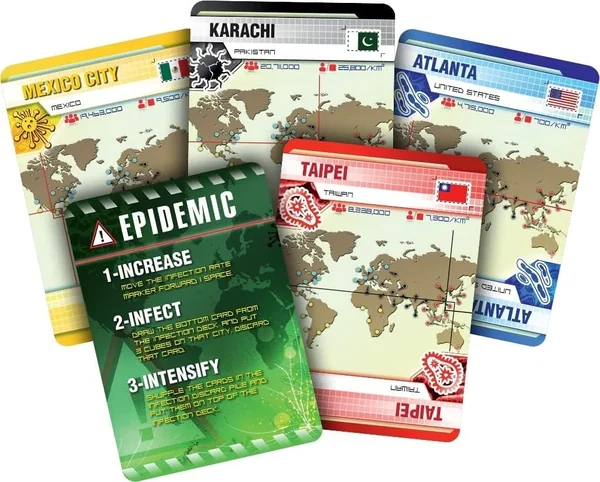
Pandemic's city cards representing global outbreak locations
At two players, the Share Knowledge action — which requires both pawns in the matching city (rulebook, p. 4) — asks two pawns to rendezvous across an entire world map. That's a rules-structure observation, not a dealbreaker, but it explains the community's preference for a full table.
Replayability and the Wider Series
Randomized roles, shuffled infection setups, and the three difficulty tiers are all stateable plainly from the rulebook (pp. 1-3). Beyond the base game, BGG lists a deep family: Pandemic Legacy Seasons 0-2, Iberia, Fall of Rome, Reign of Cthulhu, the Hot Zone line, and expansions like On the Brink and In the Lab — and Z-Man's own Pandemic System page frames the original as the entry point to that series, as does the listing.
Meeple and the Moose calls it "a venerable classic" that "feels like it singlehandedly defines the co-op genre." Reviewer Josh, covering the game and On the Brink, scored it a personal 8.0/10 for the replayability the expansion added to a game he already enjoyed.
Honest Limitations
Swinginess is the documented criticism: Board Game Quest notes "you may have a setup where you lose on turn 2," with "a win or loss contingent on the flip of a single card." That's one reviewer's take, but the Epidemic reshuffle makes it structurally plausible — the same mechanism that creates the tension also concentrates the luck.
The rulebook's own guidance — "players should freely give each other advice... However, the player whose turn it is decides what to do" (p. 3) — reads as a guardrail against the quarterbacking dynamic common to open-information co-ops generally; one dominant strategist can crowd the table if your group lets them.
Verdict
Buy it if you want the foundational cooperative experience — a tense, teachable team puzzle whose difficulty dial scales from family night to genuinely hard. Groups who dislike luck-driven losses, or tables with one player prone to directing everyone's turns, should weigh those caveats first.
Rules questions, answered from the rulebook
How do you win Pandemic?
There is no score. The team wins together by discovering cures for all four diseases, and loses together if 8 outbreaks occur, if disease cubes run out when needed, or if the Player Deck is exhausted (rulebook, p. 1).
What happens when an Epidemic card is drawn?
Epidemics fire in three steps: move the infection rate marker forward, draw the bottom card of the infection deck and put 3 cubes on that city, then shuffle the infection discard pile and place it back on top of the deck (rulebook, p. 1). That intensify step is why previously infected cities keep coming back.
How many players is this game best with?
The box says 2-4 players, and BGG's player-count poll (1,339 votes) rates it best at 4. One reason for the cap: running out the Player Deck is a loss condition, and a Board & Card Games Stack Exchange discussion notes more players drain that deck faster.
Can you adjust this game's difficulty?
Yes — during setup you choose 4 Epidemic cards for an Introductory game, 5 for Standard, or 6 for Heroic, and the rulebook recommends 4 for your first game and 6 once you've mastered Standard (rulebook, p. 3).
Should I buy this game or this game Legacy first?
Z-Man's Pandemic System page and the Amazon listing both frame base Pandemic as the series entry point, with Pandemic Legacy: Season 1 named on the listing as the campaign follow-up. BGG lists the Legacy seasons plus spin-offs like Iberia, Fall of Rome, and the Hot Zone games as official reimplementations.
Is this game suitable for kids?
The listing says ages 8+ with a 45-60 minute playtime, while BGG's community age poll lands at 10+ (239 votes) and its complexity weight is a mid-light 2.4/5. Younger kids will likely manage with an adult guiding the group decisions.
Sources & Further Reading
The key facts and claims in this review are grounded in the retrieved, verified sources listed below.
- 1
images-cdn.zmangames.com
- 2
BoardGameGeek
- 3
zmangames.com
- 4
zmangames.com
- 5
en.wikipedia.org
- 6
meepleandthemoose.com
- 7
boardgamequest.com