
GAMES
Published by
Rio Grande Games
Published
Read Time
7 min read
Amazon player rating
4.9
Share This Review
Dominion Review: The Original Deck-Builder, Assessed Without Nostalgia
BGG community
7.6/10
97,107 raters
4.9 Amazon (3,664)
Dominion is the 2008 card game that invented deck-building: two to four players race to grow a starting deck of Coppers and Estates into a point-scoring engine, with a different ten-card market every game. This review synthesizes Rio Grande Games' official rulebook, the Amazon listing, BGG community data, and published coverage — not hands-on play — to cover how it plays, how it teaches, and who it's for.
Players
2–4
Best at 3 (1,000 votes)
Playtime
30 min
Complexity
2.3/5
5,359 votes
BGG rating
7.6/10
97,107 raters
BGG rank
#146
#142 Strategy Game
Age
10+
community poll (201)

Source-grounded review: synthesized from the official rulebook, the listing, community data, and published coverage — we don't claim hands-on play, and every rating shown is attributed. How we review →
 Tap to enlarge
In This Review
- What Works & What Doesn't
- What Dominion Is
- How It Plays
- Complexity and Teachability
- Player Count Truth
- Replayability and Components
- Honest Limitations
- Verdict
What Works & What Doesn't
What Works
- Variable 10-of-26 Kingdom card setup makes every game's market different (rulebook, p. 3)
- Clean Action–Buy–Clean-up turn structure with a fixed starter set for first games (rulebook, pp. 3–4)
- Enduring community standing: BGG rank #146 overall, 7.6/10 from 97,107 voters
- 4.9/5 reader aggregate from 3,664 Amazon ratings
- Organizer tray and labeled inlay built for fast setup between games (rulebook, p. 2)
What Doesn't
- Interaction is largely indirect unless Attack Kingdom cards make the Supply; Meeple Mountain's reviewer found sessions can slide toward parallel solitaire — one reviewer's read, but consistent with BGG's 'Take That' mechanism tag
- Seventeen Supply piles to lay out and put away every game, per the rulebook's setup
- Moderate in-game text per BGG's language-dependence poll — each new Kingdom combination brings fresh card text to read and teach
- Base box alone tops out at 4 players; official 5–6 player rules live in Dominion: Intrigue and require its cards (per Board & Card Games Stack Exchange)
What Dominion Is
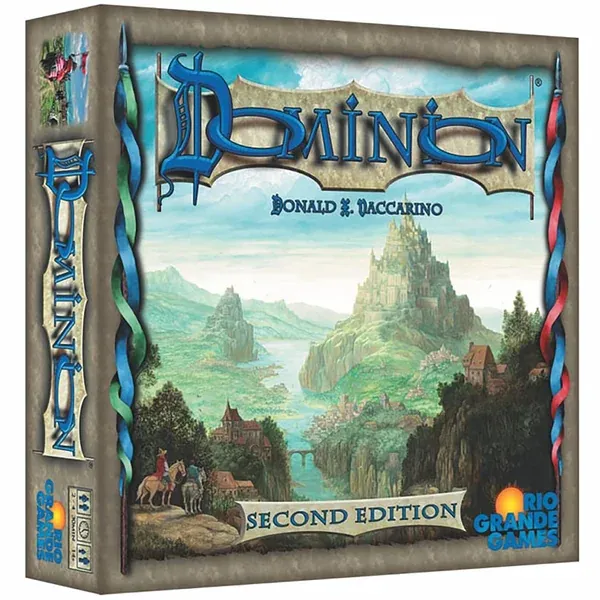
This review synthesizes the publisher's official rulebook, the Amazon listing, BoardGameGeek community data, and published coverage — it is not based on hands-on play by our team. Dominion is the 2008 deck-building card game by Donald X. Vaccarino, published by Rio Grande Games, and the listing sells this printing as the 2nd Edition.
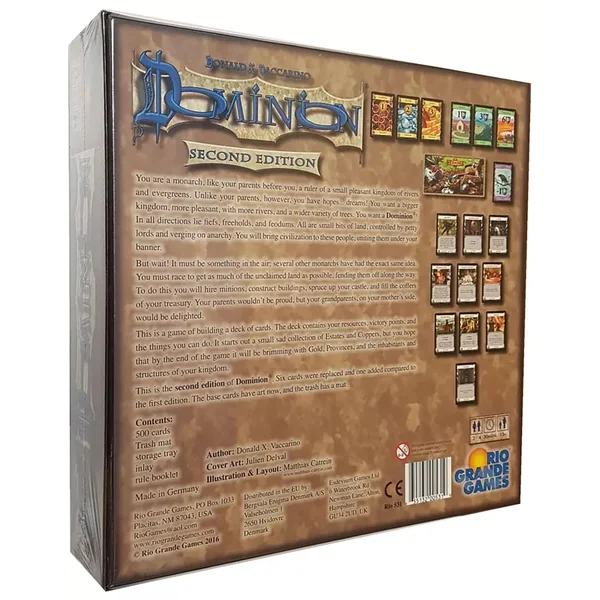
Dominion Second Edition box back showing game overview and card examples
The box covers 2–4 players, ages 13+, with a listed 30-minute playtime that matches BGG's own figure. The listing bills it as "the original deckbuilding game," and the history supports the claim — per Wikipedia, the game was developed under the working title "Castle Builder" before Rio Grande Games published it, and it went on to define a genre.
“actually love it... Maybe even top 3”
A note on editions: neither the listing nor the rulebook documents what the 2nd Edition changed from the original release. The publisher hasn't published a changelist in any of our sources, so we won't speculate — buyers cross-shopping printings should know that gap exists.
How It Plays
Each player starts with an identical deck of 7 Coppers and 3 Estates, shuffled face down (rulebook, p. 3). The table gets a shared Supply: seven Base card piles (Copper, Silver, Gold, Estate, Duchy, Province, Curse) plus ten Kingdom card piles chosen from the 26 included, either by choice or via the blue-backed Randomizer cards (rulebook, p. 3).
Turns follow a strict ABC structure: Action, then Buy, then Clean-up. You may play one Action card, then play any number of Treasures and buy one card — gained cards go to your discard pile, so you won't draw them until your deck cycles — then you discard everything and draw a fresh hand of five (rulebook, p. 4).
The signature mechanic is the deck itself: every card you buy joins your personal draw pile, so your deck is your score, your economy, and your engine at once. The variable ten-of-26 Kingdom selection is what makes each game's market different (rulebook, p. 3).
The game ends when the Province pile is empty or any three Supply piles run out. Players then count the victory points on every card in their deck — Estates 1, Duchies 3, Provinces 6, Curses minus 1 — and the highest total wins (rulebook, pp. 3–4).
Complexity and Teachability
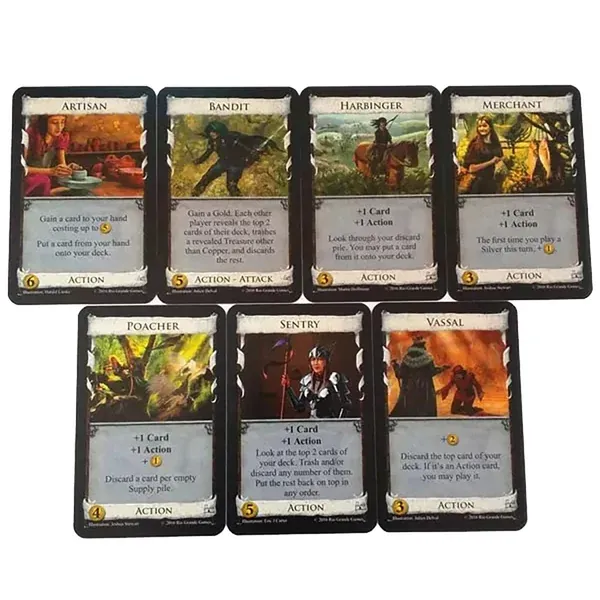
BGG's community rates Dominion's complexity at 2.3 out of 5 — squarely in gateway-plus territory. The ABC structure is genuinely teachable in minutes, and the rulebook prescribes a fixed set of ten Kingdom cards (Cellar, Market, Merchant, Militia, Mine, Moat, Remodel, Smithy, Village, Workshop) for a group's very first game (rulebook, p. 3).
One teachability caveat is grounded in BGG's own language-dependence poll: the game carries a moderate amount of in-game text, and every new Kingdom combination means new card text to read and explain. That's a rules-structure reality, not a flaw unique to this title.
Player Count Truth
The box says 2–4. BGG's player-count poll, with 1,000 votes, says the game plays best at 3 — so the community broadly endorses the box range while crowning the middle of it.
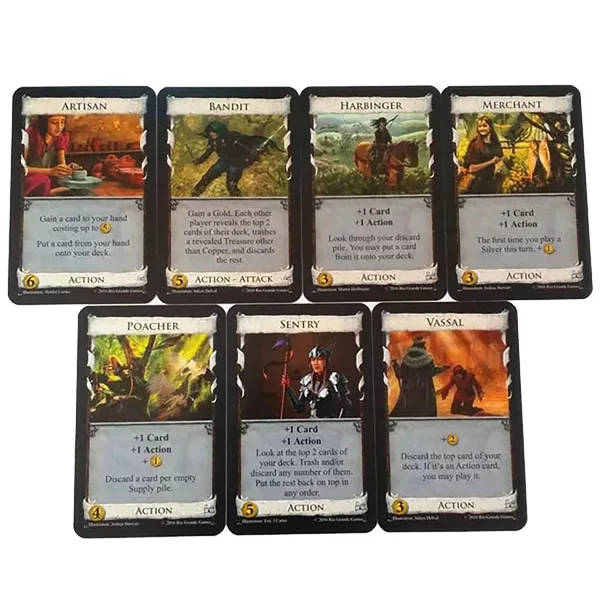
Action cards from Dominion showing various player abilities and effects
For larger groups, per Board & Card Games Stack Exchange, official 5–6 player rules exist in the Dominion: Intrigue rulebook, but they require the extra Treasure and Province cards from that set. Base Dominion alone stays within its printed 2–4.
Replayability and Components
Replayability is structural: with 26 Kingdom cards in the box and only 10 used per game, the Supply changes every session (rulebook, p. 3). BGG also lists official expansions including Dominion: Adventures, Dominion: Alchemy, and Dominion: Allies, which multiply that pool further — the rulebook itself notes expansion Kingdom cards can be mixed in (p. 3).
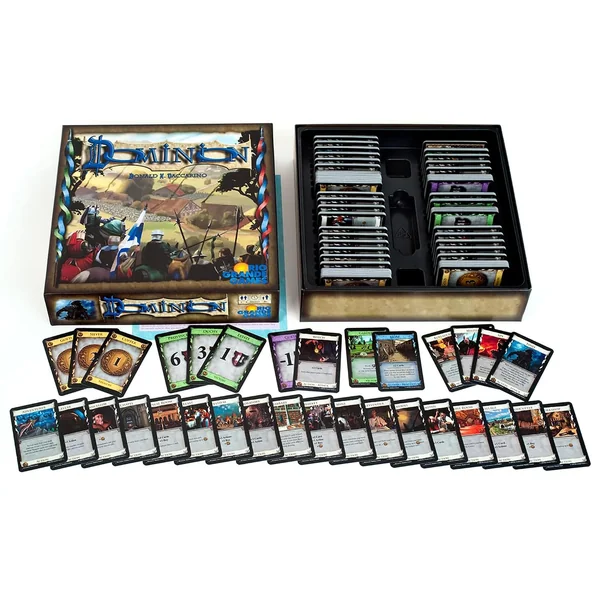
Dominion's box, card storage, and sample gameplay cards displayed
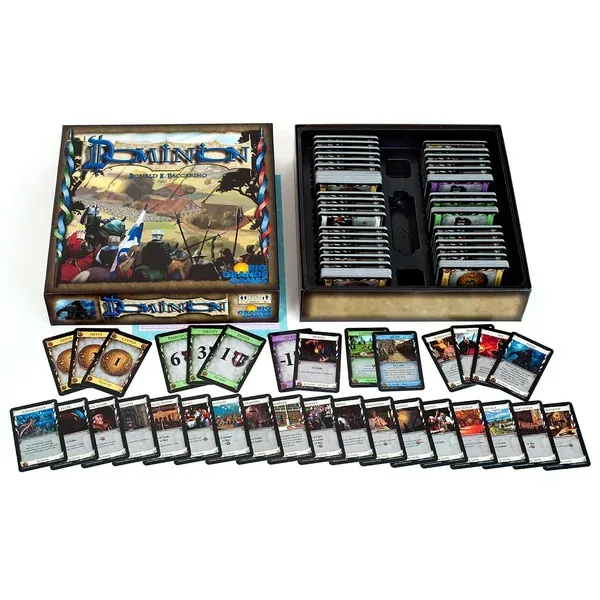
On components, the rulebook inventories 500 cards, a trash mat, and a plastic organizer tray with a labeled inlay designed so each game pulls only the piles in use and returns them for fast setup next time (rulebook, p. 2).
Honest Limitations
Interaction is mostly indirect — you're building your own deck, not touching an opponent's — unless Attack cards like Militia happen to be in the chosen Kingdom set (rulebook, p. 3). Meeple Mountain's reviewer put it plainly: he still has fun every session, but each play reminds him why he drifted away from the game. That's one reviewer's read, though BGG's mechanism tags ("Take That," "Open Drafting") confirm the interaction profile is real and setup-dependent.
The 17-pile Supply also means real setup and teardown work every game, even with the organizer tray (rulebook, p. 3). And readers should know the review ecosystem is heavily nostalgia-weighted — even critics like the BGG user behind "The Good and the Bad" thread and the converted skeptic at Board Game Reviews by Josh ("actually love it... Maybe even top 3") write from deep affection, so sharp modern criticism is scarcer than the game's age would suggest.
Verdict
Buy Dominion if you want the genre's foundation in a 30-minute package — its BGG standing (#146 overall, 7.6/10 from over 97,000 voters) and a 4.9/5 Amazon reader aggregate from 3,664 ratings say the design has aged well. Skip it, or look to its expansions and successors, if you want heavy direct conflict baked into every game rather than dependent on which Attack cards make the Supply.
Rules questions, answered from the rulebook
How do you win Dominion?
The game ends when the Province pile is empty or any three Supply piles run out; players then count victory points on every card in their deck — Estates 1, Duchies 3, Provinces 6, Curses minus 1 — and the highest total wins (rulebook, pp. 3–4).
How many players is this game best with?
The box says 2–4 players. BGG's player-count poll (1,000 votes) rates it best at 3 players, so the community endorses the full box range with the middle of it as the sweet spot.
Is this game easy to teach to new players?
Yes. BGG's community rates its complexity at 2.3 out of 5, and the rulebook prescribes a fixed ten-card Kingdom set (Cellar, Market, Merchant, Militia, Mine, Moat, Remodel, Smithy, Village, Workshop) specifically for a group's first game (rulebook, p. 3).
Can you play this game with 5 or 6 players?
Not with the base box alone. Per Board & Card Games Stack Exchange, official 5–6 player rules exist in the Dominion: Intrigue rulebook, but they require the extra Treasure and Province cards included with that set.
What's different in this game 2nd Edition?
The listing sells this as the 2nd Edition, but neither the listing nor the official rulebook documents what changed from the original release — the publisher has published no changelist in the sources we reviewed.
Does this game have expansions?
BGG lists official expansions including Dominion: Adventures, Dominion: Alchemy, and Dominion: Allies, and the rulebook itself confirms expansion Kingdom cards can be mixed into the selection pool (rulebook, p. 3).
Sources & Further Reading
The key facts and claims in this review are grounded in the retrieved, verified sources listed below.
- 1
www.riograndegames.com
- 2
BoardGameGeek
- 3
riograndegames.com
- 4
en.wikipedia.org
- 5
boardgamereviewsbyjosh.com
- 6
meeplemountain.com