
BOOKS
Published by
Kaveh Akbar
Published
Read Time
8 min read
Share This Review
Martyr! by Kaveh Akbar Review: A Searing, Multilayered Debut Novel
Kaveh Akbar's debut novel Martyr! Follows Cyrus Shams, a young Iranian-American poet in recovery who is obsessed with martyrdom, as he grapples with inherited grief — his mother's death when her plane was shot down over the Persian Gulf, and his father's diminished life working at a Midwestern chicken factory. A National Book Award finalist, the novel has drawn praise from major literary figures and critics for its fearless blend of addiction, displacement, biculturalism, and the aching need to make something meaningful out of pain.
Source-grounded review: synthesized from the listing, community data, and published coverage — we don't claim hands-on play, and every rating shown is attributed. How we review →
In This Review
- What Works & What Doesn't
- What the Novel Is and What It Does
- Significance and Critical Standing
- The Craft: Poetry Translated Into Prose
- Thematic Range and Emotional Stakes
- Who This Novel Is For — and Where It Challenges
What Works & What Doesn't
What Works
- National Book Award finalist with an exceptional concentration of praise from major literary peers, including Tommy Orange, Lauren Groff, John Green, and Clint Smith
- Critical coverage credits Akbar's poet's economy of language with producing prose that ranges from funny and witty to deeply philosophical without losing narrative grip
- Grounds sweeping themes — addiction, grief, biculturalism, martyrdom, the drive to create — in the specific, lived details of Cyrus Shams's family history
- Described across sources as both emotionally serious and genuinely entertaining, avoiding the trap of letting literary ambition crowd out readability
- A debut novel that critical coverage called the work of 'a great, fearless novelist,' marking a significant expansion of an already acclaimed poetic career
What Doesn't
- The novel's emphasis on interiority, philosophy, and voice over conventional plot mechanics may frustrate readers who expect event-driven narrative momentum
- Its thematic scope — addiction, grief, sexuality, racism, displacement, martyrdom, and more — is vast, and readers seeking a narrower, more focused story may find the breadth demanding
This review covers the content and published reception of Martyr! from available sources, not hands-on use or reading.
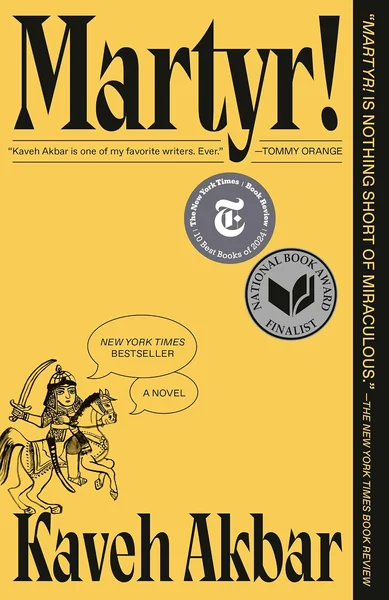
Martyr! (National Book Award Finalist): A Novel by Kaveh Akbar front cover
What the Novel Is and What It Does
Martyr! centers on Cyrus Shams, a young Iranian-American poet in recovery who is consumed by an obsession with martyrdom — specifically, those who die for a cause that never asked for their sacrifice. His mother was killed when her plane was shot down over the Persian Gulf in what the novel frames as a senseless accident; his father endured a constricted life in America, working at a chicken farm in the Midwest. Cyrus moves through grief, addiction, guilt, sexuality, and the drive to create art that genuinely matters, all while confronting what it means to be shaped by loss that predates your own memory. The novel is Akbar's debut in long-form fiction, though he is already an established poet whose work has appeared in The New Yorker, The New York Times, and The Paris Review.
“the best novel you'll ever read about the joy of language, addiction, displacement, martyrdom, belonging, homesickness.”
Significance and Critical Standing
Martyr! arrived as a National Book Award finalist, a distinction that signals its standing among the most significant American literary works of its publication year. The reception from peers and critics has been striking in its consistency. Tommy Orange, the Pulitzer Prize–nominated author of There There, called Akbar "one of my favorite writers. Ever." Lauren Groff, author of Matrix and Fates and Furies, described it as "the best novel you'll ever read about the joy of language, addiction, displacement, martyrdom, belonging, homesickness." John Green wrote that he would "carry this story, and the people in it, with me for the rest of my life," and Clint Smith, author of How the Word Is Passed, called it "simply extraordinary," adding that "the language moves across the page like a symphony." These are not routine blurbs — they represent an unusual degree of sustained enthusiasm from writers across different corners of contemporary American literature.
The Craft: Poetry Translated Into Prose
critical coverage's review drew direct attention to Akbar's background as a poet, noting that "as a poet, Akbar is a master of economy of language, and that mastery remains untouched in this novel." The same review observed that the writing "dances on the page, effortlessly going from funny and witty to deep and philosophical to dialogue that showcases the power of language as well as its inability to discuss certain things." Importantly, critical coverage was careful to note that calling the novel lyrical is not code for a lack of plot — Martyr! is described as "gripping and multilayered," with Akbar maintaining narrative momentum even while operating at the level of the sentence. That combination — propulsive storytelling held together by a poet's precision — is identified across sources as the book's defining formal achievement.
Thematic Range and Emotional Stakes
The novel does not narrow itself to a single concern. NPR catalogued its ambitions as addiction, grief, guilt, sexuality, racism, martyrdom, biculturalism, the compulsion to create meaningful work, and the search for purpose in an indifferent world. What makes this range workable, according to the same source, is Akbar's ability to ground those universal feelings in the very specific — Cyrus's particular family history, the particular absurdity of the accident that killed his mother, the particular texture of an immigrant father's diminished American life. The book has also been described, across multiple sources, as "funny" and "wildly entertaining" alongside its heavier registers, a combination that critics credited with making it "engaging" rather than exhausting. The publisher's own description calls it "electrifying, funny, and wholly original."
Who This Novel Is For — and Where It Challenges
Martyr! is designed for readers drawn to literary fiction that operates at the intersection of personal grief and larger political and cultural inheritance. Readers who enjoy novels where voice, language, and interiority drive the narrative — rather than conventional plot mechanics — are the natural audience. That same quality, however, means readers who prefer tightly plotted, event-driven fiction may find the novel's internal and philosophical registers demanding. Critical coverage also noted that the novel is "gripping" in spite of its ambitions, not because it simplifies them — which suggests Akbar earns the complexity rather than hiding behind it, though the book does ask a great deal of its reader's attention and patience with ideas that resist easy resolution.
Questions & answers, grounded in our sources
Is Martyr! by Kaveh Akbar worth reading?
The review makes a strong case that Martyr! is one of the most significant American literary novels of its publication year, arriving as a National Book Award finalist with an unusually consistent wave of praise from major contemporary writers. LuvemBooks notes it is best suited to readers who value voice, language, and interiority over conventional plot mechanics, and that it earns its complexity rather than hiding behind it.
Who is the target audience for Martyr!?
According to the review, Martyr! is designed for readers drawn to literary fiction that operates at the intersection of personal grief and larger political and cultural inheritance. Readers who enjoy novels where voice, language, and interiority drive the narrative are the natural audience, while those who prefer tightly plotted, event-driven fiction may find the novel's internal and philosophical registers demanding.
What is Martyr! about?
The novel centers on Cyrus Shams, a young Iranian-American poet in recovery who is consumed by an obsession with martyrdom — specifically, those who die for a cause that never asked for their sacrifice. The review describes Cyrus moving through grief, addiction, guilt, sexuality, and the drive to create art that genuinely matters, all while confronting what it means to be shaped by loss that predates his own memory.
Who is Cyrus Shams in Martyr!?
Cyrus Shams is the novel's protagonist, a young Iranian-American poet in recovery whose mother was killed when her plane was shot down over the Persian Gulf in what the novel frames as a senseless accident. His father endured a constricted life in America working at a chicken farm in the Midwest, and Cyrus grapples with grief, addiction, guilt, sexuality, and the compulsion to create meaningful art.
What themes does Martyr! explore?
The review notes that the novel is remarkably wide in its thematic ambitions, with NPR cataloguing them as addiction, grief, guilt, sexuality, racism, martyrdom, biculturalism, the compulsion to create meaningful work, and the search for purpose in an indifferent world. What makes this range workable, according to the review, is Akbar's ability to ground those universal feelings in the very specific details of Cyrus's particular family history and circumstances.
How does Akbar handle the theme of martyrdom in the novel?
The review explains that Akbar frames martyrdom not as heroic self-sacrifice but as dying for a cause that never asked for your sacrifice — an idea embodied in the senseless accident that killed Cyrus's mother when her plane was shot down over the Persian Gulf. This specific, almost absurd tragedy becomes the lens through which the novel interrogates larger questions of loss, purpose, and what it means to be shaped by inherited grief.
Does Martyr! deal with addiction?
Yes, addiction is one of the novel's central concerns. Cyrus Shams is a poet in recovery, and the review notes that addiction is listed alongside grief, guilt, sexuality, and martyrdom as one of the book's core thematic threads. Lauren Groff's blurb, cited in the review, specifically names addiction as one of the subjects the novel treats with extraordinary depth.
What is the writing style like in Martyr!?
The review highlights Akbar's background as an established poet and notes that his mastery of economy of language carries directly into the novel. The writing is described as dancing on the page, moving effortlessly from funny and witty to deep and philosophical, with dialogue that showcases both the power of language and its inability to discuss certain things.
Is Martyr! a lyrical novel without much plot?
The review is careful to address this directly, noting that calling the novel lyrical is not code for a lack of plot. Martyr! is described as gripping and multilayered, with Akbar maintaining narrative momentum even while operating at the level of the sentence — a combination of propulsive storytelling and a poet's precision that is identified as the book's defining formal achievement.
Is Martyr! funny or is it a heavy read?
The review emphasizes that the novel balances its heavier registers with genuine humor, describing it across multiple sources as funny and wildly entertaining. The publisher's own description, cited in the review, calls it electrifying, funny, and wholly original, and critics credited this combination with making the book engaging rather than exhausting.
Sources & Further Reading
The key facts and claims in this review are grounded in the retrieved, verified sources listed below.
- 1
- 2
en.wikipedia.org
- 3
mastersreview.com
- 4
bookbrowse.com
- 5
devontrevarrowflaherty.com
- 6
- 7
wakefieldbooks.com
- 8
wordbookstores.com
- 9
nationalbook.org
- 10
- 11