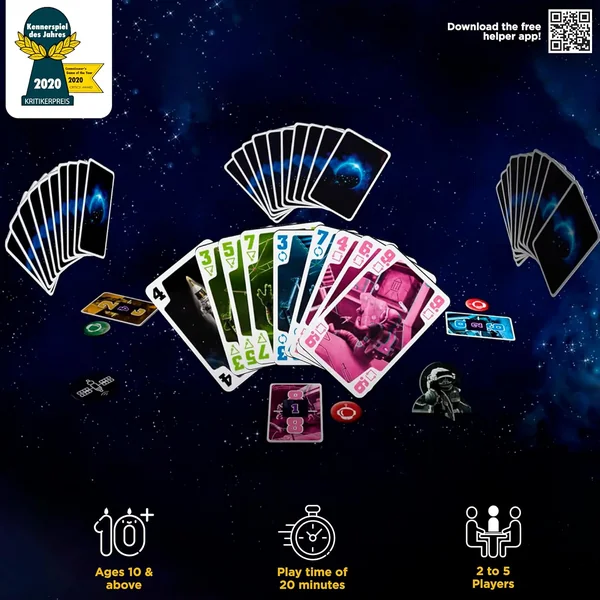
The Crew: The Quest for Planet Nine is a cooperative trick-taking card game from designer Thomas Sing and publisher Kosmos (Thames & Kosmos in English-speaking markets). It won the Kennerspiel des Jahres — the connoisseur's tier of Germany's top game award, per the listing — and it packs a 50-mission campaign across the solar system into sessions the listing pegs at 5–10 minutes each.
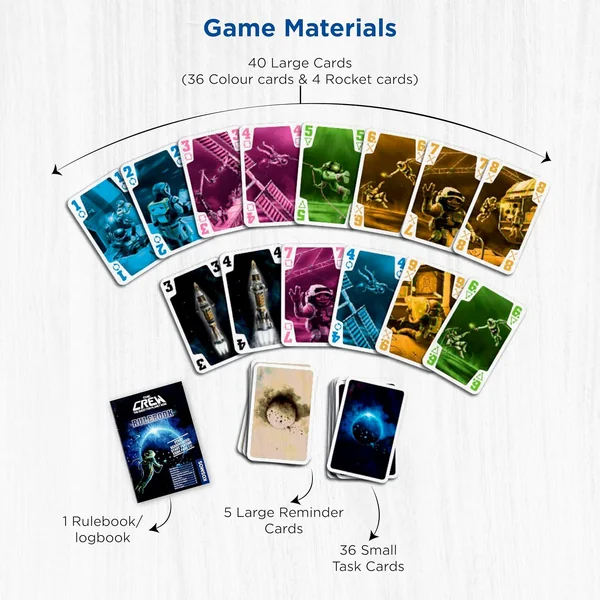
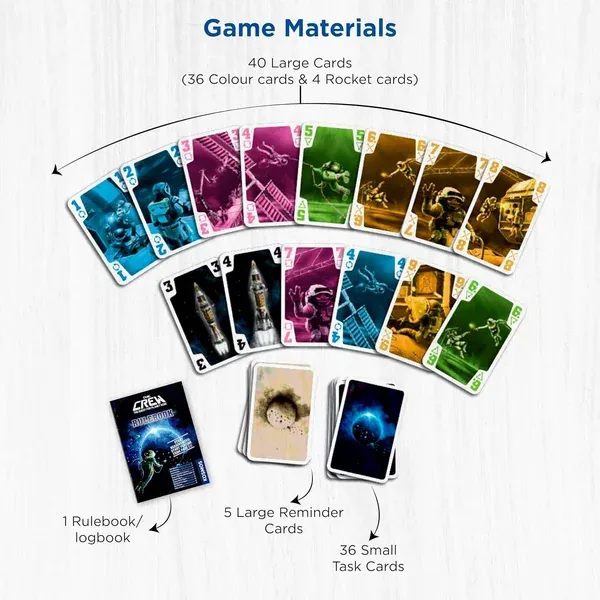
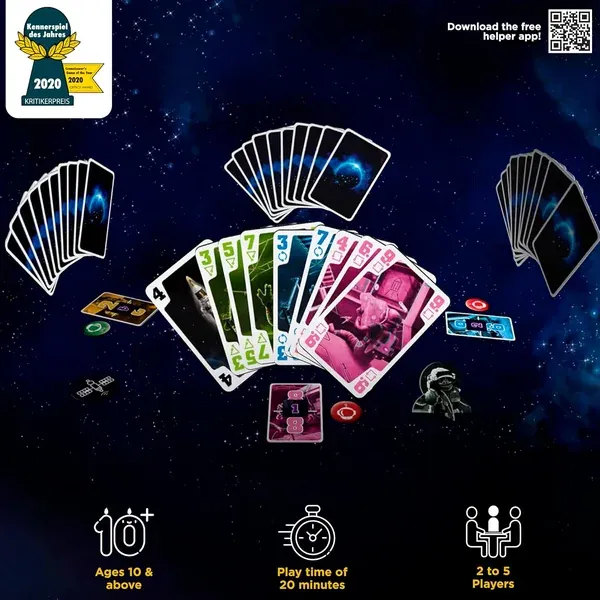
The Crew's complete game component set and card deck
This guide synthesizes the Amazon listing, BoardGameGeek community data, and published reviews. It is not based on hands-on play.
“deep concentration, determination, individual initiative... And patience with your fellow crew.”
What It Is
Each mission deals out a familiar trick-taking deck — players follow suit, highest card takes the trick — but the goal is inverted. Instead of winning the most tricks, the crew must make sure specific task cards end up captured by specific players, and they win or lose together (per the listing).
The Crew's cards, tokens, and game components displayed
BGG's mechanism tags tell the structural story: Communication Limits, Cooperative Game, Hand Management, and Scenario/Mission/Campaign Game. The box lists ages 10+, and BGG's community age poll lands on 10+ as well, with "no necessary in-game text" per BGG's language-dependence poll.
How It Plays
Setup is about a minute per Board Game Review, which also lists a 15-minute play time; BGG says 20 minutes, and What's Eric Playing clocks roughly 10 minutes per mission. A mission begins by assigning tasks, then plays out as a series of tricks with the crew's objectives checked at the end. There is no published points formula in the sources — success is binary: complete the mission's tasks together, or retry.
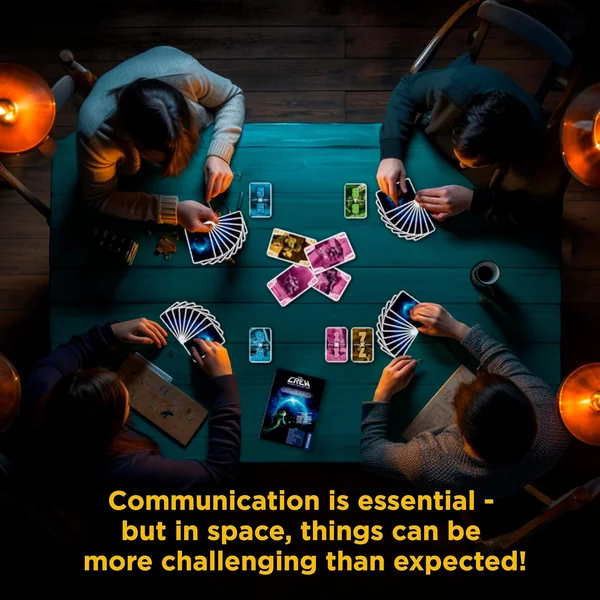
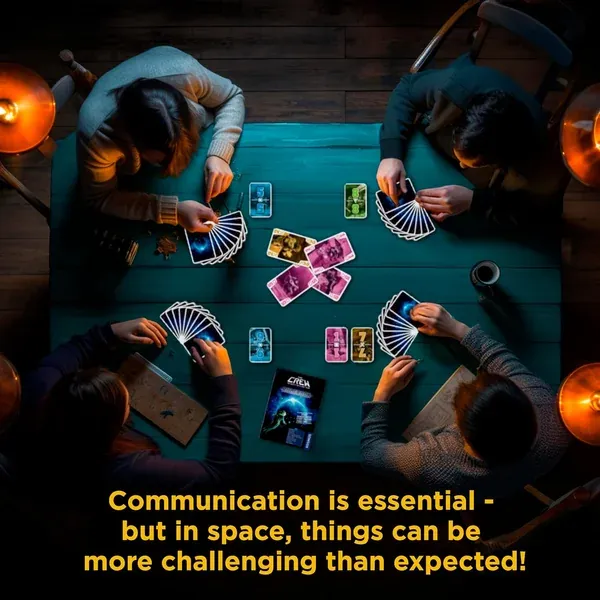
The Crew's cooperative card play and communication challenges in action
The signature mechanic is the communication limit. Coverage at Coop Board Games singles out the "radio communication mechanic" — a tightly rationed channel for sharing what your hand can do — as the twist that makes familiar trick-taking feel new. The play-pattern a first-timer feels immediately: you usually can't just say "I can take that card," so every play of a card doubles as a message, and early missions that seem trivial become genuinely tight once the task load ramps.
The logbook format — 50 missions of increasing difficulty, per the listing — is the campaign spine. Coop Board Games' second review notes the logbook "encourages returning to it across multiple" sessions rather than bingeing.
Complexity and Teachability
BGG's community weight is 2.0/5 (1,009 votes) — light-to-middle weight. Because it "uses common card game mechanics like tricks and following suit" (listing), the teach is short for any group with trick-taking experience.
The listing pitches the rising difficulty as making it suitable "for players of all skill levels." What's Eric Playing logged 43 plays, which suggests the learning curve rewards repeat sessions rather than blocking them.
Player Count Truth
The sources disagree at the edges: the listing and What's Eric Playing say 3–5 players, while Board Game Review and BGG list 2–5. BGG's player-count poll votes it best at 4 players (580 votes), which sits inside both ranges.
Coop Board Games calls it "well suited to couples and small groups who want something with depth but no long setup," adding that "one or two missions in an evening feels natural." Given the conflicting box data, buyers planning two-player sessions should know at least one editorial source endorses that use.
Reception and Limitations
The aggregates are strong: 7.8/10 from roughly 49,000 BGG voters (ranked #96 overall, #13 in Family), and a 4.8/5 buyers' aggregate from 5,546 Amazon ratings. An Impactus review calls it "compelling," demanding "deep concentration, determination, individual initiative... And patience with your fellow crew."
The dissent is real but minority. Per Coop Board Games' main review:
> "To me, The Crew is a good filler game, but not a great one. It plays smoothly and I really like that radio communication mechanic, but the lack of tension keeps it from being a hit." — Coop Board Games
One reviewer's "lacks tension" is worth weighting as exactly that — one reviewer — against a large, favorable BGG sample. The Impactus review adds a second friction: mission difficulty can feel uneven, with some missions that "seem impossible" being completed on the first try.
The Crew Family
Per BGG, the line has grown: spin-offs The Crew: Mission Deep Sea, The Crew: Journey to the Ends of the Earth, and The Crew: Mission Geldanlage exist, plus expansions The Crew: Flight to the ISS and The Crew: The Deimos Adventure. Thames & Kosmos's own store sells a bundle pairing this game with Mission Deep Sea — a sign the publisher treats them as companion purchases.
BGG lists ten editions and printings, including an English second edition from 2021 carrying the Kennerspiel logo. The retrieved sources document no gameplay differences between printings, so buyers shouldn't pay a premium chasing one.
Verdict
Buy it if your group likes trick-taking, wants a cooperative game that fits in 20 minutes, or plays mostly with three to five people who enjoy puzzles over table talk. Skip it if open discussion is the part of co-ops you love — the communication limits are the entire design — and note that at least one reviewer found the tension level flat. If the formula clicks, the 50-mission logbook and the Mission Deep Sea sibling give the line clear room to grow.


 Tap to enlarge