GAMES
Published by

Z-Man Games

Published

Read Time

8 min read

BGG community rating

7.5/10

· 135,840 raters
BoardGameGeek community, not a LuvemGames score
$49.99 on Amazon4.8/5 from 18,839 ratings on Amazon
Curated & edited by

LuvemGames Editorial

How we create our reviews →
Share This Review

Pandemic: How It Plays, Who It's For, and Where to Start

BGG community

7.5/10

135,840 raters

Pandemic is Matt Leacock's genre-defining cooperative game: 2–4 players race to cure four diseases before outbreaks, cube shortages, or the deck itself run them down. This guide synthesizes the official Z-Man rulebook, the Amazon listing, BGG community data, and published reviews — no hands-on play — to cover how it plays, who it suits, and where to go next.

Players

2–4

Best at 4 (1,339 votes)

Playtime

45 min

Complexity

2.4/5

6,312 votes

BGG rating

7.5/10

135,840 raters

BGG rank

#174

#179 Strategy Game

Age (BGG poll)

10+

239 votes

Powered by BGG
Source-grounded review: synthesized from the official rulebook, the listing, community data, and published coverage — we don't claim hands-on play, and every rating shown is attributed. How we review →
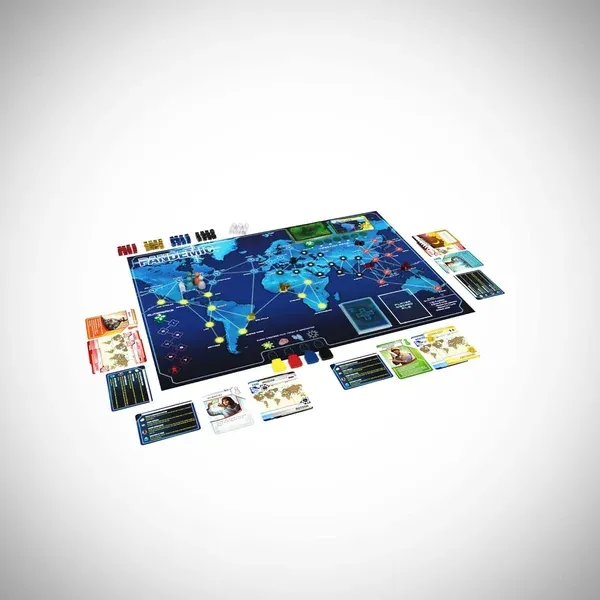
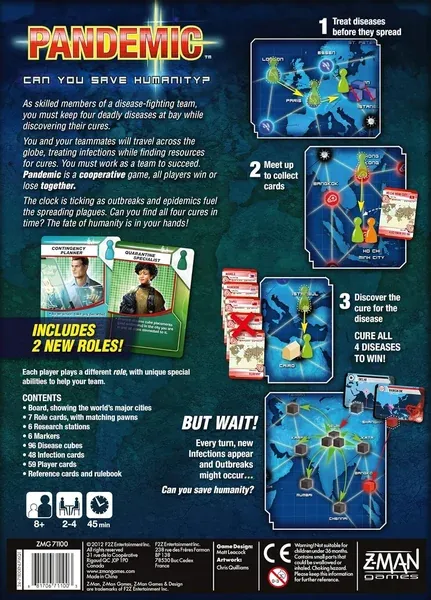
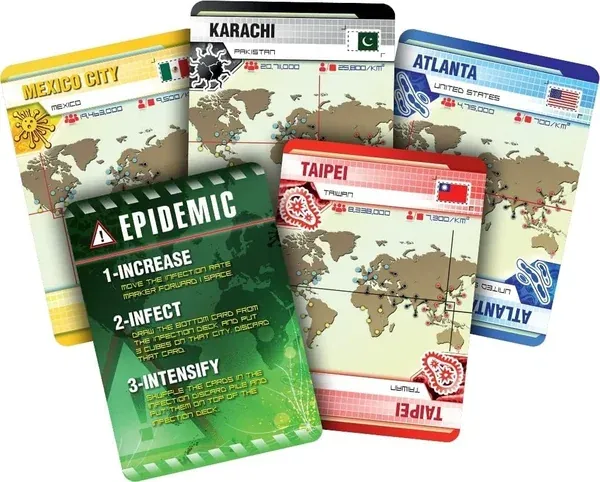
Board game components including a world map board, player cards, disease cubes, and instruction materials arranged on white backgroundBoard game box back showing gameplay instructions, components list, and four numbered steps illustrating disease containment mechanicsBoard game components showing city cards for Mexico City, Karachi, Atlanta, and Taipei with an epidemic card displaying three escalation phaTap to enlarge
In This Review
  • What Works & What Doesn't
  • What Pandemic Is
  • How It Plays
  • Complexity and Teachability
  • Player Count Truth
  • Why It Stays on the Table
  • The Ecosystem Question
  • Honest Limitations
  • Verdict

What Works & What Doesn't

What Works
  • Tense, genuinely cooperative decisions — three separate loss clocks keep every turn urgent
  • Seven asymmetric roles make every seat play differently across repeat games
  • Built-in difficulty dial: 4, 5, or 6 Epidemic cards scale Introductory to Heroic (rulebook, p. 3)
  • Easy teach — mid-light 2.4/5 BGG weight with a three-step turn on a reference card
  • Gateway to the hobby's biggest co-op lineage: Legacy seasons, Hot Zone, Iberia and more (per BGG)
What Doesn't
  • Alpha-player risk: one dominant strategist can dictate turns — the rulebook itself counters it by giving the active player final say (p. 3)
  • Luck of the epidemic shuffle can swing or even doom a game — 'you may have a setup where you lose on turn 2' (Board Game Quest)

What Pandemic Is

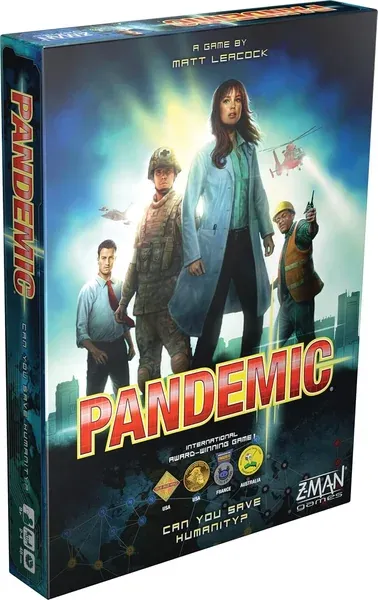
Pandemic is the cooperative board game that made "co-op" a genre unto itself: two to four players form a disease-control team racing to cure four simultaneous global outbreaks before the board collapses under them. Designed by Matt Leacock and first published by Z-Man Games in 2008 (per Wikipedia), it remains the reference point nearly every cooperative game since is measured against.
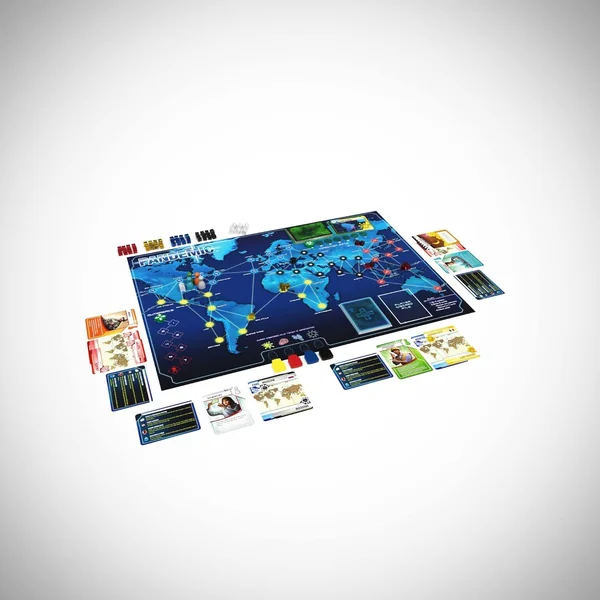
Pandemic's game board and components laid out for play
This guide synthesizes the official Z-Man rulebook, the Amazon listing, BGG community data, and published reviews — we have not played it hands-on. Where reviewers disagree, we say so.
feels like it singlehandedly defines the co-op genre.
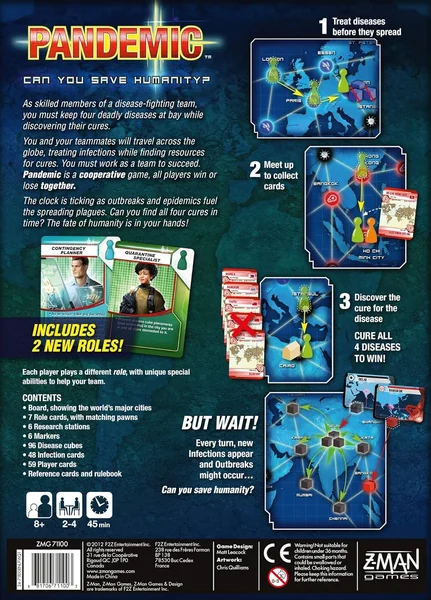
Key specs: 2–4 players, ages 8+ on the box (the BGG community age poll lands on 10+), and roughly 45–60 minutes per the listing, with BGG listing 45. The box holds a board, 7 role cards, 59 player cards, 48 infection cards, 96 disease cubes, 6 research stations, and 7 pawns (rulebook, p. 1).

How It Plays

Setup seeds the board with 18 cubes across nine cities, deals each player a role and a starting hand, and builds the player deck by shuffling one Epidemic card into each of 4, 5, or 6 piles — your difficulty dial, from Introductory to Heroic (rulebook, p. 3). Everyone starts in Atlanta, home of the CDC.
Pandemic's city cards representing global outbreak locations
Each turn has three parts: take 4 actions, draw 2 player cards, then infect cities (rulebook, p. 2). Actions include moving between connected cities, treating disease (removing a cube), building research stations, sharing knowledge, and — the goal — discarding 5 city cards of one color at a research station to cure that disease (rulebook, p. 4).
The signature tension is that your city cards are triple-purpose: they're your fastest travel (discard one to fly there), your cure currency (five matching cards), and your hand-limit pressure (discard down to 7 after drawing). Every flight you take is a card that can't go toward a cure.
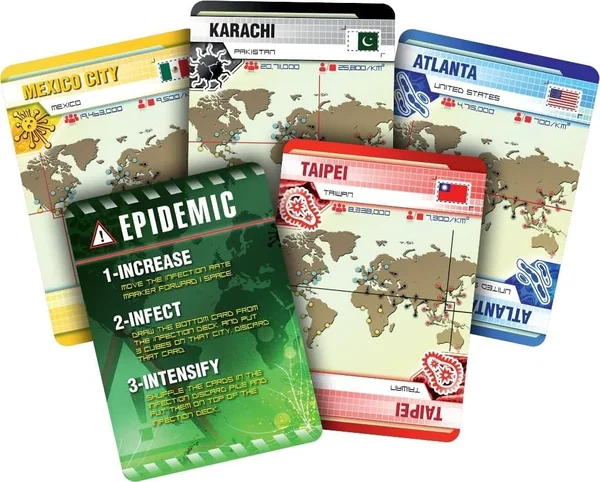
The Epidemic card is the game's identity mechanic. When drawn, it raises the infection rate, drops 3 cubes on a fresh city, then shuffles the infection discard pile back on top — meaning cities you've already seen get hit again, harder (rulebook, p. 1).
You win by discovering all four cures; there is no score. You lose if 8 outbreaks occur, if a disease runs out of cubes in supply, or if the player deck runs out — three clocks ticking at once (rulebook, p. 1).
One misconception worth killing before your first teach: curing a disease does not remove its cubes or stop new ones from appearing — it only makes treating that color cheaper, and only clearing the last cube of a cured disease eradicates it (rulebook, p. 4).

Complexity and Teachability

BGG's community weight puts Pandemic at 2.4/5 — firmly mid-light. The seven actions fit on a reference card each player holds, and the turn is a clean three-step loop.
The real learning curve is strategic, not mechanical: knowing when to stop firefighting cubes and start converging cards toward a cure. Expect the first game to run long as the group debates every move, which the game openly invites — the rulebook says players "should freely give each other advice," though the active player decides (rulebook, p. 3).

Player Count Truth

The box says 2–4, and BGG's player-count poll votes it best at 4 (1,339 votes). The design scales hands by count — 4 cards each at two players, 2 each at four (rulebook, p. 2).
Pandemic board game box back cover with gameplay overview
The structural reason it caps there is documented: running out the player deck is a loss condition, and more players burn that deck faster, which is why Board & Card Games Stack Exchange users warn against unsupported larger groups without modifying the deck.

Why It Stays on the Table

Variable roles (the Scientist cures with 4 cards; the Operations Expert builds stations cheaply) and shuffled epidemic timing mean no two setups play alike (rulebook, pp. 1–3). Meeple and the Moose calls it "a venerable classic" that "feels like it singlehandedly defines the co-op genre."
Board Game Quest, despite noting its swinginess, says its "OG edition is a permanent part of my collection." Reviewer Josh (Board Game Reviews by Josh) scored it 8.0/10 and found the On the Brink expansion meaningfully extended a game he already enjoyed — a useful signal that the base box is a platform, not a dead end.

The Ecosystem Question

Per BGG's family data, Pandemic has spawned one of the largest lineages in the hobby: Pandemic Legacy Seasons 1, 2, and 0, the Hot Zone games, Iberia, Fall of Rome, Reign of Cthulhu, and more, plus expansions including On the Brink, In the Lab, and State of Emergency. Z-Man's own site frames it as the "Pandemic System" series.
The listing itself pitches the base game as the "series entry point" to Pandemic Legacy Season 1. Our read: learn the systems here; if the group loves them, Legacy Season 1 is the widely acclaimed campaign follow-up, while expansions like On the Brink deepen the base box for repeat groups.

Honest Limitations

The alpha-player problem is real enough that the designers legislated against it in the rules: advice is encouraged, but the turn's owner decides (rulebook, p. 3). Groups with one dominant strategist can watch the game become a solo puzzle with three spectators.
Luck can also decide games. Board Game Quest notes "you may have a setup where you lose on turn 2," with wins or losses "contingent on the flip of a single card" — the epidemic shuffle is drama to some groups and arbitrariness to others.

Verdict

Buy Pandemic if you want the foundational cooperative game: teachable in one session, tense throughout, and the on-ramp to the deepest series in the genre. It suits families with kids around 10+, couples, and game-night groups who'd rather argue together than against each other.
Skip it if your group dislikes open discussion (quarterbacking will surface fast) or if luck-of-the-draw losses will sour the table — and if you already know you want a campaign, consider going straight to Pandemic Legacy Season 1, which the listing and Z-Man both position as the next step.

Rules Answers

21 cited

Every answer below is grounded in the official rulebook and shows the exact passage it rests on — verified against the publisher's PDF, not paraphrased from forums.

Setup & Components
6 answers

The number of Epidemic cards sets the difficulty: use 4 for an Introductory game, 5 for Standard, and 6 for Heroic. Any unused Epidemic cards are removed from the game. The rulebook recommends 4 Epidemic cards for your first game and moving to 6 after mastering the Standard game.

Set the game’s difficulty level, by using either 4, 5, or 6 Epidemic cards, for an Introductory, Standard, or Heroic game. Remove any unused Epidemic cards from the game.Pandemic rulebook, p. 3

After setup, the players look at the City cards in their hands, and the player holding the city with the highest population takes the first turn. Play then passes to the left after each player finishes infecting cities.

The players look at the City cards they have in their hand. The player with the highest City population goes first.Pandemic rulebook, p. 3

During setup you flip 3 Infection cards and put 3 cubes of the matching color on each of those cities, flip 3 more cards and put 2 cubes on each, then flip 3 final cards and put 1 cube on each. That places 18 disease cubes total across 9 cities, and those 9 cards go face up on the Infection Discard Pile.

Put 3 disease cubes of the matching color on each of these cities. Flip over 3 more cards: put 2 disease cubes on each of these cities. Flip over 3 more cards: put 1 disease cube on each of these cities.Pandemic rulebook, p. 3

All pawns start in Atlanta. During setup, each player is dealt a face-up Role card, and the matching colored pawns for those roles are placed in Atlanta. Role cards and pawns not dealt to anyone are removed from the game.

Place the matching colored pawns for these roles in Atlanta. Remove from the game the remaining Role cards and pawns.Pandemic rulebook, p. 2

Yes, one research station is placed in Atlanta during setup, since Atlanta is home to the CDC. The other research stations stay in a supply next to the board along with the disease cubes until players build them.

Place 1 research station in Atlanta. Atlanta is home to the CDC, the Center for Disease Control and Prevention.Pandemic rulebook, p. 2

The game contains 7 Role cards, 59 Player cards (48 City cards, 6 Epidemic cards, 5 Event cards), 96 disease cubes in 4 colors, 4 cure markers, 4 reference cards, a board, an infection rate marker, an outbreaks marker, and 6 research stations. It also includes 48 Infection cards and 7 pawns.

7 Role cards 59 Player cards (48 City cards, 6 Epidemic cards, 5 Event cards) 96 Disease cubes 24 in 4 colors 4 Cure markers 4 Reference cards 1 Board 1 Infection rate marker 1 Outbreaks marker 6 Research stationsPandemic rulebook, p. 1
Turns & Actions
6 answers

Each turn has three parts in order: do 4 actions, draw 2 Player cards (resolving any Epidemics and discarding down to 7), then infect cities. Once you finish infecting cities, the player on your left takes their turn.

Each player turn is divided into 3 parts: 1. Do 4 actions. 2. Draw 2 Player cards. 3. Infect cities. After a player is done infecting cities, the player on their left goes next.Pandemic rulebook, p. 3

Event cards can be played at any time, even during another player's turn, and playing one does not count as an action. Certain Events even specify interrupt timing, such as between the Infect and Intensify steps of an Epidemic.

Play any time. Not an action.Pandemic rulebook, p. 1

Treating normally removes 1 cube of one color from the city you are in per action. If that disease color has been cured, a single Treat Disease action removes all cubes of that color from the city instead. Note that if a city has cubes of several cured diseases, you must still Treat Disease once for each cured color.

Remove 1 disease cube from the city you are in, placing it in the cube supply next to the board. If this disease color has been cured (see Discover a Cure below), remove all cubes of that color from the city you are in.Pandemic rulebook, p. 4

Both players must be in the same city, and the card being shared must match that city. You can either give the matching City card to the other player or take it from them, and both players must agree. You cannot share a card for a city you are not currently in.

You can do this action in two ways: give the City card that matches the city you are in to another player, or take the City card that matches the city you are in from another player. The other player must also be in the city with you. Both of you need to agree to do this.Pandemic rulebook, p. 4

You can still build a research station. If all 6 supplied research stations are on the board, you take a research station from anywhere on the board and place it in your city. You still must discard the City card matching the city you are in to build there.

Take the research station from the pile next to the board. If all 6 research stations have been built, take a research station from anywhere on the board.Pandemic rulebook, p. 4

Your hand limit is 7 cards, and you discard down after drawing your 2 Player cards each turn. If a Share Knowledge action pushes you over 7 cards, you must immediately discard a card or play an Event card to get back within the limit.

If the player who gets the card now has more than 7 cards, that player must immediately discard a card or play an Event card (see Event Cards on page 7).Pandemic rulebook, p. 4
Scoring & Endgame
4 answers

Nothing is placed. When cities of an eradicated disease come up during infections or epidemics, no new disease cubes are placed there. This is the practical payoff of eradication, even though it isn't required to win.

when cities of an eradicated disease are infected, no new disease cubes are placed there (see Epidemics and Infections on page 6).Pandemic rulebook, p. 4

Nothing special happens. Removing the last cube of a disease that is not cured has no effect — the disease is not eradicated, the marker isn't flipped, and the game simply continues. Only removing the last cube of a cured disease triggers eradication.

Removing the last cube of a disease that is not cured has no effect.Pandemic rulebook, p. 4

The players lose immediately. If you ever need to place disease cubes of a color and not enough are left in the supply, the disease has spread too much and the game ends in a loss for the whole team.

not enough disease cubes are left when needed (a disease spreads too much)Pandemic rulebook, p. 1

The players lose immediately. The outbreaks marker tracks every outbreak during the game, and if 8 outbreaks occur, a worldwide panic happens and the game ends in defeat for everyone.

8 outbreaks occur (a worldwide panic happens)Pandemic rulebook, p. 1
Edge Cases & Disputes
1 answer

Yes. A white line that runs off one edge of the board wraps around to the opposite edge and connects to a city there, and you can Drive/Ferry along it. The rulebook's example is that Sydney and Los Angeles are connected this way.

A white line that goes off the board “wraps around” to the other edge and connects to a city. Example: Sydney and Los Angeles are connected.Pandemic rulebook, p. 4
Player Counts & Variants
4 answers

Pandemic has three difficulty levels set by the number of Epidemic cards used: 4 for Introductory, 5 for Standard, and 6 for Heroic. Any Epidemic cards not being used are removed from the game entirely.

Set the game’s difficulty level, by using either 4, 5, or 6 Epidemic cards, for an Introductory, Standard, or Heroic game. Remove any unused Epidemic cards from the game.Pandemic rulebook, p. 3

After dealing initial hands, the remaining player cards are split into face-down piles that are as equal in size as possible, with one pile per Epidemic card in use. One Epidemic card is then shuffled face down into each pile. This spreads the Epidemics roughly evenly through the deck rather than letting them cluster together.

Divide the remaining player cards into face down piles, as equal in size as you can, so that the number of piles matches the number of Epidemic cards you are using. Shuffle 1 Epidemic card into each pile, face down.Pandemic rulebook, p. 3

After shuffling an Epidemic into each pile, the piles are stacked with the smaller piles on the bottom to form the Player Deck. Because the piles are only as equal as you can make them, placing smaller ones deeper keeps the deck's overall size consistent and the Epidemic spacing predictable.

Stack these piles to form the Player Deck, placing smaller piles on the bottom.Pandemic rulebook, p. 3

The game is played with exactly 6 research stations in the supply. If your copy came with more than 6, the extras are simply set aside during setup and not used.

If more than 6 research stations were supplied, set any extra aside during setup.Pandemic rulebook, p. 4

Sources & Further Reading

The key facts and claims in this review are grounded in the retrieved, verified sources listed below.

  1. 1
    Pandemic Rulebook (PDF)High-authority source

    images-cdn.zmangames.com

  2. 2
    Pandemic on BoardGameGeekHigh-authority source

    BoardGameGeek

  3. 3
    Pandemic - Z-MAN GamesHigh-authority source

    zmangames.com

  4. 4

    zmangames.com

  5. 5
  6. 6
  7. 7
  8. 8
Pandemic: How It Plays, Who It's For, and Where to Start | LuvemGames