GAMES
Published by

Stonemaier Games

Published

Read Time

9 min read

BGG community rating

8/10

· 114,714 raters
BoardGameGeek community, not a LuvemGames score
$55.00 on AmazonWe earn a commission if you buy through this link. How this works4.8/5 from 12,809 ratings on Amazon
Curated & edited by

LuvemGames Editorial

How we build our guides →
Share This Guide

Wingspan: How It Plays, What Wins, and Who Should Buy It

BGG community

8/10

114,714 raters

Wingspan is Elizabeth Hargrave's Kennerspiel des Jahres-winning engine-builder: you attract birds to three habitats on your player mat, and every card you play makes the next activation of that row stronger. With 170 unique bird cards, a gentle teach via the included Swift-Start guides, and a built-in Automa for solo play, it suits couples, families, and groups who want medium-weight strategy without direct conflict. Skip it if your table needs player confrontation or theme-driven drama.

Players

1–5

Best at 3 (1,244 votes)

Playtime

40–70 min

Complexity

2.5/5

3,797 votes

BGG rank

#38

#49 Strategy Game

Age (BGG poll)

10+

224 votes

Powered by BGG
How we made this guide: we read the publisher's rulebook cover to cover and cross-checked it against community data and published coverage. We haven't played this copy at a table — where we take a position, it's reasoned from the rules and the numbers, and we show our working. Every rating shown is attributed. How we build guides →
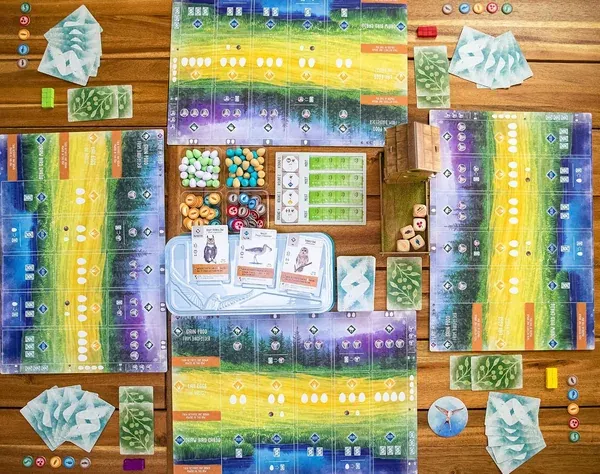
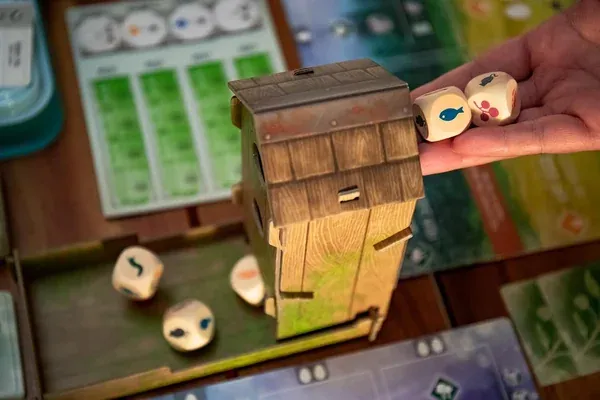
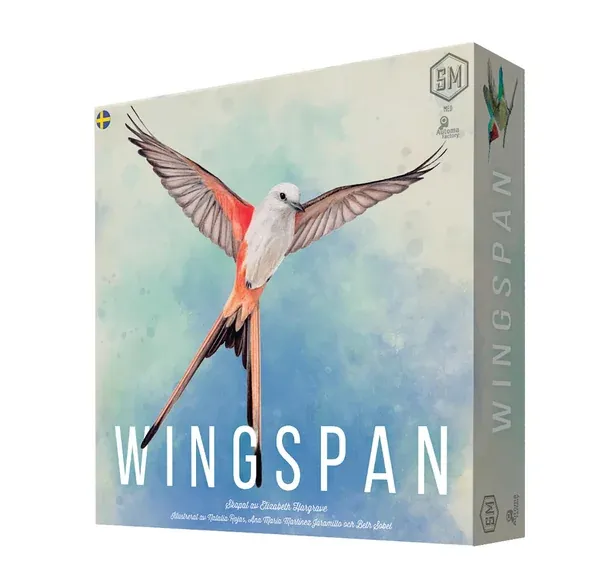
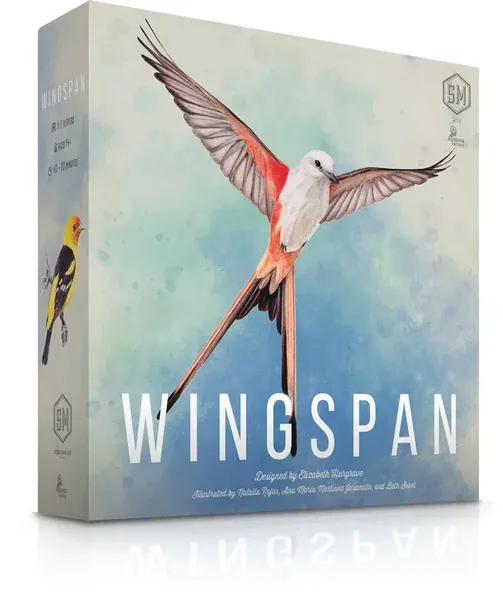
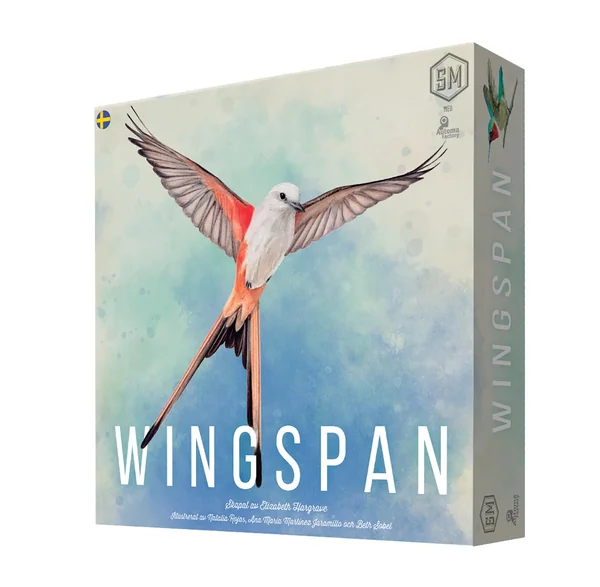
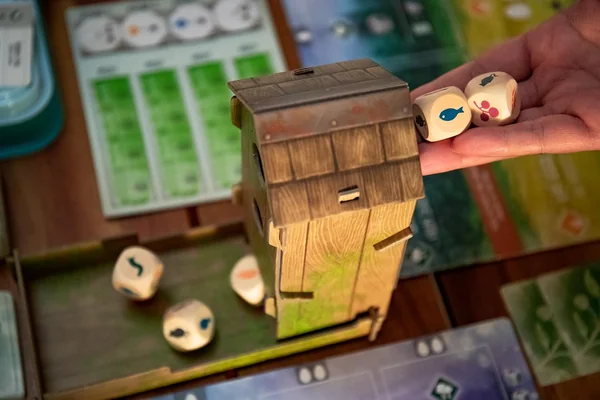
Overhead view of Wingspan board game showing player boards, bird cards, egg tokens, and central game board on wooden surfaceWooden game components including a birdhouse structure and dice with painted bird faces displayed during gameplayBoard game box featuring watercolor artwork of a flying bird with spread wings against a blue gradient backgroundTap to enlarge
In This Guide
  • What Works & What Doesn't
  • How a game plays
  • Where the tension comes from
  • Player count
  • What actually wins
  • Editions, expansions, and the Wingspan family
  • Limitations
  • Should you buy it?

What Works & What Doesn't

What Works
  • A real engine-building arc in 70 minutes — rows that fire one power early chain three or four by round four
  • Swift-Start guides script the first four turns, so new players learn by playing (rulebook, p. 3)
  • 170 unique bird cards with theme-true powers (cowbirds lay in others' nests, mockingbirds copy) keep setups fresh
  • Included Automa deck delivers full solo play, rare at this weight
  • Components match the theme — dice-tower birdfeeder, marbled eggs — and current printings use plastic-free trays (rulebook, p. 1)
What Doesn't
  • Interaction is indirect — you race for goals and the shared card tray but never affect another player's mat
  • Extensive card text (per BGG's language-dependence poll) is a barrier for younger or mixed-language tables
  • Dice and deck luck can stall a plan — the food face or bird you need may simply not appear that turn
Wingspan earns its reputation. Elizabeth Hargrave's design is a card-driven engine-builder where you attract birds to forest, grassland, and wetland habitats, and every bird you play makes that row's next activation stronger. It won the Kennerspiel des Jahres — the "connoisseur" category created for games a step above family fare — which tells you exactly where it sits: approachable, but a real strategy game.
Wingspan board game box featuring elegant bird illustration artwork
The BoardGameGeek community rates it 8.0/10 across more than 114,000 voters and ranks it in the top 40 games overall (as of early 2026), with a complexity weight of 2.5/5. That combination — heavy approval, moderate rules load — is the whole pitch. This guide recommends it for couples, families with older kids, and groups who like building something over an hour without attacking each other.
none of them as easy as they sound

How a game plays

Setup is quick: shuffle the 170-card bird deck, place three face-up in the tray, toss the five custom food dice into the birdfeeder tower, and deal each player five bird cards, five food tokens, and two bonus cards (rulebook, p. 2). The first decision is a real one — you keep up to five bird cards, but each bird you keep costs you one food token, so holding a fat hand of birds means starting with no way to pay for them.
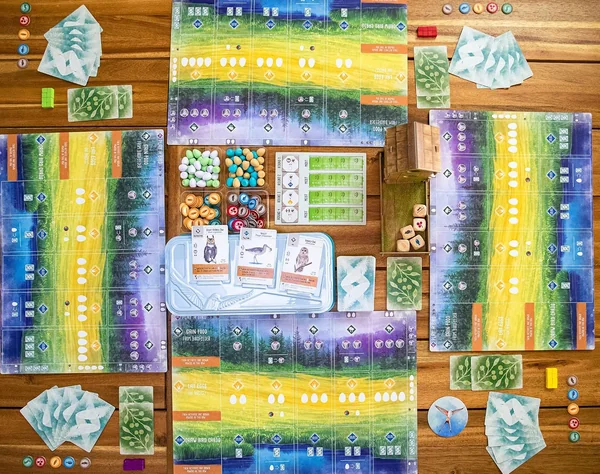
Wingspan game setup showing player boards, bird cards, and components
Each of the four rounds, players spend action cubes on one of four actions: play a bird, gain food, lay eggs, or draw cards (rulebook, p. 4). The last three all work the same way — place a cube in a habitat row, take the slot's benefit, then trigger the brown powers of every bird already in that row as the cube travels back. That right-to-left activation chain is the engine: a wetland row with three birds draws cards and fires three powers in one turn.
Here's the twist that defines the pacing: scoring each end-of-round goal consumes one of your action cubes, so turns shrink from 8 per player in round one to 5 in round four (rulebook, p. 5) — just as your engine becomes strong enough that you want more turns, not fewer. Final scoring adds printed bird points, bonus cards, end-of-round goal points, and one point each for every egg, cached food token, and tucked card on your mat (rulebook, p. 5).
The teach is genuinely easy. The included Swift-Start guides script each player's first four turns with preset cards (rulebook, p. 3), and Tabletop Mom's review calls the game "a breeze to learn and teach," with fast turns once the four actions click.

Where the tension comes from

The game's signature pressure is the shrinking action supply. Because you lose a cube each round, the food and card engines you build in rounds one and two are what fund everything later — a player who spends round one laying eggs has nothing to show for it by round four.
End-of-round goals create the main indirect fight. On the green side of the goal board, players rank 1st/2nd/3rd for each goal; the blue side instead pays one point per qualifying item with no ranking, which the rulebook itself flags as better for new players (rulebook, p. 2). Groups who dislike racing each other for "most birds with ground nests" should start on blue.
The bonus card you keep at setup quietly shapes your whole game, since birds matching it are worth printed points at the end. Expect the round-three moment where you must choose between playing a high-point bird that advances nothing and a cheap bird that extends your best activation chain.

Player count

The box says 1–5, and the community poll says best at three (1,244 votes). Two works better than the poll suggests — Meeple Mountain's coverage calls two a favorite count in practice — and the tighter goal race at five suits groups who want more competition.
Solo play is fully supported by the included Automa deck, which flips a card each turn to simulate an opponent while your game plays unchanged. Four and five players means more downtime between turns but livelier end-of-round goal contests; at two, the goals are closer to parallel puzzles.

What actually wins

Per Meeple Mountain's strategy coverage, the four actions are "none of them as easy as they sound," and the starting-hand selection — which birds to keep versus which food to keep — is a genuine skill test, not a coin flip. That matches the rules: a bird's habitat, food cost, and the escalating egg cost of deeper columns (rulebook, p. 6) all have to line up before it ever hits your mat.
The less obvious read is in the scoring maths. Eggs, cached food, and tucked cards are each worth a point (rulebook, p. 5), so a grassland row that lays two eggs per activation is quietly a two-points-per-turn machine — and it needs no new cards to keep paying out. Building grassland early, then playing egg-hungry birds into deeper columns once the food engine is running, is the line the action economy rewards.
> "There's nothing quite like it when you get to the end game and you're activating one bird after another, laying eggs, chucking out food and tucking away birds." — We're Not Wizards

Editions, expansions, and the Wingspan family
Stonemaier's store page confirms the current version is the one with the Swift-Start pack included — the version sold here. The rulebook also notes that current printings use custom cardboard trays instead of plastic (rulebook, p. 1), and BGG's versions list shows a 2022 English edition with wooden eggs, so very old used copies may differ in components.
Wingspan's wooden birdhouse with custom dice components
The base box is deep on its own — 170 unique birds plus 26 bonus cards give it real legs — but the line is expansion-heavy. BGG links the European, Oceania, and Americas expansions, and the family has since spun off Wyrmspan and Finspan; treat those as later purchases, not prerequisites.

Limitations

Interaction is mostly indirect. You race for goals and draft from a shared face-up tray, but you never touch another player's mat, so tables that want negotiation or confrontation will find it quiet.
The cards carry a lot of text — BGG's language-dependence poll rates it "extensive" — which matters for mixed-language tables or younger readers despite the 10+ community age rating. And with 170 unique cards, some turns hinge on whether the tray or deck serves up a bird that fits your plan; the dice can likewise refuse to show the food you need, so players who want perfect-information control should look elsewhere.

Should you buy it?

Buy it if you want a beautiful, medium-weight engine-builder that teaches in ten minutes, plays well at two through four, and supports solo out of the box. It's an especially strong pick for couples and families graduating from gateway games — the Kennerspiel win marks exactly that step up.
Skip it if your group needs direct conflict, dislikes card-draw luck, or plays mostly at five and wants constant engagement. For everyone else, this is one of the safest purchases in modern board gaming.

Rules Answers

23 cited

Every answer below is grounded in the official rulebook and shows the exact passage it rests on — verified against the publisher's PDF, not paraphrased from forums.

Setup & Components
5 answers

Each player is dealt 5 random bird cards and 5 food tokens at setup, then keeps up to 5 bird cards and discards the rest. For each bird card kept, you must discard 1 food token, so you might keep 2 birds and 3 food, or 4 birds and 1 food.

Keep up to 5 bird cards and discard the others. For each bird card you keep, you must discard 1 food token.Wingspan rulebook, p. 2

Each player receives 1 player mat, 8 action cubes of one color, 2 random bonus cards, 5 random bird cards, and 5 food tokens (one of each type). You then narrow down your birds, food, and bonus cards before the game begins.

Each player receives: • 1 player mat • 8 action cubes of one color • 2 random bonus cards • 5 random bird cards • 5 food tokensWingspan rulebook, p. 2

The green side is the default and creates direct competition, awarding points for 1st, 2nd, and 3rd place on each goal. The blue side is gentler for new players, awarding 1 point for each targeted item up to a maximum of 5 points.

Green: For a game with more direct competition for goals, choose the side that has 1st, 2nd, and 3rd place for each goal. This is the default.Wingspan rulebook, p. 2

Shuffle the double-sided goal tiles without looking at them, then place 1 tile (random side up) on each of the four blank spaces on the goal board. Return the extra goal tiles to the box.

Place 1 goal tile (random side up) on each of the four blank spaces on the goal board. Return extra goal tiles to the box.Wingspan rulebook, p. 2

The first player is selected randomly during setup and receives the first-player token. At the end of each round, the token rotates clockwise to the next player.

Randomly select the first player and give them the first-player token.Wingspan rulebook, p. 2
Turns & Actions
8 answers

Yes. You choose 1 of the 4 actions each turn, and the rulebook explicitly allows picking the same action again and again. There is no restriction against repeating actions across turns.

You may even select the same action multiple times, which is absolutely allowed!Wingspan rulebook, p. 4

No. When paying a bird's food cost, you discard food tokens from next to your player mat — cached food on bird cards cannot be spent. Cached food is instead worth 1 point per token at the end of the game.

Discard food tokens to the supply (these tokens must be from next to your player mat, not food tokens cached on bird cards, a concept that will be explained later).Wingspan rulebook, p. 6

Yes, but only when playing a bird. During the play-a-bird action, any 2 food tokens can be spent as if they were any 1 food token; this exchange cannot be used during other parts of the game.

When playing birds, you may spend any 2 food tokens as if they are any 1 food token. This exchange cannot be used during other parts of the game.Wingspan rulebook, p. 6

No. Brown WHEN ACTIVATED powers are optional each time you use the habitat, and powers generally are always optional. You also activate them from right to left in the row, skipping any you don't want to use.

Bird powers are always optional. For example, if you do not want to spend a card by tucking it under a flocking bird, you do not have to do so.Wingspan rulebook, p. 10

No. When you take the draw bird cards action, you draw the number of cards shown on the slot from the face-up cards on the bird tray or the bird deck, and there is no limit on how many cards you can hold.

Place an action cube in the leftmost exposed slot in the “draw cards” row on your player mat, and draw the number of cards shown there from either the face-up cards on the bird tray or the bird deck. There is no hand limit.Wingspan rulebook, p. 9

The extra eggs are lost. You may distribute eggs on any combination of birds — including all on a single bird — but each bird has an egg limit shown by its egg icons, and a bird card can never hold more than that number.

You can lay eggs on any combination of birds (including all on 1 bird), but each bird has an egg limit. A bird’s egg limit is shown by the egg icons. A bird card can never hold more than this number of eggs.Wingspan rulebook, p. 8

There is no egg cost for the first column. To play a bird in column 2 or 3, you discard 1 egg to the egg supply; in columns 4 or 5, you discard 2 eggs, paid from any birds on your player mat.

To play a bird in column 2 or 3, you must discard 1 egg to the egg supply. In columns 4 or 5, you must discard 2 eggs.Wingspan rulebook, p. 6

If the birdfeeder tray is ever empty, throw all 5 dice back in. You may also reroll all 5 dice before gaining food whenever every die in the tray shows the same face — including when only 1 die remains.

If the dice in the tray all show the same face (including if there is only 1 die) and you are about to gain food from the birdfeeder for any reason, you may first throw all 5 dice back into the birdfeeder.Wingspan rulebook, p. 7
Scoring & Endgame
4 answers

The tied player with the most unused food tokens wins. If players are still tied after comparing unused food, they share the victory.

In the case of a tie, the player with the most unused food tokens wins. If players are still tied, they share the victory.Wingspan rulebook, p. 5

Each egg on a bird card, each food token cached on a bird card, and each card tucked under a bird card is worth 1 point at the end of the game. These are scored on top of the points printed on your bird cards, bonus cards, and end-of-round goals.

1 point for each: » egg on a bird card » food token cached on a bird card » card tucked under a bird cardWingspan rulebook, p. 5

Tied players both place their cubes on the tied place, and the next place is not awarded. At game end, add the points for the tied place and the next place(s), divide by the number of tied players, and round down. For example, two players tying for 1st on a 5-2-1 goal each get 3 points.

For example, when using the goal that scores 5, 2, or 1 points, if two players tie for 1st place, each gets 3 points (5 + 2 divided by 2 players, rounded down). Do not award 2nd place to another player.Wingspan rulebook, p. 11

No. You must have at least 1 of the targeted items to score points for a goal. For example, you need at least 1 grassland bird to score for the “most birds in the grassland habitat” goal.

You must have at least 1 of the targeted items to score points for a goal.Wingspan rulebook, p. 11
Edge Cases & Disputes
4 answers

Empty spaces on the bird tray are not refilled right away as you draw. You wait until the end of your turn before refilling them, so other bird powers you activate during that same turn draw from a tray that hasn't been restocked yet.

As you draw face-up cards, they are not immediately refilled. Instead, wait until the end of your turn before refilling empty spaces on the bird tray.Wingspan rulebook, p. 9

If the face-down bird deck is emptied at any point, you reshuffle all discarded bird cards to form a new deck and keep playing. Note that the discard pile is kept face-up.

If the face-down deck is ever emptied during the game, reshuffle all discarded bird cards to form a new deck.Wingspan rulebook, p. 9

A pink power can trigger on opponents' turns, but you can only use it once between each of your own turns, even if multiple opponents would trigger it. The rulebook recommends telling other players what the power is and what activates it so the table can help notice when it should fire.

You can only use a pink power once between each of your own turns (if an opponent triggers it).Wingspan rulebook, p. 10

You pay the egg cost by discarding eggs from any birds on your player mat — they do not have to come from a specific bird or habitat. The discarded eggs go to the egg supply.

Pay the corresponding egg cost (if any) by discarding eggs from any birds on your player mat.Wingspan rulebook, p. 6
Player Counts & Variants
2 answers

It's the group's choice. The rules allow each player to keep their hand of cards either private or public throughout the game, so you can play openly if you prefer—handy when teaching new players.

You may keep your hand of cards private or public throughout the game.Wingspan rulebook, p. 2

Star nests are wild: they match any of the four standard nest types (platform, bowl, cavity, and ground). This makes them powerful, since they count for any nest type required by end-of-round goals, bonus cards, and bird powers.

Star nests are wild. (These birds build unusual nests that don't fit into the four standard types.)Wingspan rulebook, p. 8

Sources & Further Reading

The key facts and claims in this guide are grounded in the retrieved, verified sources listed below.

  1. 1
    Wingspan Rulebook (PDF)High-authority source

    boardgamegeek.com

  2. 2
    Wingspan on BoardGameGeekHigh-authority source

    BoardGameGeek

  3. 3

    meeplemountain.com

  4. 4

    meeplemountain.com

  5. 5
  6. 6
Wingspan: How It Plays, What Wins, and Who Should Buy It | LuvemGames