GAMES
Published by

Rio Grande Games

Published

Read Time

7 min read

BGG community rating

7.6/10

· 97,107 raters
BoardGameGeek community, not a LuvemGames score
$37.90 on Amazon4.9/5 from 3,664 ratings on Amazon
Curated & edited by

LuvemGames Editorial

How we create our reviews →
Share This Review

Dominion: How It Plays, 2nd Edition Changes, and Who It's For

BGG community

7.6/10

97,107 raters

Dominion is the genre-founding deck-building game: players start with an identical weak deck and buy better cards into it mid-game, racing for the most victory points when the piles run out. This guide synthesizes the official Second Edition rulebook, the Amazon listing, BGG community data, and published reviews to cover how it plays, what the 2016 revision changed, and who should buy it.

Players

2–4

Best at 3 (1,000 votes)

Playtime

30 min

Complexity

2.3/5

5,359 votes

BGG rating

7.6/10

97,107 raters

BGG rank

#146

#142 Strategy Game

Age (BGG poll)

10+

201 votes

Powered by BGG
Source-grounded review: synthesized from the official rulebook, the listing, community data, and published coverage — we don't claim hands-on play, and every rating shown is attributed. How we review →
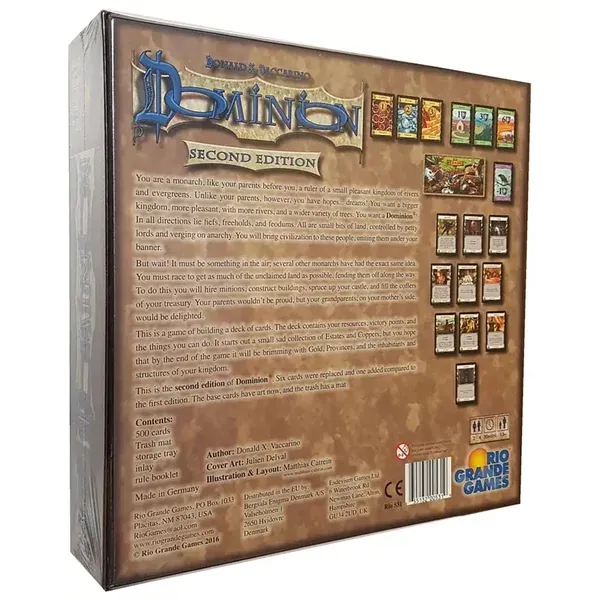
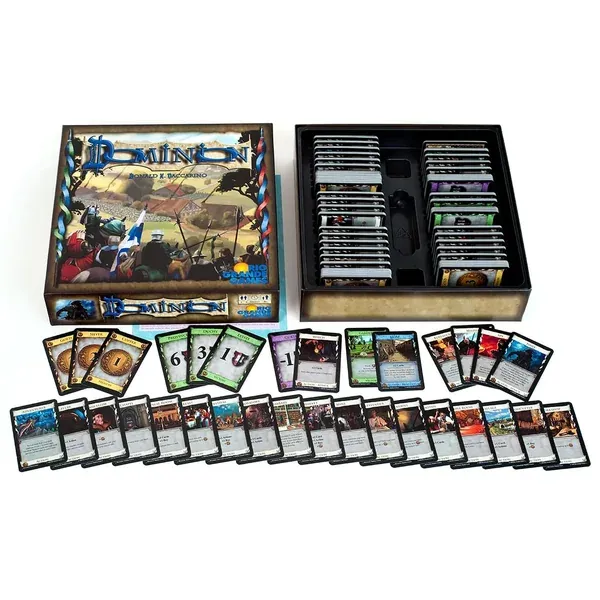
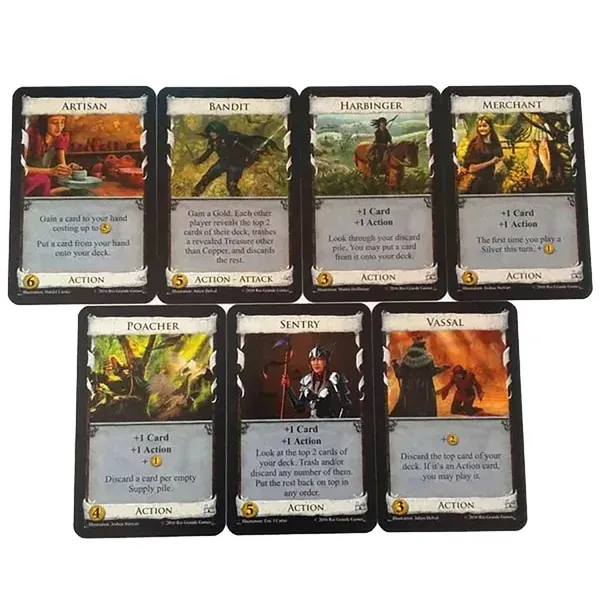
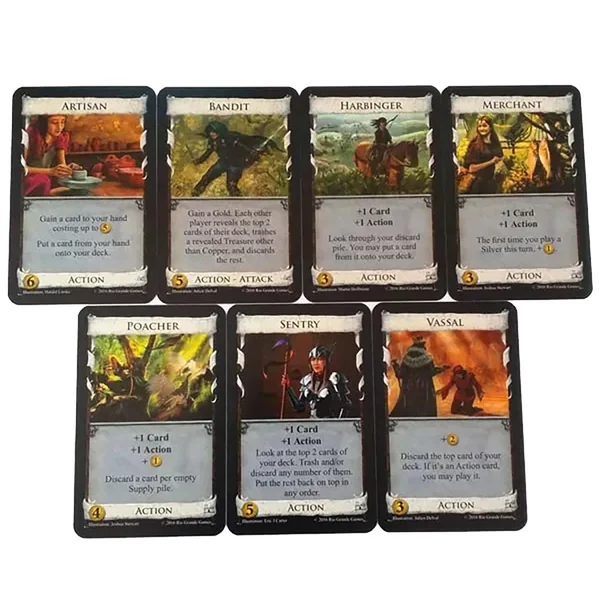
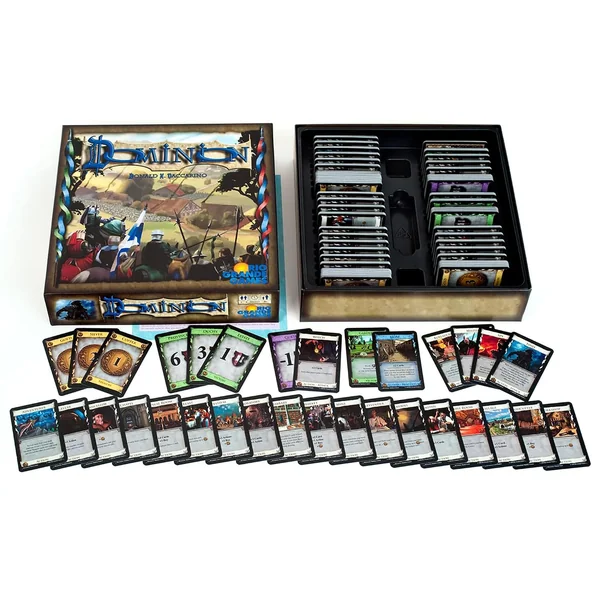
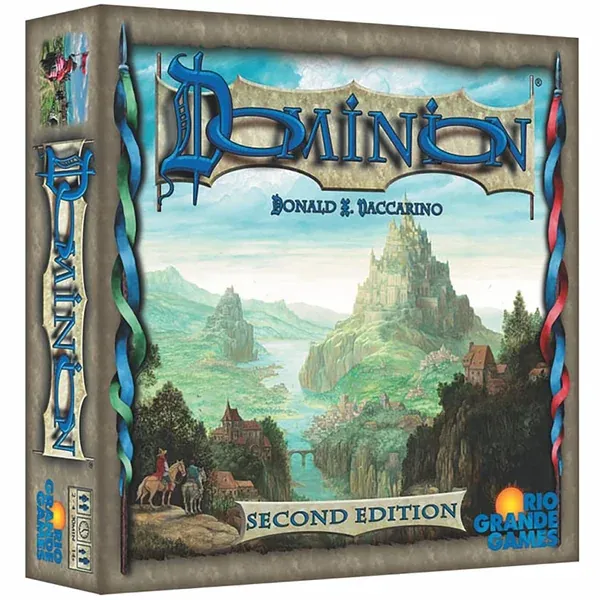
Front of box - Dominion by Rio Grande GamesDominion board game display showing box, card storage organizer, and various game cards including treasure, victory, and kingdom cardsSeven black game cards displaying character classes with artwork, titles, resource costs, and action descriptionsTap to enlarge
In This Review
  • What Works & What Doesn't
  • What Dominion Is
  • How It Plays
  • Complexity and Teachability
  • Player Count: Box vs. Reality
  • What the Second Edition Changed
  • Reception and Limitations
  • Verdict

What Works & What Doesn't

What Works
  • The original deck-builder, and still the cleanest teach of the genre: a strict Action-Buy-Cleanup turn structure (rulebook, p. 4) plus a prescribed first-game Kingdom set (rulebook, p. 3)
  • 26 Kingdom cards, only 10 used per game, means variable setup is a rules fact — no two tables need play alike (rulebook, p. 3)
  • Real strategic depth in deck-thinning and engine timing, with a dedicated Trash mat and trasher cards like Chapel and Remodel in the box (rulebook, p. 2)
  • Fast for the depth: 20-30 minutes per the listing, 30 per BGG
  • Validated at scale: 2009 Spiel des Jahres winner per the listing, 7.6/10 from over 97,000 BGG voters, 4.9/5 from 3,664 Amazon buyers
What Doesn't
  • Direct interaction is kingdom-dependent: Attacks like Militia and Witch only appear if chosen among the 10 Kingdom piles, so many setups play as parallel engine-building races (rulebook, pp. 3-4) — and Meeple Mountain's reviewer found repeat plays quickly reminded him why he'd slowed down on the game
  • Box caps at 4 players; 5-6 player rules require Intrigue's extra cards (per Board & Card Games Stack Exchange) or the Big Box II bundle (per Wikipedia)
  • Moderate in-game text per BGG's language-dependence poll — some groups will need a crib sheet, and the box's 13+ age sits above BGG's community poll of 10+

What Dominion Is

Dominion is the game that invented deck-building: every player starts with the same sad ten-card deck and constructs a better one during play, buying cards that then cycle through their own hands. This guide covers the Rio Grande Games Second Edition (2-4 players, ages 13+ per the listing), the 2016 revision of the 2008 original. This page synthesizes the official rulebook, the Amazon listing, BoardGameGeek community data, and published coverage — it is not based on hands-on play.
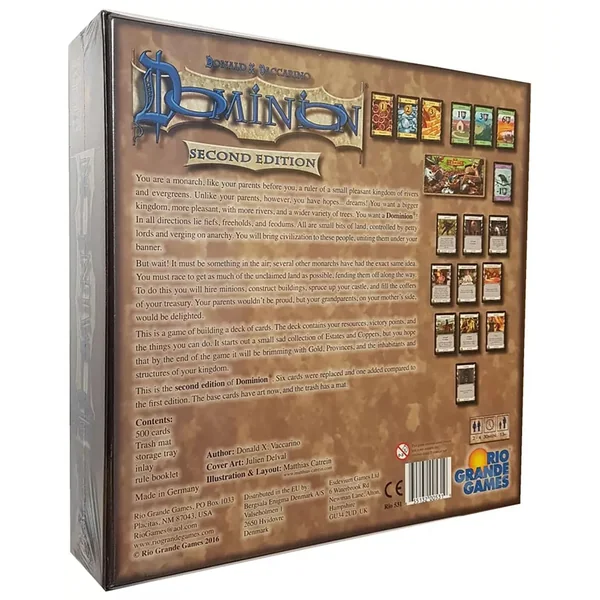
Dominion Second Edition box back showing game overview and card examples
The credentials are hard to argue with. The listing notes the 2009 Spiel des Jahres win, and BGG's community rates it 7.6/10 across more than 97,000 voters, ranking it around #146 overall with over 131,000 owners logged. Amazon buyers' aggregate sits at 4.9/5 from 3,664 ratings.

How It Plays

Setup gives each player 7 Coppers and 3 Estates as a starting deck, with 17 face-up Supply piles on the table: 7 Base card piles that never change, plus 10 Kingdom piles chosen from the 26 in the box, randomly via the randomizer deck or deliberately (rulebook, p. 3). The rulebook prescribes a fixed first-game set — Cellar, Market, Merchant, Militia, Mine, Moat, Remodel, Smithy, Village, Workshop — which is a genuine teachability aid (rulebook, p. 3).
Dominion's box, card storage, and sample gameplay cards displayed
Turns follow a strict ABC: Action phase (play one Action card, unless it grants "+1 Action" to chain more), Buy phase (play any number of Treasures, then buy one card, which goes to your discard pile), Clean-up (discard everything, draw five fresh cards) (rulebook, p. 4). That delayed-purchase loop — bought cards only reach your hand after your deck reshuffles — is the signature mechanic every later deck-builder inherited.
The game ends when the Province pile empties or any three Supply piles run out; players then count the victory points on every card in their deck — Estates are worth 1, Duchies 3, Provinces 6, and Curses -1 — and the highest total wins (rulebook, pp. 3-4). The central strategic concept is deck-thinning: cards like Chapel and Remodel trash your weak starting cards, and the box includes a dedicated Trash mat for exactly this purpose (rulebook, p. 2). The play-pattern insight every new player feels: buying Victory cards early seems productive, but Estates and Duchies are dead cards in your hand all game — they only count at the end, so an engine built on Treasures and Actions has to come first.

Complexity and Teachability

BGG's community weight poll puts Dominion at 2.3/5 — light-medium, and the three-phase ABC structure is genuinely easy to teach. The listing pitches 20-30 minute games; BGG lists 30. The box says ages 13+, while BGG's community age poll lands at 10+, and BGG's language-dependence poll flags "moderate in-game text," so younger or non-native readers will lean on card text.

Player Count: Box vs. Reality

The box supports 2-4, but BGG's player-count poll votes it best at 3. Larger groups aren't locked out entirely: Board & Card Games Stack Exchange notes official 5-6 player rules live in the Dominion: Intrigue rulebook using that expansion's extra cards, and Wikipedia documents Big Box II, which bundles Second Edition, Intrigue Second Edition, and the extra base cards for 5-6 player games.
Action cards from Dominion showing various player abilities and effects

What the Second Edition Changed

Per Wikipedia, Rio Grande began releasing the second edition in 2016 with improved card layout and adjusted card effects — the current rulebook's 26-card Kingdom lineup (Artisan, Bandit, Harbinger, Merchant, Poacher, Sentry, Vassal among them) reflects that revision (rulebook, p. 2). Crucially for owners of the 2008 original, Wikipedia confirms Rio Grande sold update packs, so upgrading did not require buying the whole box again.

Reception and Limitations

Commenters on Board Game Reviews by Josh's review capture the game's gateway pull — one described being skeptical, then landing it in their top five. A BGG reviewer recalling it as their second or third designer game frames it the same way: an entry point that stuck. Meeple Mountain's reviewer is the counterweight:
> "It's a fine game and I have a lot of fun playing it. But each time that I play it, it doesn't take long for me to remember just why it was that I slowed down on it so much." — Meeple Mountain
The structural explanation sits in the rules themselves: direct interaction only exists when Attack cards like Militia or Witch are among the ten Kingdom cards chosen, so many setups run as largely parallel engine-building races (rulebook, p. 3-4). BGG also links a long official expansion line — Intrigue, Adventures, Dark Ages, Empires, Allies, and more, several with their own second editions and update packs — so the base box is best understood as the front door to a system, not a closed product.

Verdict

Buy it if you want a fast, teachable card game with real engine-building depth and near-bottomless expansion runway; three players is the sweet spot per BGG's poll. Skip it if your group demands constant direct confrontation or plays almost exclusively at five-plus — the base box caps at four. First-edition owners should look for the update pack rather than a full new box.

Rules Answers

17 cited

Every answer below is grounded in the official rulebook and shows the exact passage it rests on — verified against the publisher's PDF, not paraphrased from forums.

Setup & Components
7 answers

Each player starts with a deck of 3 Estates and 7 Coppers, shuffled face down. From that deck, each player draws an initial hand of 5 cards.

Each player takes 3 Estates and 7 Coppers and shuffles them face down as a starting deck.Dominion rulebook, p. 3

Use 8 copies each of Estate, Duchy, and Province in a 2-player game, and 12 copies of each in a game with 3-4 players.

Estate, Duchy, Province: Use 8 copies of each for a 2-player game, 12 copies for 3-4 players.Dominion rulebook, p. 3

The rulebook recommends a specific first-game set of ten: Cellar, Market, Merchant, Militia, Mine, Moat, Remodel, Smithy, Village, and Workshop.

For your very first game of Dominion, use these cards: Cellar, Market, Merchant, Militia, Mine, Moat, Remodel, Smithy, Village, Workshop.Dominion rulebook, p. 3

You can pick Kingdom cards randomly by shuffling the randomizer cards — the ones with blue-framed backs — and turning over 10 of them. Randomizer cards are not playing cards and must not be mixed with them; do not put the randomizer card into the Supply pile itself.

You can pick the Kingdom cards randomly by shuffling the randomizer cards - the cards with the blue framed backs - and turning over 10 of them.Dominion rulebook, p. 3

Each Kingdom card pile gets 10 copies of the card. The exception is Victory Kingdom cards like Gardens, which follow the Victory card rule: 8 copies for 2 players and 12 copies for 3-4 players.

Whichever 10 cards you pick, get out those piles - 10 copies of each card (do not put the randomizer card in the pile).Dominion rulebook, p. 3

The starting player is chosen randomly. If you just played a game that wasn't a tie, the winner of the previous game goes last and the player to their left goes first.

If you have just played a game of Dominion and it was not a tie, have the player who won the previous game go last (the player to their left goes first).Dominion rulebook, p. 4

Each player draws an initial hand of 5 cards from their shuffled starting deck before the game begins.

Each player draws an initial hand of 5 cards.Dominion rulebook, p. 4
Turns & Actions
5 answers

Yes. You may play an Action card even knowing you won't be able to fully carry out its instructions; you simply do as much of it as you can. This means you never have to hold back a card just because part of its effect would be wasted.

you can still play a card even if you know you will not be able to do everything it tells you toDominion rulebook, p. 4

No. Playing Actions is entirely optional — you can stop whenever you like, even with a playable Action card still in your hand and Actions remaining. There is no penalty for leaving Actions unused.

Using up your Actions is optional; you can have an Action card left in hand that you can play, and decide not to play it.Dominion rulebook, p. 4

The extra Action is added immediately when the card resolves, but you must completely finish the current Action card before playing the next one. A card giving +2 Actions lets you play two more Action cards that turn.

The increase happens right then, but you do not play the next Action card until completely finishing the first one.Dominion rulebook, p. 4

You can play any number of Treasure cards from your hand, in any order you choose. Each Treasure played goes to your in-play area and produces its coins for the turn.

First you can play any number of Treasure cards from your hand, in any order.Dominion rulebook, p. 5

Gaining a card means moving it from the Supply directly to your discard pile — not to your hand or deck. You won't see the card until you shuffle your discard pile into a new deck and draw it.

"Gaining" a card means moving it from the Supply to your discard pile.Dominion rulebook, p. 5
Scoring & Endgame
3 answers

The game ends after three Supply piles are empty or after the Province pile is empty. Once that happens, players count up the victory points on all of their cards, and the player with the most points wins.

The game ends after 3 piles are empty or the Province pile is empty; then players count up the on all of their cards, and the player with the most wins.Dominion rulebook, p. 4

You count up the victory points on all of your cards when the game ends. Your whole deck is your Dominion — it contains your victory points along with your resources and actions — and the player with the most points wins.

then players count up the on all of their cards, and the player with the most winsDominion rulebook, p. 4

The rules acknowledge that games can end in a tie — the guideline for choosing the starting player of the next game only applies when the previous game was not a tie. Beyond that, the rulebook provides no tiebreaker procedure.

If you have just played a game of Dominion and it was not a tie, have the player who won the previous game go last (the player to their left goes first).Dominion rulebook, p. 4
Player Counts & Variants
2 answers

No. Buying a card only spends the coins you have available that turn; the Treasure cards themselves stay with you. Treasures produce income every time you draw them, so they can be spent again on future turns.

Buying cards does not use up Treasure cards; you still have the cards.Dominion rulebook, p. 5

The blue-bordered cards are Randomizer cards, one per Kingdom card, used only to randomly choose which 10 Kingdom cards to play with. They are not playing cards and must never be mixed in with the tan-bordered playing cards or placed in Supply piles.

Do not mix the playing cards with the Randomizer cards.Dominion rulebook, p. 2

Sources & Further Reading

The key facts and claims in this review are grounded in the retrieved, verified sources listed below.

  1. 1
    Dominion Rulebook (PDF)High-authority source

    www.riograndegames.com

  2. 2
    Dominion on BoardGameGeekHigh-authority source

    BoardGameGeek

  3. 3

    riograndegames.com

  4. 4
  5. 5
  6. 6
Dominion: How It Plays, 2nd Edition Changes, and Who It's For | LuvemGames