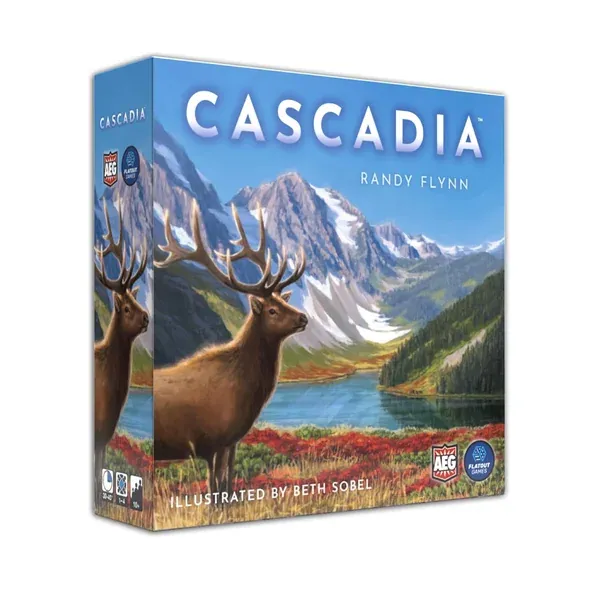
Flatout Games
8 min read
7.9/10
· 56,519 ratersShare This Guide
Cascadia: How It Plays, Scoring, and Who Should Buy It
BGG community
7.9/10
56,519 raters
Cascadia is Randy Flynn's Spiel des Jahres-winning tile-and-token drafting game about building Pacific Northwest habitats and placing wildlife into scoring patterns. Each turn you draft a paired habitat tile and wildlife token, balancing corridor growth against the five species scoring cards drawn for that game. It suits families, couples, and solo players who want a relaxing spatial puzzle with real decisions and almost no direct conflict.
Players
1–4
Best at 2 (562 votes)
Playtime
30–45 min
Complexity
1.8/5
1,607 votes
BGG rank
#60
#1 Abstract Game
Age (BGG poll)
8+
148 votes

 Tap to enlarge
In This Guide
- What Works & What Doesn't
- Verdict
- What Works
- How a Game Actually Flows
- Tensions You'll Actually Hit
- Player Count and Modes
- Strategy Read
- Honest Limitations
- Buy, Skip, or Buy Something Else First
What Works & What Doesn't
What Works
- The paired tile-token draft creates a genuine dilemma every turn, with Nature Tokens as the pressure valve.
- One of four scoring cards per species changes what you're building each game — replayability is structural.
- Teaches in minutes; BGG community weight of 1.8/5 backs the 'elegantly simple' claim.
- Official solo mode with a score ladder, plus a Family Variant for new gamers, both in the rulebook.
- Spiel des Jahres 2022 winner with a 7.9/10 BGG community rating and #1 rank in Abstract Games.
What Doesn't
- The paired draft can force dead picks: an unplaceable token goes back in the bag (rulebook, p. 7), which some players will read as luck punishing good planning.
- End-game scoring is administrative — five wildlife tallies, five corridor counts, majorities, and tokens on the scorepad.
- Almost no direct interaction: you contest corridor majorities and the draft, never an opponent's landscape.
- Playtime figures diverge — the listing says 15-30 minutes while BGG lists 45 (30-45).
Verdict
What Works
How a Game Actually Flows
Tensions You'll Actually Hit
Player Count and Modes
Strategy Read
Honest Limitations
Buy, Skip, or Buy Something Else First
Rules questions, answered from the rulebook
Rules Answers
Every answer below is grounded in the official rulebook and shows the exact passage it rests on — verified against the publisher's PDF, not paraphrased from forums.
Setup & Components
6 answersHow many players does Cascadia support?
Cascadia plays with 1 to 4 players and is recommended for ages 10 and up. Solo mode uses its own setup detailed separately in the rulebook.
How are the Wildlife Scoring Cards chosen during Cascadia setup?
Randomly select one Wildlife Scoring Card for each of the five wildlife and place those five cards in the center of the play area where everyone can see them. All the other scoring cards go back in the box for that game.
Who goes first in Cascadia?
The player who most recently saw one of the wildlife featured in the game is the first player. If you prefer, you may simply select the first player randomly.
What does the starting display look like in Cascadia?
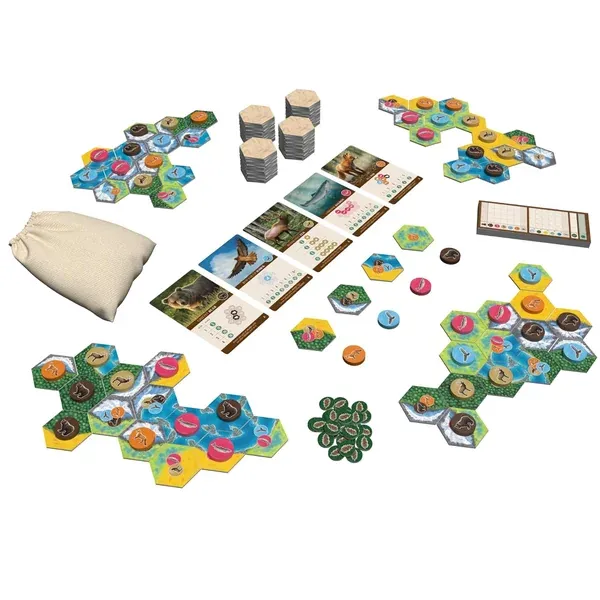
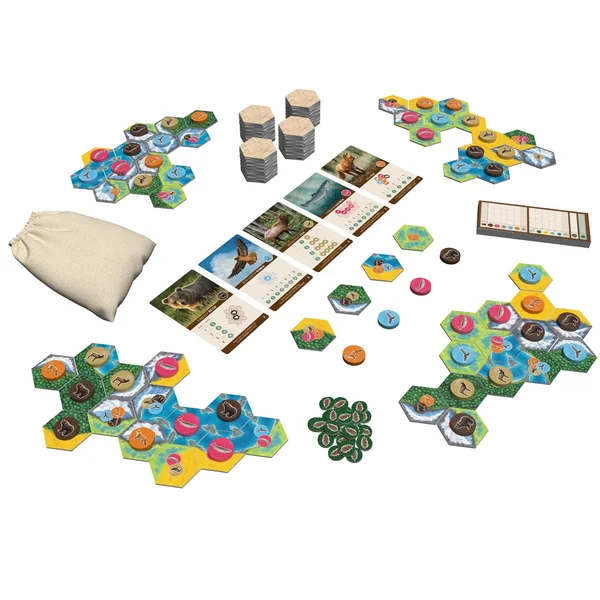
The starting display has 4 Habitat Tiles revealed face-up from the stacks and 4 Wildlife Tokens drawn from the Cloth Bag, paired in order with the tiles. This forms 4 combinations of 1 tile and 1 token that players will draft from on their turns.
What does each player start with in Cascadia?
Each player is randomly dealt one Starter Habitat Tile, placed face-up in front of them — this is the beginning of their environment. The leftover Starter Habitat Tiles go back in the box and aren't used that game.
What components come in a game of Cascadia?
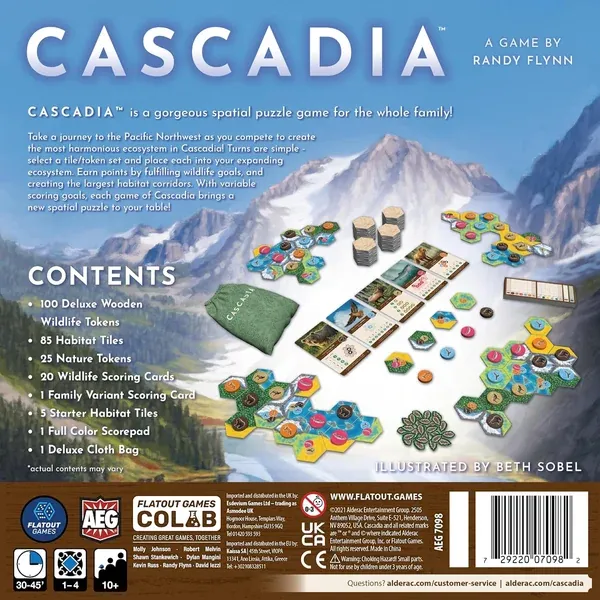
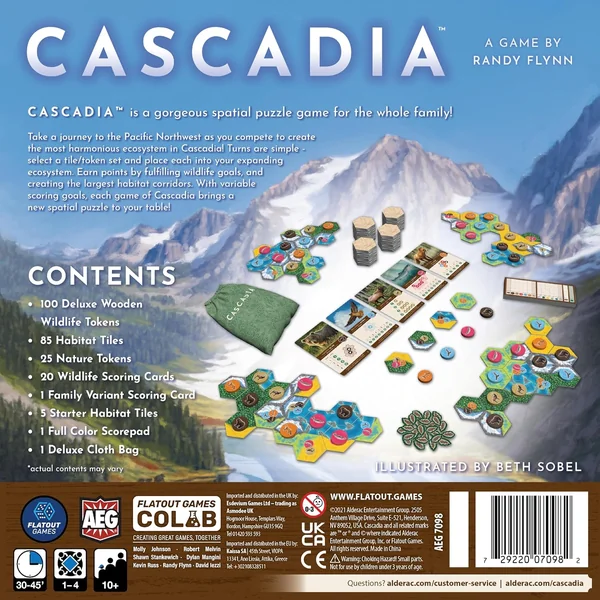
The game includes 85 Habitat Tiles (25 of them Keystone Tiles), 5 Starter Habitat Tiles covering Mountains, Forests, Prairies, Wetlands, and Rivers, 100 Wildlife Tokens, Wildlife Scoring Cards for the five species, 25 Nature Tokens, a Cloth Bag for the Wildlife Tokens, and a Scorepad. If anything is missing, the rulebook directs you to the publisher's customer service page.
Turns & Actions
4 answersCan you spend more than one Nature Token on a single turn in Cascadia?
Yes. Spending a Nature Token lets you take any one tile and any one token, or wipe any number of tokens, and you can keep spending them within the same turn. The rulebook states there is no limit to how many you may spend on your turn.
What happens when 3 of the 4 Wildlife Tokens in the display are the same animal in Cascadia?
The active player may choose to wipe those 3 tokens, setting them aside and drawing 3 new tokens one at a time from the Cloth Bag, pairing each in order with a Habitat Tile. This is optional, and you may only do it once per turn.
Where are you allowed to place a Habitat Tile in your Cascadia environment?
Each new tile must be placed adjacent to a tile already in your environment, meaning it must touch at least one side of a previously placed tile or your Starter Habitat Tile. Tiles may not be stacked on top of other tiles, and once placed, no tile can be moved.
When does a game of Cascadia end?
The game ends immediately when there are no face-down Habitat Tiles left in the stacks to replace one taken by a player. Each player will play exactly 20 turns, and then scores are tallied.
Scoring & Endgame
3 answersWhat counts as a contiguous habitat corridor in Cascadia?
Tiles belong to the same habitat corridor if they share at least one matching edge of the six edges of the tile. So two forest tiles connected only at a corner, or connected through a non-forest edge, do not count as one corridor.
How do habitat corridor majority bonuses work in a 2-player game of Cascadia?
In a 2-player game, the player with the largest corridor in each habitat type earns a 2 point bonus. If the two players tie for largest, each gets 1 bonus point, and there are never any bonus points for the second largest corridor.
Can two bear groups be placed next to each other in Cascadia?
No. Bear groups may be in any shape or orientation, but two groups may not be placed next to one another. Each group must also contain exactly the number of bears shown on the scoring card in order to score.
Edge Cases & Disputes
3 answersCan you wipe 3 matching Wildlife Tokens more than once on the same turn in Cascadia?
No. The optional wipe when exactly 3 of the available Wildlife Tokens match may only be done once per turn. However, if all 4 tokens match, they are wiped automatically, and that automatic wipe can happen multiple times on a single turn if the newly drawn tokens also match.
Can you rearrange or move Habitat Tiles after placing them in Cascadia?
No. Once placed, a Habitat Tile cannot be moved, and tiles may never be stacked on top of each other. Every placement is permanent, so plan your corridors before committing a tile.
How do you score connected elk groups that could form multiple shapes in Cascadia?
Each elk may only score once, for a single group or formation, even though elk groups may sit next to one another. When connected elk could be read as different groups, always score them using the interpretation that yields the largest number of points.
Player Counts & Variants
2 answersWhat is the tiebreaker in Cascadia?
If players tie for the most points, the tied player with the most Nature Tokens wins. If they are still tied on Nature Tokens, they share the victory.
What are Rule Restrictions in Cascadia's Achievement system?
Rule Restrictions are an Achievement mode where you set up and play a multi-player game under the normal rules but with one restriction from a list of ten, such as requiring at least one habitat to match when placing tiles or playing with a display of only three pairs. Only the winner of the game fills in their Achievement shape under the rule restriction that was used.
Sources & Further Reading
The key facts and claims in this guide are grounded in the retrieved, verified sources listed below.
- 1
BoardGameGeek
- 2
flatout.games
- 3
flatout.games
- 4
flatout.games
- 5
boardgamereview.co.uk
- 6
whatboardgame.com