Next Move Games
8 min read
7.7/10
· 109,913 ratersShare This Guide
Azul: How It Plays, Player Counts, and Who Should Buy It
BGG community
7.7/10
109,913 raters
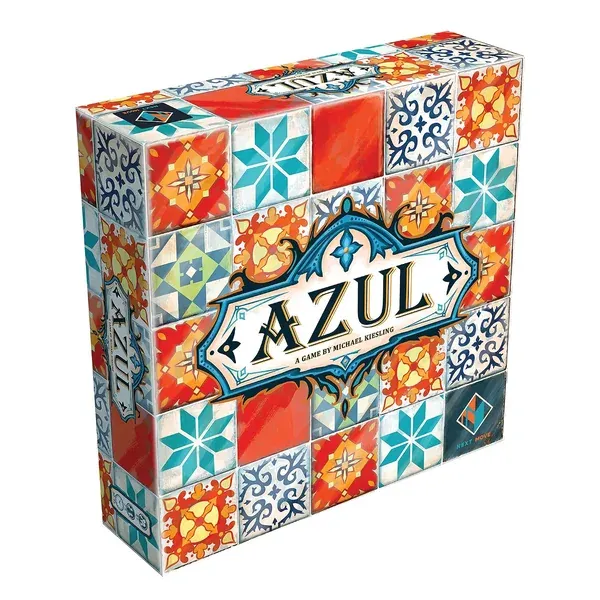
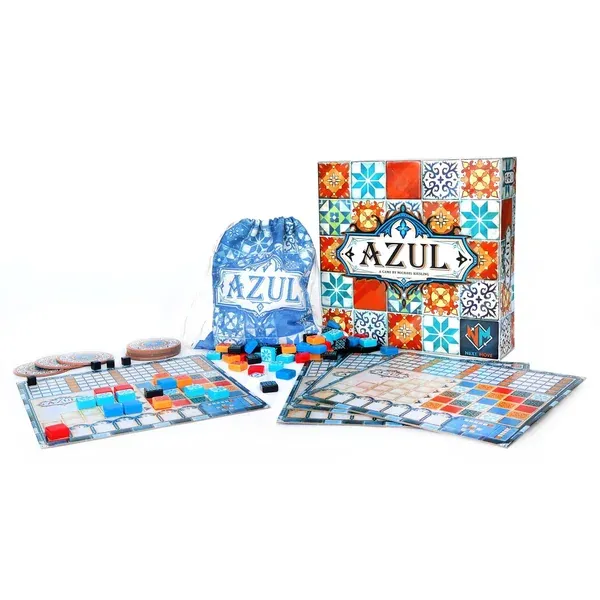
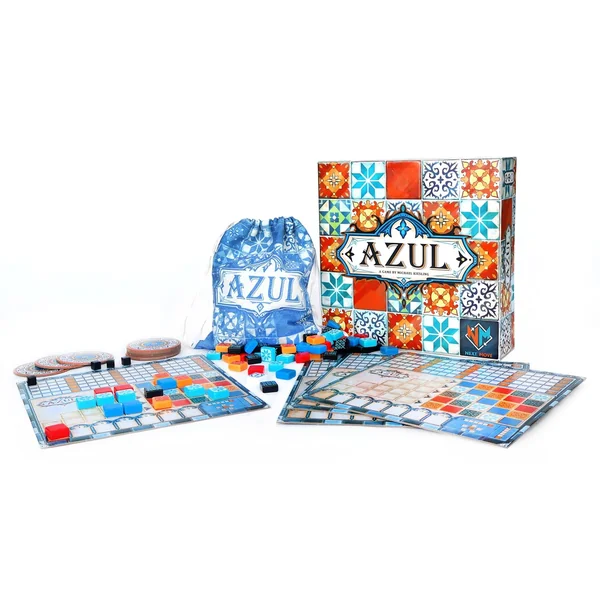
Azul is Michael Kiesling's Spiel des Jahres-winning tile-drafting game: pull colourful tiles from shared factory displays, build pattern lines, and tile a scoring wall while dodging floor-line penalties. It plays 2-4 in 30-45 minutes, teaches in five minutes, and hides real draft-and-deny tension under a gorgeous surface — strongest as a two-player duel, and a near-default buy for families and couples who like abstracts with bite.
Players
2–4
Best at 2 (1,092 votes)
Playtime
30–45 min
Complexity
1.8/5
2,956 votes
BGG rank
#99
#3 Abstract Game
Age (BGG poll)
8+
233 votes

 Tap to enlarge
In This Guide
- What Works & What Doesn't
- The Verdict
- How a Round Plays
- The Fights You'll Actually Have
- Player Count
- Strategy Read
- Honest Limitations
- Who Should Buy This
What Works & What Doesn't
What Works
- Teaches in five minutes but the draft-and-deny decisions stay sharp (BGG weight: 1.8/5)
- Tactile resin tiles and mosaic art elevate the whole table experience
- Interaction without attacks — blocking happens through the draft, not conflict cards
- Genuinely excellent at two players, the mode most boxes handle worst
- Grey-side variant board and random factory fills keep it replayable
What Doesn't
- Style-over-substance dissent exists — There Will Be Games argues the lovely tiles carry the hype
- Random bag draws can force an unavoidable floor-line spill in a close game
- Less control at 3-4 players; the centre pile swings harder between turns
The Verdict

How a Round Plays
The Fights You'll Actually Have
Player Count
Strategy Read
Honest Limitations
Who Should Buy This
Rules questions, answered from the rulebook
Rules Answers
Every answer below is grounded in the official rulebook and shows the exact passage it rests on — verified against the publisher's PDF, not paraphrased from forums.
Setup & Components
5 answersHow many Factory displays do you use in Azul for 2, 3, or 4 players?
The number of Factory displays scales with player count: 5 in a 2-player game, 7 in a 3-player game, and 9 in a 4-player game. They are placed in a circle around the center of the table during setup.
How many tiles come in Azul, and how many of each color?
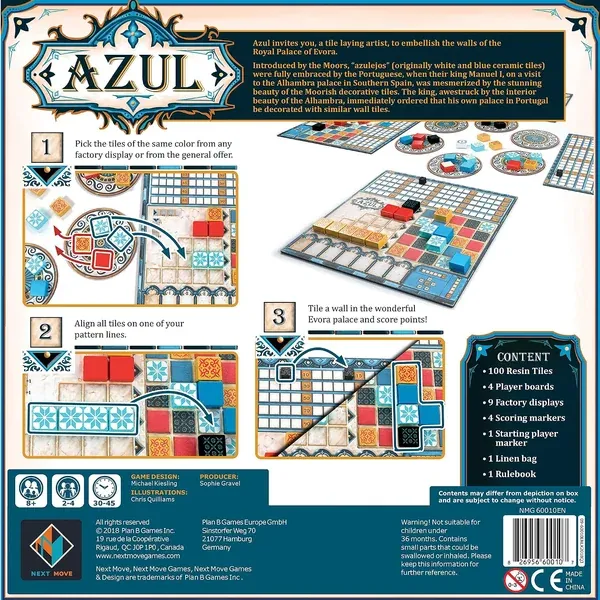
Azul includes 100 tiles total, with 20 tiles of each color. All 100 tiles go into the bag during setup.
Who is the starting player in Azul?
The player who most recently visited Portugal takes the starting player marker. That player then fills each Factory display with 4 randomly drawn tiles and takes the first turn of the game.
Where does the scoring marker start in Azul?
Each player takes 1 scoring marker and places it on space "0" of their score track during setup. Scores are tracked from there throughout the game.
How are the Factory displays arranged at the start of Azul?
The Factory displays are placed in a circle around the center of the table. Tiles picked from displays will later be discarded into that central area during the Factory offer phase.
Turns & Actions
2 answersWhat can you do on your turn in Azul?
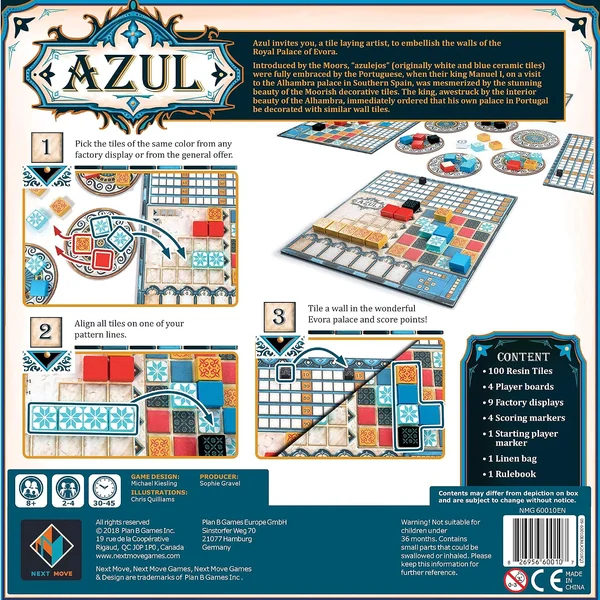
On your turn you must pick tiles in one of two ways: either take all tiles of one color from a single Factory display and push the rest of that display's tiles into the center of the table, or take all tiles of one color from the center of the table. You then add the picked tiles to one of the 5 pattern lines on your board, or to your floor line if they cannot be placed.
Can you add tiles to a pattern line that already holds tiles in Azul?
Yes, but only tiles of the same color already in that pattern line. Tiles are placed one by one from right to left, and a line is complete once all its spaces are filled — the first line has 1 space and the fifth line has 5.
Scoring & Endgame
3 answersHow are ties broken in Azul?
If players are tied on points, the tied player with more complete horizontal lines wins. If that still doesn't break the tie, the victory is shared.
How are floor line penalties calculated in Azul?
At the end of the Wall-tiling phase, check your floor line. For each tile in it, you lose the number of points indicated directly above that space, then all floor line tiles are removed to the lid of the box.
What happens when the tile bag runs empty in Azul?
When preparing the next round, refill the empty bag with all the tiles that were placed in the lid of the game box, then continue filling the remaining Factory displays. If you run out of tiles again with none left in the lid, you still start the new round even though not all Factory displays are properly filled.
Edge Cases & Disputes
1 answerDo tiles in incomplete pattern lines carry over to the next round in Azul?
Yes. Only complete pattern lines move a tile to the wall and get cleared; any tiles still sitting in incomplete pattern lines remain on your player board for the next round. You can then keep adding to those lines in later rounds, still matching their color.
Player Counts & Variants
1 answerWhat extra restriction applies in Azul's gray-side variant?
Because you can choose where each tile goes on a wall line, the variant adds one restriction: in each of the 5 vertical lines of your wall, no color may appear more than once. You must keep this in mind as you place tiles over the course of the game.
Sources & Further Reading
The key facts and claims in this guide are grounded in the retrieved, verified sources listed below.
- 1
BoardGameGeek
- 2
therewillbe.games
- 3
toplayornottoplay.net
- 4
apairofmeeples.com