Days of Wonder
8 min read
7.4/10
· 99,046 ratersShare This Guide
Ticket to Ride: How It Plays, Player Counts, and Who It's For
BGG community
7.4/10
99,046 raters
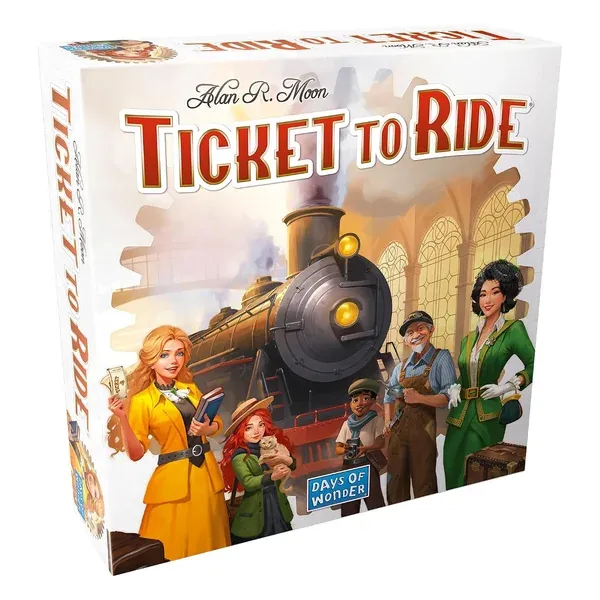
Ticket to Ride is Alan R. Moon's cross-country route-building game: draft coloured train cards, claim rail routes across a North America map, and secretly complete Destination Tickets for the bulk of your score. One action per turn makes it a genuine five-minute teach, while hidden tickets and contested double-routes keep four-player games sharp. The benchmark gateway game — ideal first strategy buy for families, too gentle for groups who want direct conflict.
Players
2–5
Best at 4 (814 votes)
Playtime
30–60 min
Complexity
1.8/5
5,245 votes
BGG rank
#261
#61 Family Game
Age (BGG poll)
8+
226 votes

 Tap to enlarge
In This Guide
- What Works & What Doesn't
- The Verdict
- What Works, What Doesn't
- How It Plays
- The Tensions You'll Hit
- Player Count
- Strategy Read
- Honest Limitations
- Buy / Don't Buy
What Works & What Doesn't
What Works
- Five-minute teach with no in-game text — genuinely accessible for ages 8+ and mixed-language tables.
- Single-action turns hide real tension: open route-building versus secret ticket ambitions.
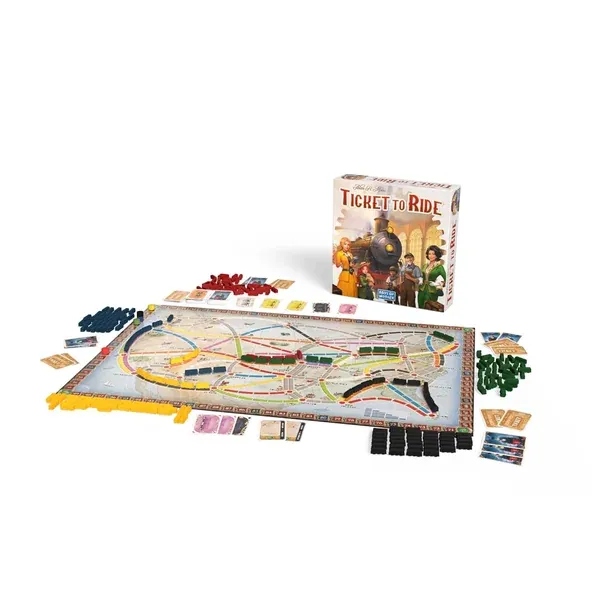
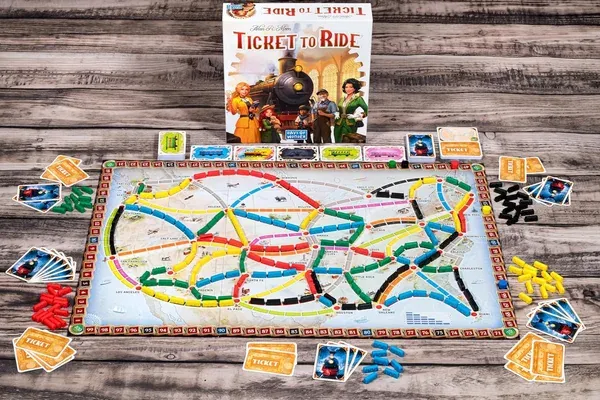
- Premium table presence — oversized map, 240 plastic trains, clear iconography.
- Route-scoring curve (up to 15 for six trains) rewards planning without punishing new players.
- Enormous ecosystem: Europe, First Journey, Legacy and more if the base box lands.
What Doesn't
- At 2–3 players the second track of every double-route closes, tightening the map exactly when fewer people are competing for it (rulebook, p. 3).
- Unfinished Destination Tickets subtract their full value, so a late ticket draw is a priced gamble some tables will resent (rulebook, p. 4).
- The 2025 refresh publishes no changelist — nothing documents what changed from recent printings.
The Verdict
What Works, What Doesn't
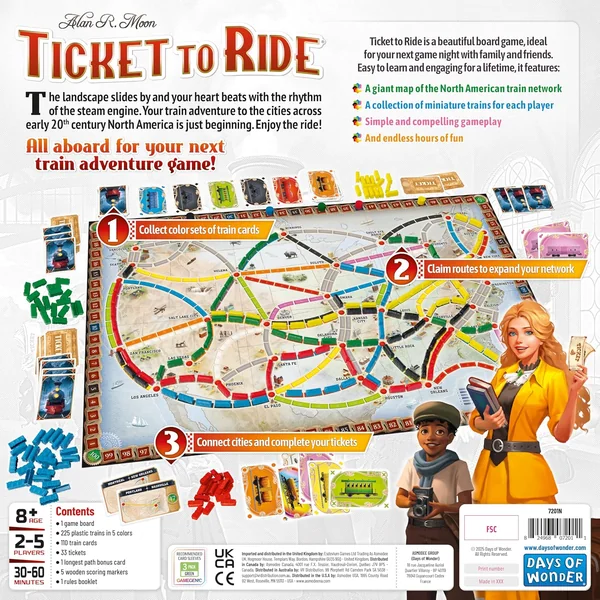
How It Plays
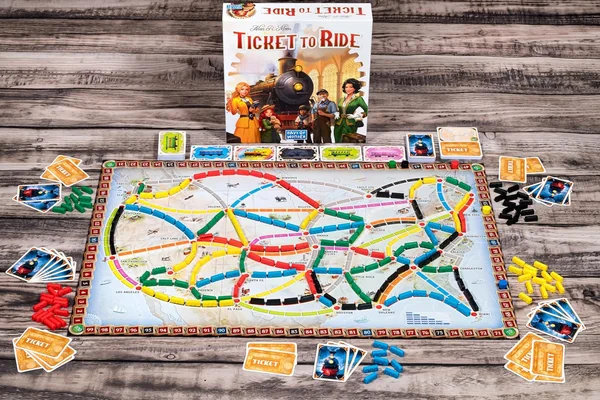
The Tensions You'll Hit
Player Count
Strategy Read
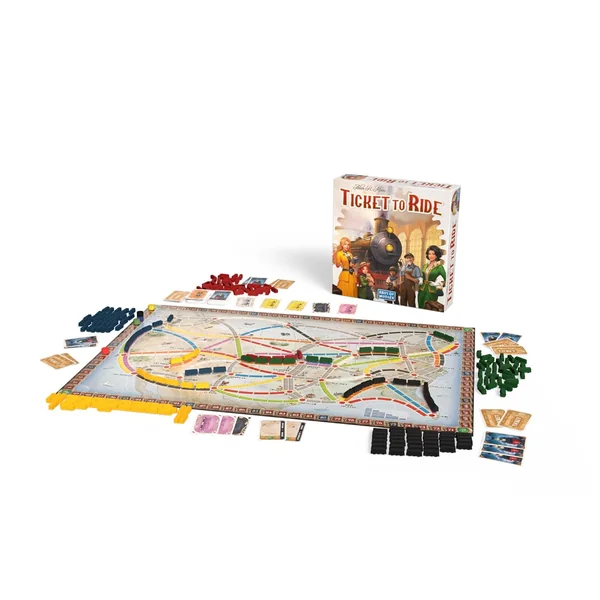
Honest Limitations
Buy / Don't Buy
Rules questions, answered from the rulebook
Rules Answers
Every answer below is grounded in the official rulebook and shows the exact passage it rests on — verified against the publisher's PDF, not paraphrased from forums.
Setup & Components
2 answersHow many Train Car cards are dealt to each player at the start of the game?
Each player is dealt a starting hand of 4 Train Car cards. The rest of the shuffled deck is placed near the board, and the top five cards are turned face-up next to it to form the available pool.
How many face-up Train Car cards are placed next to the board during setup?
Five cards from the top of the Train Car deck are turned face-up beside the board. Players draw from these face-up cards (or blindly from the deck) when taking the Draw Train Car Cards action.
Turns & Actions
1 answerWhat happens when three of the five face-up cards are Locomotives?
If three of the five face-up Train Car cards are Locomotives at any time, all five cards are immediately discarded and five new cards are turned face-up to replace them.
Scoring & Endgame
5 answersWhat happens if two players tie for the Longest Continuous Path?
All tied players score the 10 point bonus. The bonus is not split or withheld when multiple players have paths of equal length.
Do you lose points for Destination Tickets you don't complete?
Yes. If you do not successfully connect the two cities on a Destination Ticket you kept, you deduct the point value shown on that ticket from your score. Tickets are added or subtracted during final scoring at the end of the game.
How many trains left in your supply trigger the end of the game, and does the triggering player get another turn?
The end is triggered when a player's stock of trains gets down to only 0, 1, or 2 trains left at the end of their turn. Each player, including the player who triggered the end, then gets one final turn before final scores are calculated.
Can the same train be counted twice when scoring the Longest Continuous Path?
No. A continuous path may include loops and pass through the same city several times, but a given plastic train may never be used twice in the same continuous path. When comparing path lengths, only continuous lines of plastic trains of the same color are counted.
Are Destination Tickets revealed to other players during the game?
No. Destination Tickets are kept secret from other players until the game's final scoring, when all players reveal their tickets and add or subtract their values.
Edge Cases & Disputes
5 answersDoes a Locomotive drawn blind from the top of the deck count as both draws?
No, a blind-drawn Locomotive still counts as just a single card, and you may still draw a total of two cards that turn. The one-card penalty only applies when you deliberately take a face-up Locomotive.
Can I take the replacement card as my second draw if it turned out to be a Locomotive?
No. If the replacement card flipped face-up after your first draw is a Locomotive, you cannot take it as your second card. You would have to choose a different face-up card or draw blind from the deck instead.
Can one player claim both routes of a double-route between the same two cities?
No. A single player is never allowed to claim both routes connecting the same pair of cities, no matter the player count.
Can I claim two routes on the same turn if I have enough cards?
No. Regardless of how many cards you hold, you may claim a maximum of one route — connecting two adjacent cities — on your turn, never more.
What if fewer than 3 Destination Tickets remain when I use my turn to draw them?
You simply draw whatever cards are available, even if that is only one or two cards. You must still keep at least one of the drawn cards, and any you return go on the bottom of the deck.
Sources & Further Reading
The key facts and claims in this guide are grounded in the retrieved, verified sources listed below.
- 1
ncdn0.daysofwonder.com
- 2
BoardGameGeek
- 3
daysofwonder.com
- 4
boardgamereviewsbyjosh.com
- 5