GAMES
Published by

Lookout Games

Published

Read Time

7 min read

BGG community rating

7.6/10

· 74,715 raters
BoardGameGeek community, not a LuvemGames score
$29.99 on AmazonWe earn a commission if you buy through this link. How this works4.6/5 from 22 ratings on Amazon
Curated & edited by

LuvemGames Editorial

How we build our guides →
Share This Guide

Patchwork: How the Revised Edition Plays, Scores, and Who It's For

BGG community

7.6/10

74,715 raters

Patchwork is Uwe Rosenberg's two-player abstract about sewing the most efficient quilt: patches cost buttons and time, the time track decides who moves next, and empty squares cost you at scoring. This revised edition refreshes the components and presentation while keeping the 2014 gameplay intact. It suits couples and duel-minded players who want a deep game in 30 minutes.

Players

2

Best at 2 (631 votes)

Playtime

15–30 min

Complexity

1.6/5

1,922 votes

BGG rank

#148

#5 Abstract Game

Age (BGG poll)

8+

117 votes

Powered by BGG
How we made this guide: we synthesized the publisher's listing, community data, and published coverage. We haven't played this copy at a table — where we take a position, it's reasoned from the rules and the numbers, and we show our working. Every rating shown is attributed. How we build guides →
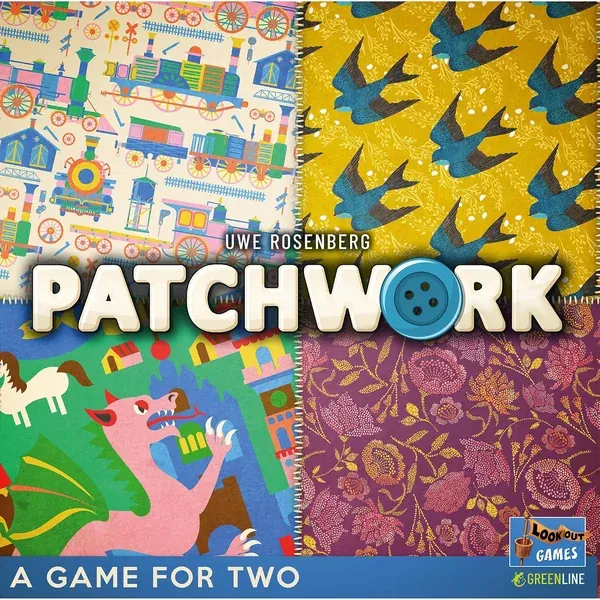
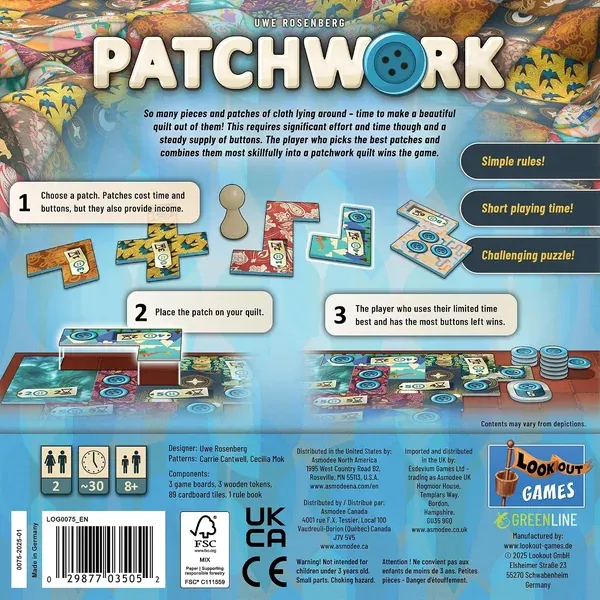
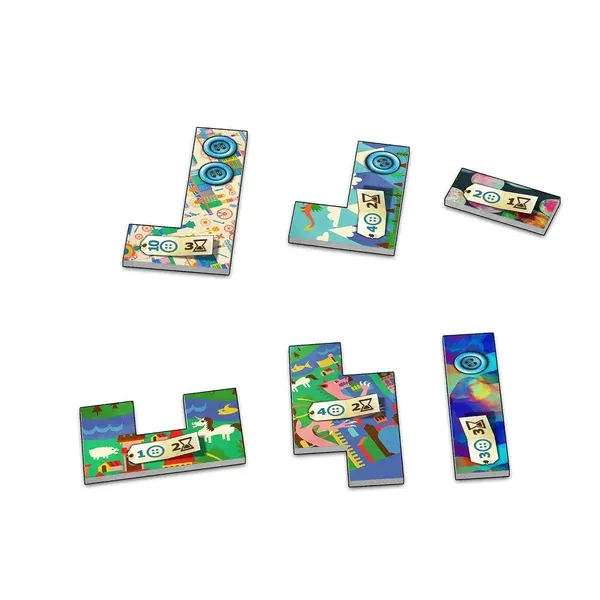
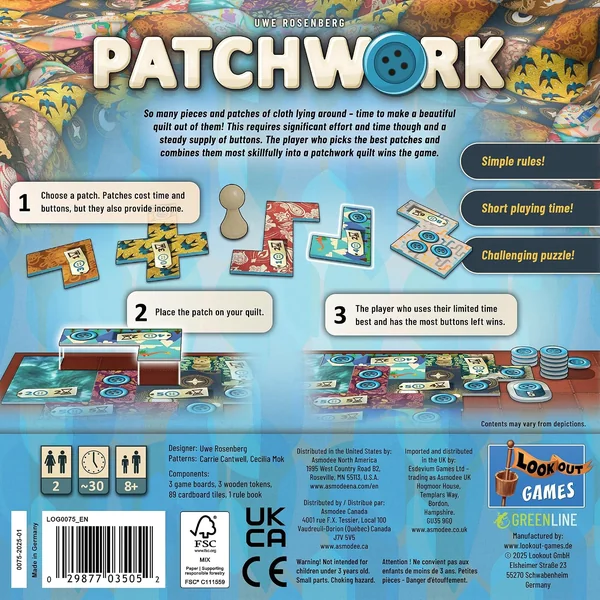
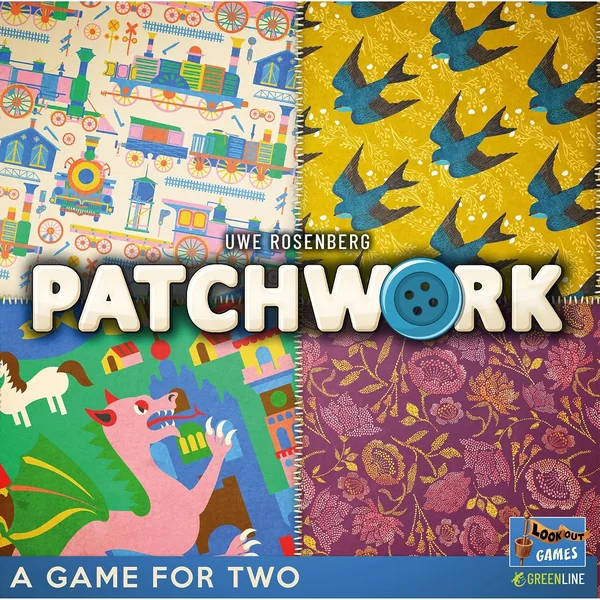
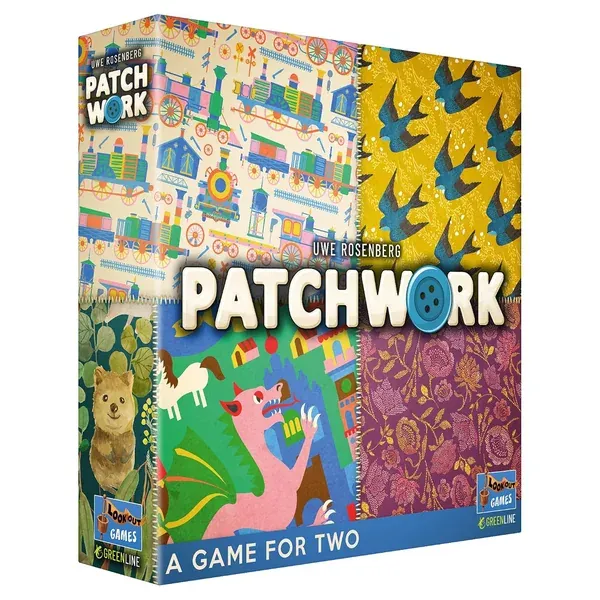
Board game box showing four fabric pattern designs with trains, birds, animals, and floral motifs in colorful stylesBoard game box showing fabric patches, buttons, game boards, and rules for Patchwork by Uwe RosenbergColorful domino-like tiles with circular symbols and decorative patterns arranged in various configurationsTap to enlarge
In This Guide
  • What Works & What Doesn't
  • The Verdict
  • What Works
  • How It Plays
  • Where Games Are Won
  • Player Count
  • The Strategy Read
  • Honest Limitations
  • Buy / Don't Buy

What Works & What Doesn't

What Works
  • Five-minute teach with a two-action turn structure (per Play Better Games) — weight 1.6/5 on BGG
  • Time-as-currency turn order creates real tactical depth in a 30-minute game
  • Open draft of three visible patches makes every purchase also a denial decision
  • No in-game text at all (BGG language-dependence poll) — fully language-independent
  • Ranked #148 overall and #5 among abstract games by the BGG community
What Doesn't
  • Strictly two players — BGG's own forums host threads from groups wishing it stretched further, and the box never will
  • The button/time arithmetic is constant and visible — BoostYourPlay's own strategy guide admits the cost-benefit balance 'can feel difficult to quantify in the moment'
  • Owners of the 2014 original gain nothing gameplay-wise from the revised edition — the listing documents only refreshed components and visuals

The Verdict
Patchwork is Uwe Rosenberg's tightest design — a two-player quilt-building duel where every patch costs buttons and time, and the clock is the board. The BGG community rates it 7.6/10 across 74,715 voters as of early 2026, with a complexity weight of just 1.6/5, and it sits at #5 among abstract games on that site. Buy it if you want a 30-minute head-to-head game with zero luck in the drafting; skip it if you regularly play with more than two people.
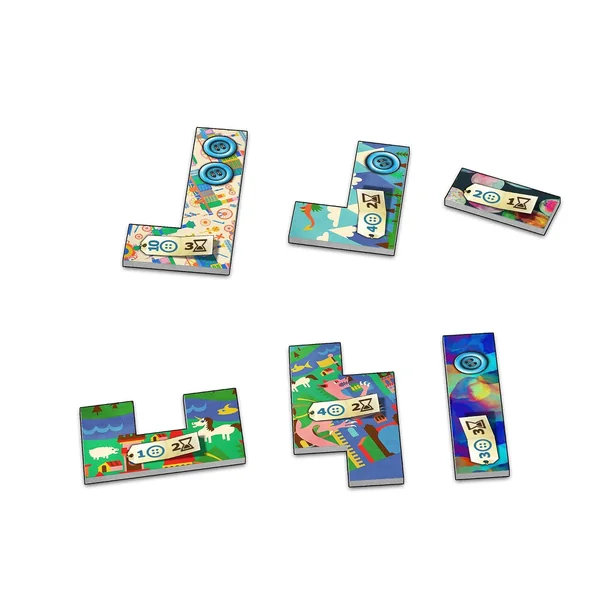
Patchwork's colorful patch tiles with varying shapes and button costs

What Works

The teach is genuinely five minutes: on your turn you either buy one patch or advance your token to collect buttons, and that's the whole action menu (Play Better Games confirms the two-action structure). Shut Up & Sit Down called it "a bonsai of a game that has been expertly sculpted," and that is the right metaphor — small, dense, nothing wasted.
updated components, refreshed visuals, and a sleek presentation
The tension comes from one elegant coupling: time is currency. Spending time to move earns buttons, but the player furthest back on the time track keeps taking turns, so falling behind is sometimes the plan.

How It Plays

Patches sit in a circle around the central time track, and a neutral pawn limits you to buying one of the next three patches clockwise — this is the game's signature open draft, and the thing that makes every purchase a denial decision too (mechanisms per BGG: Open Drafting, Rondel, Time Track). Paying for a patch advances your marker by the time cost printed on it; passing leaps you one space ahead of your opponent and pays one button per space moved, per Dicebreaker's rules walkthrough.
Patchwork game overview showing rules, components, and gameplay mechanics
Button spaces on the track pay out income equal to the buttons sewn onto your placed patches. Single-square leather patches sit on the track as freebies for whoever crosses them first.
A round of turns ends when both markers land on the final space of the time track, and scoring is brutally simple: buttons in hand, minus two points per empty square on your 9×9 board (Dicebreaker's scoring guide). The first player to complete a 7×7 square also claims a 7-point bonus tile.

Where Games Are Won

Someone at your table will buy the gorgeous five-square patch with three income buttons and then discover it costs eight time — the income never catches up because the opponent took three cheap turns while it was being placed. The stat-based turn order means the player who spends time is the player who skips turns, and no amount of button income un-skips them.
Expect the argument about the leather patches: taking a detour for a free 1×1 square feels trivial until the endgame, when empty spaces cost two points each and that one leather patch is the difference between -6 and -8.

Player Count

Two players, full stop — the box says 2, and BGG's poll of 631 voters says best at 2 because that's the only option. Dicebreaker puts it plainly: "a game for two players (and only two players)." If you want the system at a higher count, BGG lists spin-offs Patchwork Doodle and Patchwork Express, but neither replaces this.

The Strategy Read

BoostYourPlay's strategy guide argues the game reduces to cost-per-square arithmetic: a patch's true price is buttons paid plus the button income you forgo by spending time instead of moving. Their math-first read is worth following, with one caveat — patches are openly drafted, so you can't always assemble the efficient set you planned; treat the arithmetic as a tiebreaker, not a script.
Patchwork's colorful fabric patches and game board design
Worked example: a 2-button, 2-time patch that covers four squares is almost always better than a 5-button, 1-time patch covering three, because the cheap patch keeps you behind on the track and taking extra turns. The 7×7 bonus (7 points) is worth chasing only if your early patches already tessellate compactly — contorting your board for it usually costs more in empty squares than the bonus returns.

Honest Limitations

The cost-benefit math "can feel difficult to quantify in the moment," as BoostYourPlay admits — players who dislike visible arithmetic every turn may find the game more homework than hobby. And the two-player ceiling is hard; a BGG forum thread of players wanting a group version exists precisely because the box won't stretch.
The revised edition's changes are presentational: the listing promises "updated components, refreshed visuals, and a sleek presentation" while retaining the original gameplay, and BGG's editions data shows this as the 2025–2026 printing wave across languages. If you own the 2014 original, the listing documents no gameplay reason to upgrade.

Buy / Don't Buy

Buy it if you want a couples' game or a travel-friendly two-player abstract with real depth at a featherweight teach (1.6/5 weight, no in-game text per BGG's language poll). Skip it if your group is three or more, or if arithmetic-as-gameplay sounds like a chore. Edition call: the Revised Edition is the current printing and the one to buy new; a used 2014 copy plays identically, so pay less if you find one.

Rules Answers

17 cited

Every answer below is grounded in the official rulebook and shows the exact passage it rests on — verified against the publisher's PDF, not paraphrased from forums.

Setup & Components
6 answers

Each player takes a quilt board, a time token, and 5 buttons, which serve as the game's currency. The remaining button tiles are kept on the table close at hand for payments and income during play.

Each player takes a quilt board, a time token and 5 butt ons (as currency).Patchwork rulebook, p. 1

The regular patches are placed in a circle or oval around the central time board. The time board itself goes in the middle of the table, and players choose patches from this ring during the game.

Place the (regular) patches in a circle or oval around the time board.Patchwork rulebook, p. 1

Find the smallest patch, which is the patch of size 1x2, and place the neutral token between that patch and the next patch in clockwise order. This token then governs which patches players may choose from during the game.

Locate the smallest patch, i.e. the patch of size 1x2, and place the neutral token between this patch and the next patch in clockwise order.Patchwork rulebook, p. 1

No. The central time board is two-sided, but the two sides only differ in appearance. Players simply choose the side they like better.

two-sided; the two sides only diff er in appearance - choose the one you like bett erPatchwork rulebook, p. 2

The game includes a central two-sided time board, 2 quilt boards (1 per player), 1 neutral token, 1 special tile, time tokens in lime green and yellow, 5 special patches, button tiles, and 33 patches.

2 quilt boards (1 per player) 1 neutral token 1 special tile time tokens (lime green and yellow) 5 special patches (leather patches)Patchwork rulebook, p. 2

The box contains 32 "1 button" tiles, 12 "5 buttons" tiles, 5 "10 buttons" tiles, and 1 "20 buttons" tile. These are used as the game's currency for buying patches and scoring at the end.

32 “1 butt on” tiles 12 “5 butt ons” tiles 5 “10 butt ons” tiles 1 “20 butt ons” tilePatchwork rulebook, p. 2
Turns & Actions
5 answers

The player whose time token is on top goes first. When you move onto the same space as your opponent's token, you place your token on top of it, so the most recent arrival moves again.

If both time tokens are on the same space, the player whose token is on top goes fi rst.Patchwork rulebook, p. 1

Move your time token so it occupies the space directly in front of your opponent's time token. You receive 1 button (a button tile of value 1) per space you moved your time token.

Move your time token on the time board so that it occupies the space directly in front of your opponent’s time token. You receive 1 butt on (i.e. a butt on tile of value 1) per space you moved your time token.Patchwork rulebook, p. 1

You can choose only from the three patches in front of the neutral token, counting in clockwise order. You cannot choose any other patch at that moment; after choosing, place the neutral token next to the chosen patch.

You can choose from the three patches in front of the neutral token (in clockwise order). In this example, you can choose from the 3 marked patches. You cannot choose any other patch at the moment.Patchwork rulebook, p. 1

You may turn the patch any way you like before placing it on your quilt board. However, patches on your quilt board may not overlap.

The patches on your quilt board may not overlap. You may turn the patch any way you like before placing it on your quilt board.Patchwork rulebook, p. 1

It simply stops on the last space. If you took the Advance action, you only receive buttons for the actual number of spaces moved, not the full distance to the space in front of your opponent.

If a time token were to move past the last space, it simply stops on the last space. In case of action A, you only receive butt ons for the actual number of spaces moved.Patchwork rulebook, p. 2
Scoring & Endgame
4 answers

At the end of the game, count the buttons you have left and add the value of the special tile if you earned it. Then subtract 2 points for each empty space on your quilt board. The resulting number is your final score.

Determine the number of butt ons you have left , adding the value of the special tile if available. From this score, subtract 2 points for each empty space of your quilt board.Patchwork rulebook, p. 2

The game ends after both players' time tokens have reached the last space of the time board. If a token would move past the last space, it simply stops on the last space instead.

The game ends aft er both time tokens reach the last space of the time board. If a time token were to move past the last space, it simply stops on the last space.Patchwork rulebook, p. 2

The special tile goes to the first player who completely fills a 7x7 square of spaces on their quilt board. It is worth 7 points when added to your score at the end of the game.

The fi rst player to completely fi ll a 7x7 square of spaces on his quilt board receives the special tile, which is worth 7 points.Patchwork rulebook, p. 2

Single spaces can only be covered by the special patches. You earn a special patch by moving onto or past one of the marked special patch spaces on the time board, and you place it on your quilt board immediately.

The special patches are the only way to “patch” single spaces of your quilt board.Patchwork rulebook, p. 2
Edge Cases & Disputes
1 answer

Both. Marked spaces on the time board trigger their event whenever you move onto them or move past them, so a single move can resolve more than one event. This applies to both special patch spaces and button income spaces.

Whenever you move onto or past one of those spaces, resolve the corresponding event:Patchwork rulebook, p. 2
Player Counts & Variants
1 answer

You receive a number of buttons according to the patches on your quilt board — each button depicted on your placed patches pays out every time you trigger a button income space. For example, a patch showing 2 buttons gives you 2 buttons each time income is received.

Butt on Income: You receive a number of butt ons according to the patches on your quilt board. You will receive 2 butt ons for this patch every time you receive butt on income.Patchwork rulebook, p. 2

Sources & Further Reading

The key facts and claims in this guide are grounded in the retrieved, verified sources listed below.

  1. 1
    Patchwork on BoardGameGeekHigh-authority source

    BoardGameGeek

  2. 2

    shutupandsitdown.com

  3. 3

    meeplemountain.com

  4. 4
  5. 5
  6. 6
Patchwork: How the Revised Edition Plays, Scores, and Who It's For | LuvemGames