
GAMES
Published by
Days of Wonder
Published
Read Time
7 min read
Amazon player rating
4.8
Share This Review
Ticket to Ride Review: The Family Train Game, Twenty Years On
BGG community
7.4/10
99,046 raters
4.8 Amazon (524)
Ticket to Ride is the definitive gateway train game: collect colored cards, claim routes across North America, and secretly connect your destination cities before someone blocks your corridor. This grounded review synthesizes the official rulebook, the 2025 Amazon listing, BGG community data, and published coverage — not hands-on play — to tell you who it's still worth buying for.
Players
2–5
Best at 4 (814 votes)
Playtime
30–60 min
Complexity
1.8/5
5,245 votes
BGG rating
7.4/10
99,046 raters
BGG rank
#261
#61 Family Game
Age
8+
community poll (226)

Source-grounded review: synthesized from the official rulebook, the listing, community data, and published coverage — we don't claim hands-on play, and every rating shown is attributed. How we review →
 Tap to enlarge
In This Review
- What Works & What Doesn't
- What It Is
- How It Plays
- Complexity and Teachability
- Player Count Truth
- Replayability and Components
- Honest Limitations
- Verdict
What Works & What Doesn't
What Works
- Teaches in minutes — one action per turn, a BGG weight of 1.8/5, and no necessary in-game text
- The open card draft with the wild-Locomotive trade-off gives every turn a genuine decision
- The shared route race creates constant low-key tension as corridors get claimed out from under you
- Family credentials are corroborated: 4.8/5 from 524 Amazon readers and BGG's #61 Family Game rank
- Deep ecosystem — BGG lists official spin-offs like Europe, London, and Legacy: Legends of the West
What Doesn't
- Ticket draws carry real luck: you must keep at least one of three blind Destination Tickets (rulebook, p. 3), and BGG's Push Your Luck tag reflects how a bad late draw can cost the game
- Community data says it plays best at four (BGG poll, 814 votes), so dedicated two-player tables get a roomier, less contested map even with the double-route closure rule
- Hidden tickets make the score track misleading — the apparent leader can lose at the final reveal (rulebook, p. 4)
Ticket to Ride is Alan R. Moon's cross-country train game: players collect colored train cards, claim railway routes across a map of North America, and secretly race to connect the city pairs printed on their destination tickets. This review synthesizes the publisher's official rulebook, the Amazon listing for the 2025 refresh, BoardGameGeek community data, and published coverage — no hands-on play is implied anywhere below.
One transparency note up front: the publisher has not released a changelist for the 2025 refresh, and BGG simply lists it among ten printings; the rules PDF reviewed here is Days of Wonder's current US rules booklet, and the listing's component description matches it.
“can be learned in less than five minutes”
What It Is
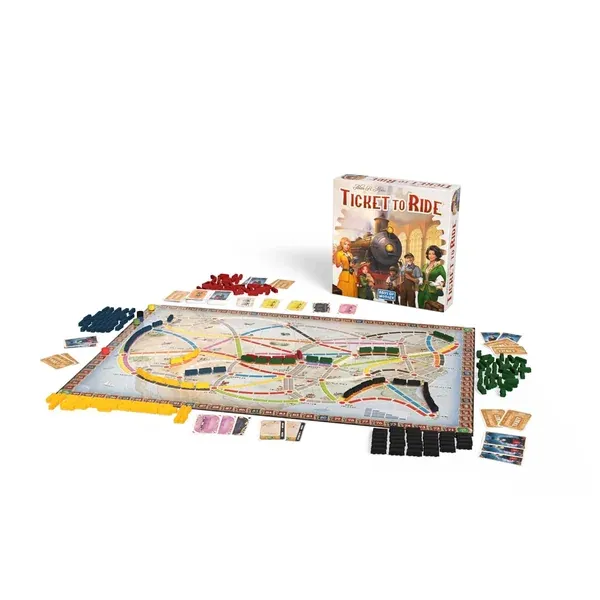
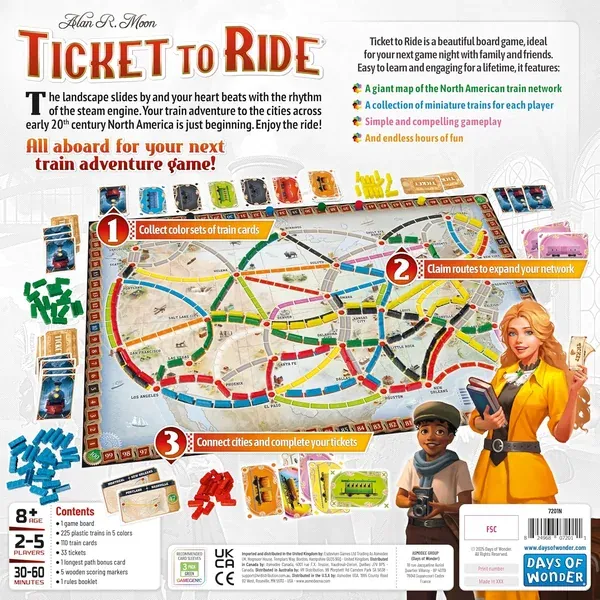
Ticket to Ride plays 2–5 players, ages 8 and up, in a listed 30–60 minutes (rulebook, p. 1). In the box: a board map of North American routes, 240 colored plastic train cars, 110 Train Car cards, 30 Destination Ticket cards, a Longest Continuous Path Bonus card, and five wooden scoring markers (rulebook, p. 2).
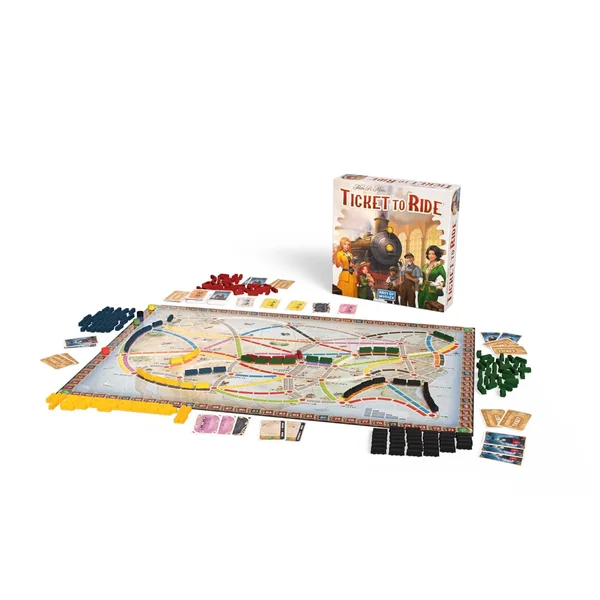
Ticket to Ride game board with trains, cards, and components
The game's standing is hard to overstate in raw community terms. BGG ranks it #261 overall and #61 in Family Games, with over 150,000 users logging it as owned.
How It Plays
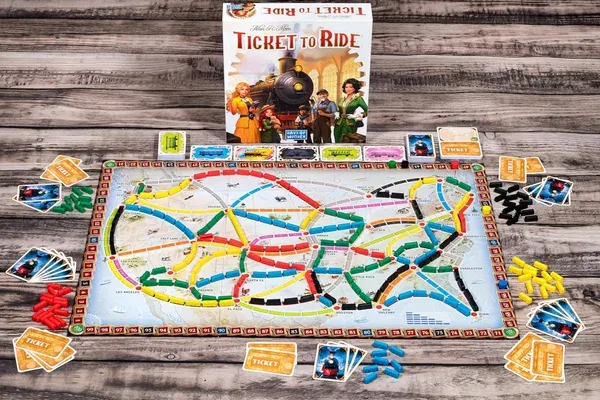
Setup is quick: each player takes 45 trains, four Train Car cards, and three Destination Tickets — keeping at least two — while five Train Car cards are turned face-up beside the board (rulebook, p. 2). On a turn, a player does exactly one of three things: draw two Train Car cards from the face-up market or the deck, claim one route by playing a matching colored set, or draw three new Destination Tickets (keeping at least one) (rulebook, pp. 2–3).
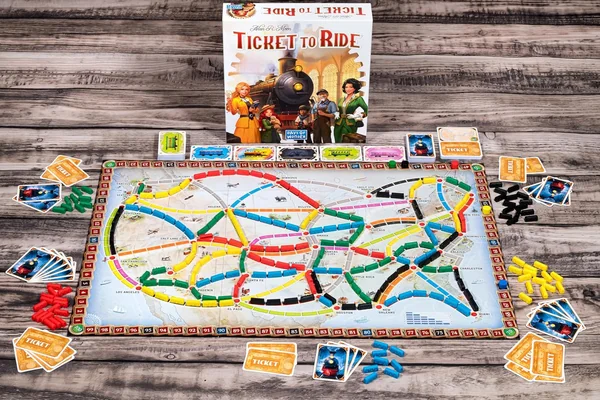
Ticket to Ride game board with colored train routes and cards
The signature mechanic is that open card draft feeding a route race. Locomotives are wild, but taking a face-up one costs your entire draw, and three face-up Locomotives wipe the market (rulebook, p. 3) — a small push-your-luck economy that Dicebreaker's rules guide highlights as the core of every turn. Gray routes accept any single color, and in 2–3 player games only one of each double-route may be claimed (rulebook, p. 3).
The game ends when a player finishes a turn with two or fewer trains left; everyone, including that player, takes one final turn (rulebook, p. 4). Scoring is fully documented: routes pay 1/2/4/7/10/15 points for lengths 1–6, completed Destination Tickets add their printed value while unfinished ones subtract it, and the Longest Continuous Path earns a 10-point bonus, with ties going to whoever completed the most tickets (rulebook, p. 4).
Complexity and Teachability
BGG's community weight is a light 1.8/5 from over 5,200 votes, and a BGG poll finds no necessary in-game text — the cards run on color and iconography. Days of Wonder's own promotional line, quoted on Wikipedia, is that the game "can be learned in less than five minutes," which matches the one-action-per-turn structure above.
The teach is genuinely short because the strategy lives in timing, not rules density. Expect a first game to run toward the 60-minute end of the listed range, which is also BGG's listed playtime.
Player Count Truth
The box says 2–5, and BGG's player-count poll — 814 votes — says it plays best at four. The rulebook visibly compensates at the low end by closing one side of every double-route in 2–3 player games (rulebook, p. 3), which tightens the map.
That mitigation helps, but the community data is clear that the fuller table, with more competition for the same corridors, is where the design sings.
Replayability and Components
Thirty Destination Tickets and a shared contested map mean routes and priorities shift every game (rulebook, p. 2). Wirecutter's reviewer credits exactly that variety — "the possibilities are endless" — with making it a multi-round household staple.
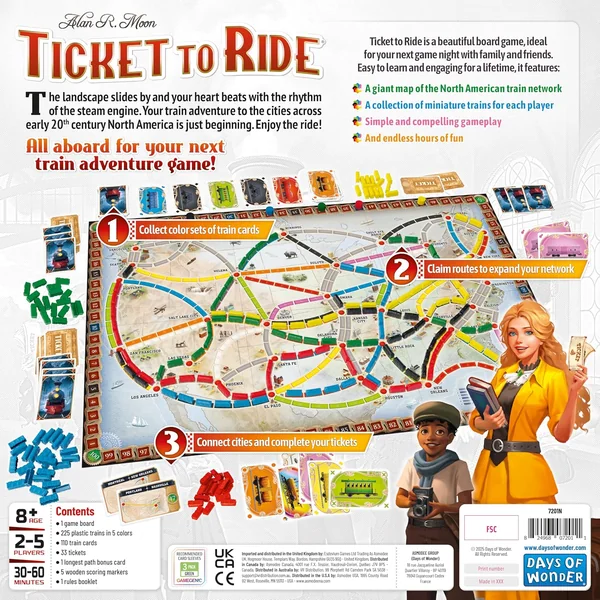
Ticket to Ride board game components and North American train network map
On the table, the package delivers: Coop Board Games' review calls the components premium, singling out the oversized map and clear iconography, and Board Game Reviews by Josh praises the quick setup and teardown. The ecosystem is deep too — BGG lists official spin-offs including Ticket to Ride: Europe, London, and the campaign-style Legacy: Legends of the West, plus a long tail of unofficial fan expansions.
Honest Limitations
Ticket luck is real. Drawing new Destination Tickets forces you to keep at least one of three blind cards (rulebook, p. 3), and BGG's mechanism list tags the game Push Your Luck for good reason — a late draw can saddle a leader with a route they cannot finish.
The visible score track also understates the true standings, since tickets stay secret until final scoring (rulebook, p. 4). A player who looks beaten on the track can overturn the result at the reveal, which some groups will read as drama and others as opacity.
Finally, weigh the BGG poll honestly: if your table is almost always two players, the community's best-at-four verdict is worth taking seriously before buying this over a head-to-head design.
Verdict
Families and mixed-experience groups who want a 20-year-tested gateway game with a five-minute teach should buy with confidence — the 4.8/5 reader aggregate across 524 Amazon ratings and BGG's family rank back the listing's "for all ages" pitch. Players who need low-luck, fully open information, or who mostly play at two, should look at the many sibling versions BGG lists — or elsewhere entirely.
Rules questions, answered from the rulebook
How do you win Ticket to Ride?
You score points three ways: claiming routes pays 1/2/4/7/10/15 points for route lengths 1–6, completed Destination Tickets add their printed value (unfinished ones subtract it), and the Longest Continuous Path earns a 10-point bonus. Most points wins; ties go to the player who completed the most Destination Tickets (rulebook, p. 4).
How long does this game take to learn and play?
Days of Wonder's promotional line, quoted on Wikipedia, says it can be learned in under five minutes, and BGG's community weight of 1.8/5 backs that up. BGG lists playtime at 60 minutes (the box says 30–60), so budget the full hour for a first game.
What is the best player count for this game?
The box supports 2–5, but BGG's player-count poll (814 votes) rates it best at four players. The rulebook compensates at lower counts by closing one side of every double-route in 2–3 player games, keeping the map contested (rulebook, p. 3).
Is this game good for kids, and what age can play?
The box and BGG's community age poll (226 votes) agree on 8+. BGG's language-dependence poll also finds no necessary in-game text, so once the rules are explained, younger players can play from colors and icons alone.
Are there other versions of this game?
Yes — BGG lists official reimplementations including Ticket to Ride: Europe, London, Amsterdam, Berlin, First Journey, and the campaign game Legacy: Legends of the West, alongside numerous unofficial fan expansions. Our sources don't compare them head-to-head, so we can't crown one over the original.
Sources & Further Reading
The key facts and claims in this review are grounded in the retrieved, verified sources listed below.
- 1
ncdn0.daysofwonder.com
- 2
BoardGameGeek
- 3
daysofwonder.com
- 4
- 5
en.wikipedia.org
- 6
boardgamereviewsbyjosh.com
- 7
coopboardgames.com