
GAMES
Published by
Repos Production
Published
Read Time
7 min read
Amazon player rating
4.8
Share This Review
7 Wonders Duel Review: A Tense Two-Player Civilization Duel
BGG community
8.1/10
109,896 raters
4.8 Amazon (9,705)
7 Wonders Duel condenses the civilization-building of 7 Wonders into a dedicated two-player duel where military invasion, scientific monopoly, or raw points can each end the game. This review synthesizes the publisher listing, BoardGameGeek community data, and published reviews — no hands-on play — to assess whether its reputation holds up.
Players
2
Best at 2 (1,484 votes)
Playtime
30 min
Complexity
2.2/5
3,450 votes
BGG rating
8.1/10
109,896 raters
BGG rank
#24
#27 Strategy Game
Age
10+
community poll (193)

Source-grounded review: synthesized from the listing, community data, and published coverage — we don't claim hands-on play, and every rating shown is attributed. How we review →
 Tap to enlarge
In This Review
- What Works & What Doesn't
- What It Is
- How It Plays
- Complexity and Teachability
- Player-Count Truth
- What Makes It Replayable
- Honest Limitations
- Verdict
What Works & What Doesn't
What Works
- Three distinct victory paths (military, scientific, points) force constant defensive awareness, per the listing
- Exceptional community standing: BGG 8.1/10 across ~110k voters, ranked #24 overall; Amazon readers 4.8/5 across 9,705 ratings
- Approachable weight — BGG complexity 2.2/5 — with familiar open-drafting mechanisms
- Wonder draft with once-per-game powers (including the signature double turn) gives each game a distinct strategic shape
- Language-independent play per BGG's poll: no necessary in-game text
What Doesn't
- Per The Thoughtful Gamer, the Wonder-exclusive double-turn ability is so dominant that the opening Wonder draft can overshadow the rest of the game — one reviewer's structural criticism, but the sharpest in available coverage
- Instant military or scientific supremacy victories end the game immediately (per the listing), so sessions can close abruptly mid-Age before a points-based strategy pays off
- Meeple Mountain's sessions consistently ran under the 30-minute box estimate — players wanting a longer, sweeping civilization arc will find a compact duel instead
What It Is
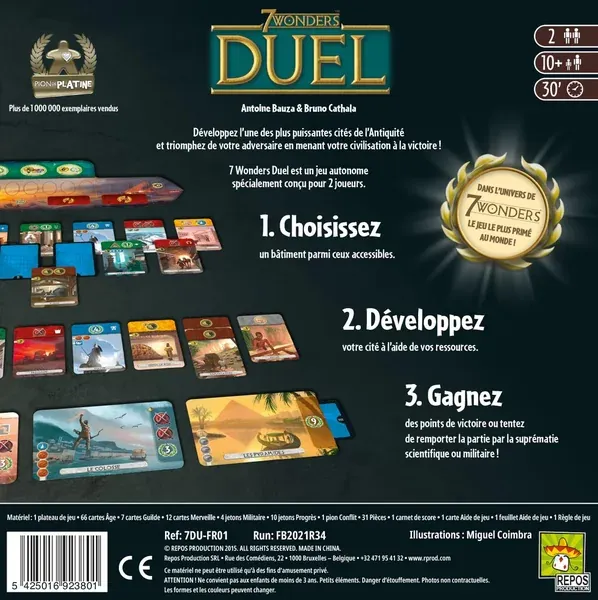
7 Wonders Duel is a two-player-only spin-off of the civilization-building card game 7 Wonders, designed by Antoine Bauza and Bruno Cathala and published by Repos Production. This review synthesizes the publisher's listing, BoardGameGeek community data, and published coverage — it is not based on hands-on play at our table.
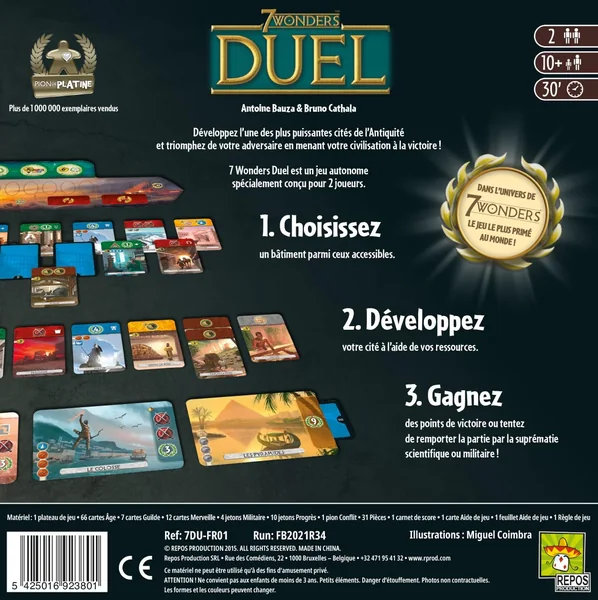
7 Wonders Duel game overview showing components and gameplay mechanics
The box promises ages 10+, exactly 2 players, and roughly 30 minutes per game. BGG's community age poll also lands at 10+ (193 votes), and BGG lists the playtime at 30 minutes flat, so the box claims align with community experience.
“the two-player version of the world's most award-winning game”
Reception is strong on every measured axis: BGG's community rating sits at 8.1/10 across 109,896 voters, ranking the game #24 overall and #27 in Strategy, while Amazon readers rate it 4.8/5 across 9,705 ratings. BGG's poll also reports no necessary in-game text, making it language-independent in play.
How It Plays
Each player drafts Wonders at the start, then competes through three Ages by claiming cards from a shared display. The game's signature tension is that Wonder powers can grant two consecutive turns — per The Thoughtful Gamer, this ability (absent from the original 7 Wonders) is "the single most important ability in 7 Wonders Duel," and it appears only on Wonder cards, four of which are drafted by the players at the start.
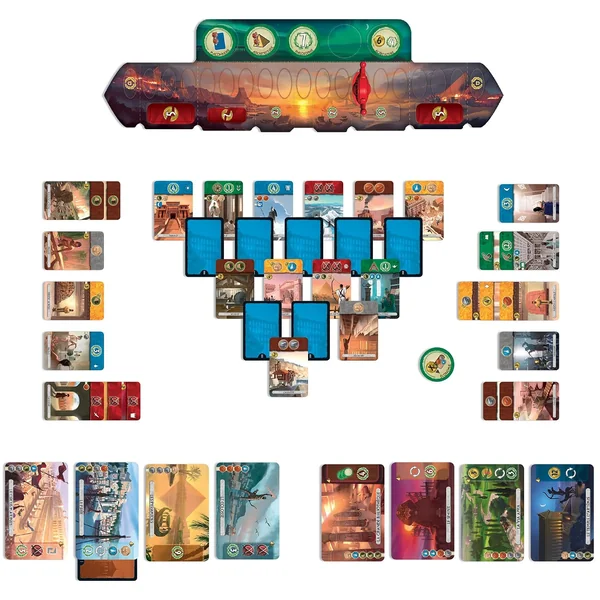
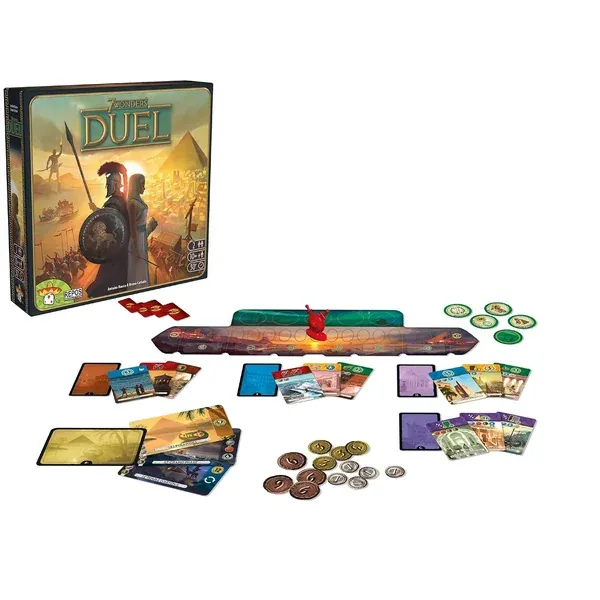
7 Wonders Duel complete game components and card layout
Victory can arrive three ways, per the listing: military supremacy by invading the opponent's capital, scientific supremacy by monopolizing scientific advancement, or simply the highest victory-point total when the third Age ends. The three-way threat structure is the game's identity — the listing warns that neglecting defenses can cost you your capital, while ignoring science leaves you "in the dark ages."
One structural twist the listing highlights: only seven of the eight Wonders in play can ever be built. That scarcity forces the Wonder draft to matter from the very first pick.
Complexity and Teachability
BGG's community rates the complexity at 2.2/5 (3,450 votes) — firmly in approachable territory for a strategy game. The mechanisms BGG lists (open drafting, multi-use cards, once-per-game abilities, income, end-game bonuses) are all recognizable to anyone who has played a modern drafting game.
Familiarity with the original 7 Wonders accelerates things further. Meeple Mountain's reviewer noted that even their first game didn't take the full 30 minutes — though both players already knew the original game well, which the reviewer calls "a big win" for picking it up.
The Thoughtful Gamer's analysis suggests the deeper skill layer is less about rules than about sequencing: recognizing when a Wonder's double turn can snatch a critical card from the display. New players should expect their first loss to teach that lesson the hard way.
Player-Count Truth
There is no ambiguity here: the box is for exactly 2 players, and BGG's player-count poll agrees emphatically, with 1,484 voters marking it best at 2. Repos Production's own page describes it as "the two-player version of the world's most award-winning game," born from Bauza teaming with Cathala after 7 Wonders' success, per the publisher's press page.
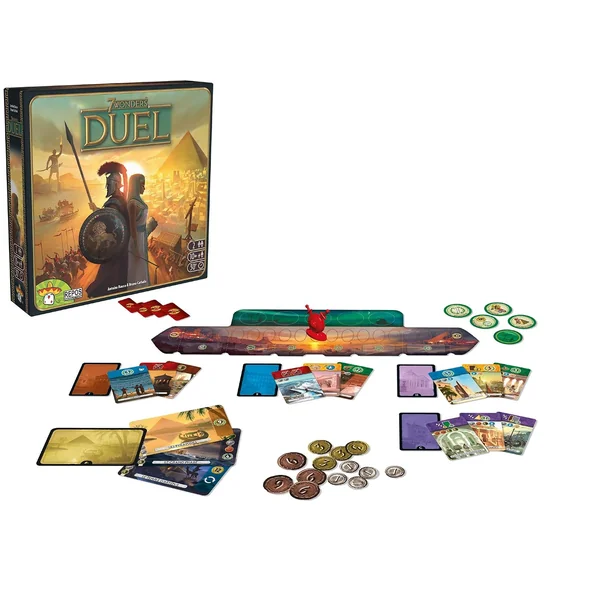
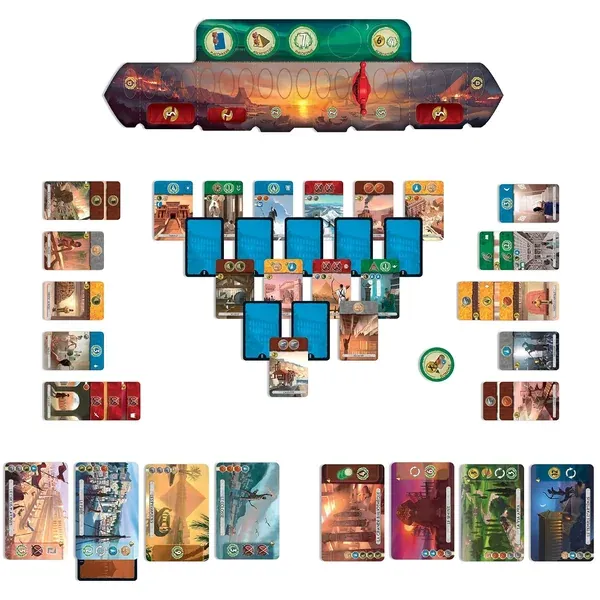
7 Wonders Duel's complete game components and setup layout
Buyers who want the Duel experience with a different theme should know BGG lists an official reimplementation, The Lord of the Rings: Duel for Middle-earth. BGG also lists several expansions for the base game — Agora, Pantheon, and a Solo variant, plus promo cards — though entries tagged "fan expansion" on BGG are unofficial.
What Makes It Replayable
The replay case rests on the interaction of drafting variance with the three victory conditions. Because Wonders are drafted and only seven of eight can be built, per the listing, the strategic landscape shifts from game to game — a rules fact, not a marketing claim.
Coverage backs the staying power: Writing at Large calls the game "gorgeous, very clever, and very fun," and a BGG forum review composed for a Central College board-game seminar examined it as a course text on immersion and design — an unusual endorsement of its design depth. The 186,209 BGG users who own it suggest the audience keeps growing a decade after release.
Honest Limitations
The Thoughtful Gamer's critique cuts deepest: because the double-turn ability lives only on Wonder cards and is so powerful, the opening Wonder draft can loom over everything after it. One reviewer finding, not a consensus — but it is the most specific structural criticism in the coverage we retrieved.
The instant-win conditions are also double-edged by design. A military or scientific supremacy victory ends the game immediately, per the listing, which means a session can conclude mid-Age before a points strategy matures — tense for some tables, abrupt for others.
Finally, sessions may run shorter than advertised. Meeple Mountain's plays consistently finished under the 30-minute box estimate, so buyers expecting an epic civilization arc should expect a sharp, compact duel instead.
Verdict
Couples, roommates, and dedicated two-player tables looking for a quick civilization game with real strategic teeth will find the community consensus — BGG 8.1/10, Amazon 4.8/5 — well earned. Players who dislike open-information drafting pressure or who want their engine-building to always reach a scoring payoff should look elsewhere.
Questions & answers, grounded in our sources
Is 7 Wonders Duel good with two players?
BGG's player-count poll marks it best at exactly 2 players (1,484 votes), matching the box's strict 2-player range. Repos Production describes it as the two-player version of 7 Wonders, designed by Antoine Bauza and Bruno Cathala specifically for head-to-head play.
How do you win this game?
The listing advertises three paths: military supremacy by invading your opponent's capital, scientific supremacy by monopolizing scientific advancement, or the highest victory-point total at the end of the third Age. Both supremacy wins end the game immediately, per the listing.
How long does a game of this game take?
The box and BGG both list 30 minutes. In Meeple Mountain's experience, sessions often finished under that mark — though their players already knew the original 7 Wonders well, which they credit as a big advantage when learning.
Does this game have expansions?
BGG lists several official expansions: 7 Wonders Duel: Agora, 7 Wonders Duel: Pantheon, and 7 Wonders Duel: Solo, plus promo cards. BGG also lists an official themed reimplementation, The Lord of the Rings: Duel for Middle-earth; entries marked 'fan expansion' on BGG are unofficial.
Is this game hard to learn?
BGG's community complexity weight is 2.2/5 (3,450 votes), and both the box and BGG's age poll put it at 10+. Meeple Mountain found that familiarity with the original 7 Wonders made learning notably faster, though the game stands alone.
What do the Wonders do in this game?
Per The Thoughtful Gamer, the most important ability — taking two consecutive turns — appears only on Wonder cards, four of which are drafted at the start. The listing adds that only seven of the eight Wonders in play can ever be built, making every Wonder draft pick consequential.
Sources & Further Reading
The key facts and claims in this review are grounded in the retrieved, verified sources listed below.
- 1
BoardGameGeek
- 2
meeplemountain.com
- 3
writingatlarge.com
- 4
thethoughtfulgamer.com