
GAMES
Published by
Lookout Games
Published
Read Time
6 min read
Amazon player rating
4.6
Share This Review
Patchwork (Revised Edition) Review: A Tight Two-Player Quilting Duel
BGG community
7.6/10
74,650 raters
4.6 Amazon (22)
Patchwork (Revised Edition) is Uwe Rosenberg's two-player quilting duel — draft tetromino-like patches onto your board while a shared time track decides who moves next. This review synthesizes the publisher's page, BGG community data, and published coverage; we have not played this edition hands-on. It's a light, fast, tightly balanced design that thrives exactly at its boxed player count of two.
Players
2
Best at 2 (630 votes)
Playtime
15–30 min
Complexity
1.6/5
1,919 votes
BGG rating
7.6/10
74,650 raters
BGG rank
#148
#5 Abstract Game
Age
8+
community poll (117)

Source-grounded review: synthesized from the listing, community data, and published coverage — we don't claim hands-on play, and every rating shown is attributed. How we review →
 Tap to enlarge
In This Review
- What Works & What Doesn't
- What It Is
- How It Plays
- Complexity & Teachability
- Player-Count Truth
- Replayability & Ecosystem
- Components & Table Presence
- Honest Limitations
- Verdict
What Works & What Doesn't
What Works
- Time-track turn order makes every patch a genuine tempo decision — the player behind moves next (Dicebreaker)
- Five-minute teach and 15–30 minute playtime, per Play Better Games and BGG
- Randomized patch circle at setup keeps the draft fresh every game (listing)
- BGG community rates it 7.6/10 across 74,650 votes, ranked #5 among abstract games
- Buttons double as currency and victory points, creating a clean, elegant economy
What Doesn't
- Strictly two players — a structural limit that excludes typical game-night groups (flagged by Play Better Games)
- Abstract theme and spatial optimization under time pressure won't click for everyone, per one honest BGG reviewer
- Lightweight by design — BGG's 1.6/5 weight means strategy gamers seeking depth may burn through it quickly
What It Is
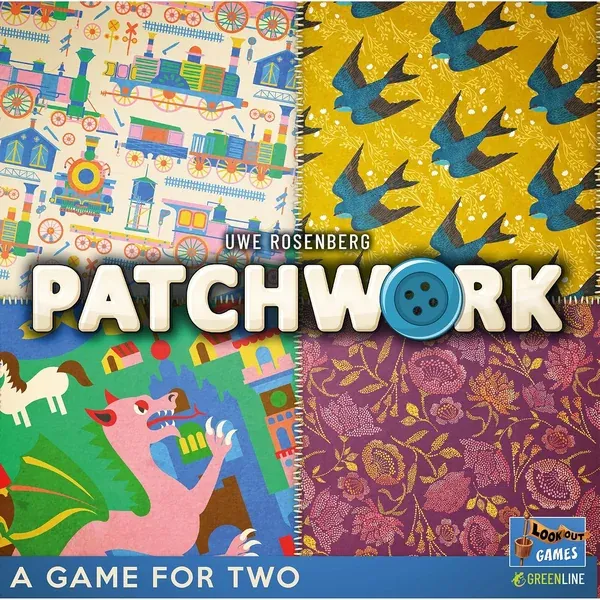
Patchwork is a two-player tile-placement game from designer Uwe Rosenberg (Agricola, A Feast for Odin), first released in 2014 per publisher Lookout Spiele's game page. This is the Revised Edition; the listing describes updated components, refreshed visuals, and a sleeker presentation while retaining the original gameplay, but the publisher has not published a detailed changelist, so exactly what changed beyond presentation isn't documented in our sources. The box promises ages 8+, two players, and roughly 30 minutes.
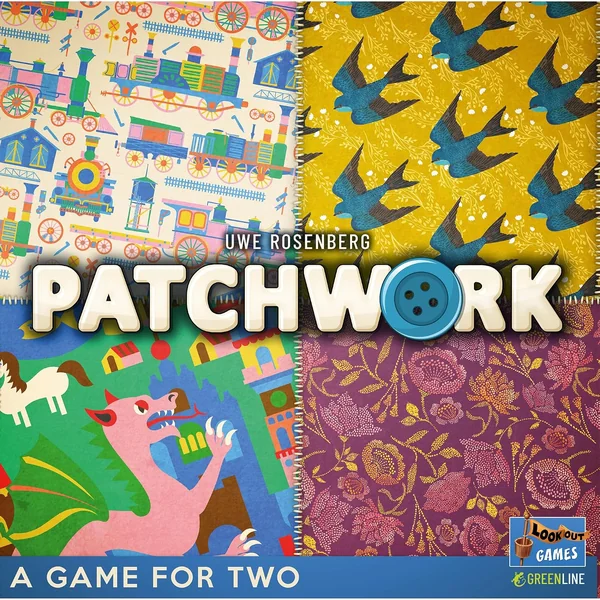
Patchwork's colorful fabric patches and game board design
BGG's community data backs the game's standing: a 7.6/10 rating from over 74,000 voters, ranked #148 overall and #5 among abstract games, with more than 124,000 owners. Amazon readers rate this edition 4.6/5, though from a thin sample of 22 ratings — treat that number as directional, not definitive.
“a tight, precise and finely chiselled design”
How It Plays
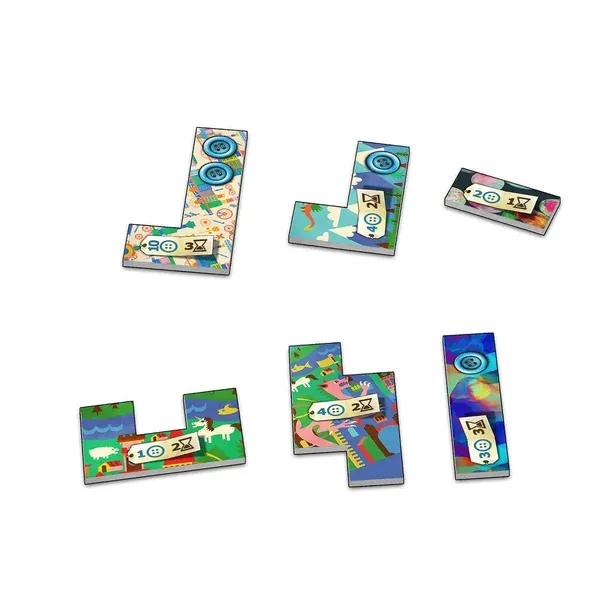
Each player has a quilt board and a time token on a shared time track. On your turn you do one of two things: buy one of the next three patches in front of the neutral pawn — paying its button cost and advancing your time token by the patch's time cost — or pass, moving ahead of your opponent's token and collecting one button per space moved, per Dicebreaker's how-to-play guide. The signature twist is that the player furthest behind on the time track always moves next, so an expensive patch can hand your opponent several consecutive turns.
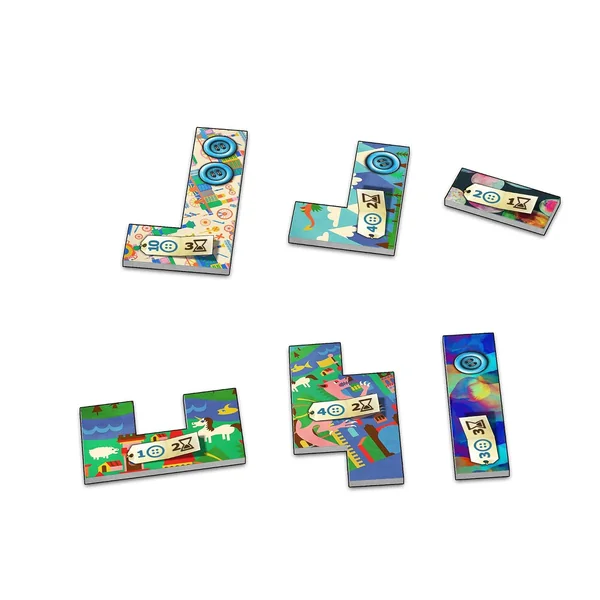
Patchwork's colorful patch tiles with varying shapes and button costs
Buttons are both currency and victory points. Moving past button icons on the time track pays income equal to the buttons sewn on your quilt, and special patches lie at fixed points on the track for whoever reaches them first, per Dicebreaker. When both tokens reach the end, you score your remaining buttons, plus a seven-button bonus for the first player to complete a 7×7 area, minus two buttons per empty square on your board — the formula Dicebreaker documents.
The listing confirms the circle of patches is arranged randomly at setup, so the draft order shifts each game.
Complexity & Teachability
BGG's complexity weight sits at 1.6/5 from nearly 1,900 votes — light territory. Play Better Games calls it "very easy to teach," estimating a five-minute rules rundown since each turn offers only two possible actions. BGG lists playtime at 15–30 minutes and its language-dependence poll reports no necessary in-game text, which helps for mixed-language tables.
That light ruleset hides real bite. Shut Up & Sit Down describes Patchwork as "a tight, precise and finely chiselled design," and the button-versus-time economy means every purchase is a tempo decision, not just a shape puzzle.
Player-Count Truth
The box says 2 players, and nothing argues otherwise. BGG's player-count poll votes it best at 2 (630 votes), and Dicebreaker states plainly it is a game for "two players (and only two players)." Play Better Games frames the two-player-only limit as its main reservation about the game — a fair warning for buyers who mostly host larger groups.
Replayability & Ecosystem
The randomized patch circle and the stat-based turn order mean the draft pool and pacing differ each session — that's a rules fact from the listing, not a quality claim. BGG lists official spin-offs including Patchwork Express (a faster, larger-grid variant), Patchwork Doodle, and Stack'n Stuff, plus expansions such as the 5×5 bonus card and an Automa; note that "Crazy Quilt" and "Special Buttons" are flagged on BGG as fan expansions, i.e. Unofficial.
Components & Table Presence
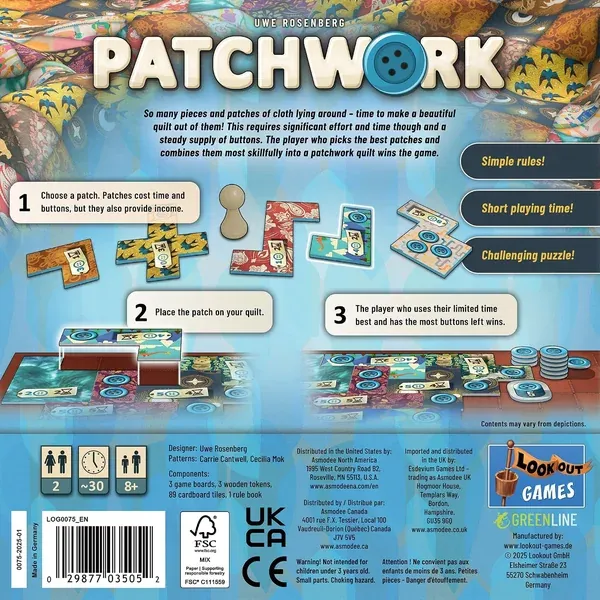
The listing specifies 3 game boards, 3 wooden tokens, 89 cardboard tiles, and a rulebook, and pitches the edition on tactile satisfaction and visual appeal. Meeple Mountain ranks Patchwork #9 on its top-100 list and calls it one of Rosenberg's finest achievements, so the presentation clearly isn't hurting its reception. Note the Amazon listing's product dimensions (8.1 inches long, 0.1 inches thick) look like a data-entry artifact rather than the real box size — don't plan shelf space around them.
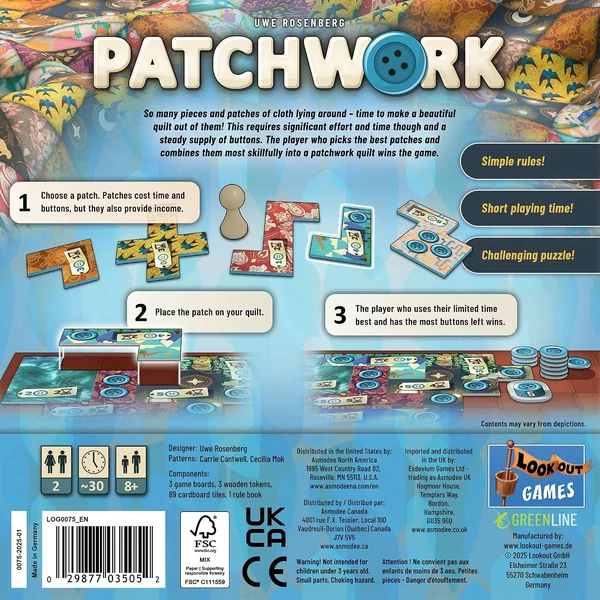
Patchwork game overview showing rules, components, and gameplay mechanics
Honest Limitations
The two-player ceiling is structural, not a mode problem: if your game nights skew to four, this box won't flex, as Play Better Games notes. One honest BGG reviewer also flagged that the abstract quilting theme won't sell everyone, and the spatial puzzle can frustrate players who dislike optimization under pressure — that's one reviewer's read, not a consensus. With a 7.6/10 across 74,650 BGG votes, there's no evidence of a divisive or broken design, but buyers seeking heavy strategy should note the 1.6/5 weight is genuinely light.
Verdict
Buy Patchwork if you want a quick, replayable two-player duel with near-zero teach time — couples, roommates, and filler-slot gamers are the audience. Skip it if your table is usually three or more, or if you want a heavier engine-builder; Rosenberg's deeper games serve that itch better.
Questions & answers, grounded in our sources
Can Patchwork be played with more than 2 players?
No — the box states 2 players, Dicebreaker explicitly describes it as a game for "two players (and only two players)," and BGG's community player-count poll votes it best at 2 (630 votes). BGG does list an official Automa expansion for solo-style play.
How long does a game of this game take?
BGG lists 30 minutes (with a 15–30 range), and the listing advertises 30 minutes. Play Better Games notes you can teach it in about five minutes, so a first game should fit comfortably inside that window.
What's different in the this game Revised Edition?
The listing says the Revised Edition retains the original gameplay with updated components, refreshed visuals, and a sleeker presentation. Neither the publisher nor the listing documents a detailed changelist, so specific component differences beyond that marketing description aren't confirmed in our sources.
Are there this game expansions or spin-offs?
Yes. BGG lists official spin-offs Patchwork Express (a quicker, larger-grid version), Patchwork Doodle, and Stack'n Stuff, plus expansions including the 5×5 Bonuskarte and an Automa. BGG flags "Crazy Quilt" and "Special Buttons" as fan-made, unofficial expansions.
Sources & Further Reading
The key facts and claims in this review are grounded in the retrieved, verified sources listed below.
- 1
BoardGameGeek
- 2
shutupandsitdown.com
- 3
lookout-spiele.de
- 4
- 5
playbettergames.com
- 6
meeplemountain.com