Cascadia is a tile-and-token drafting game set in the Pacific Northwest, designed by Randy Flynn and published by Flatout Games for 1-4 players. It won the Spiel des Jahres in 2022 — board gaming's most mainstream prize — along with the American Tabletop Award for Best Strategy Game and Board Game Geek's Light Game of the Year, per the publisher's listing.
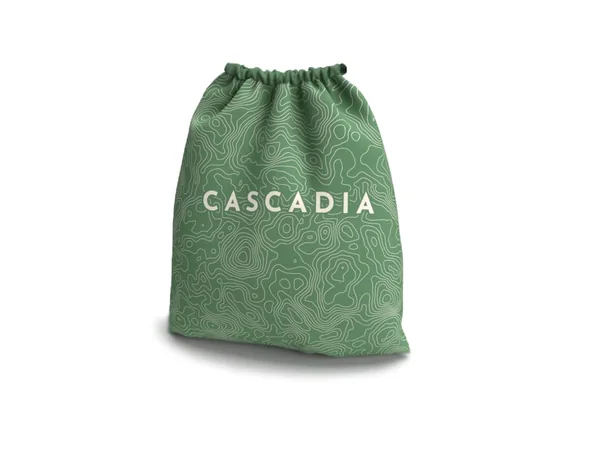
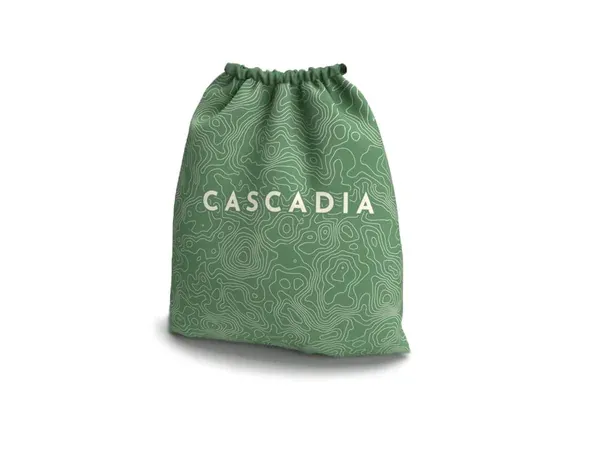
Cascadia's drawstring storage bag for game components
This guide synthesizes the Amazon listing, Flatout Games' product pages, BoardGameGeek community data, and published reviews; we did not play the game hands-on. Where the box copy and community numbers disagree, we present both with attribution.
“dual-layer puzzle that progresses over time as more habitats and wildlife are added to each player's individual ecosystem.”
What Cascadia Is
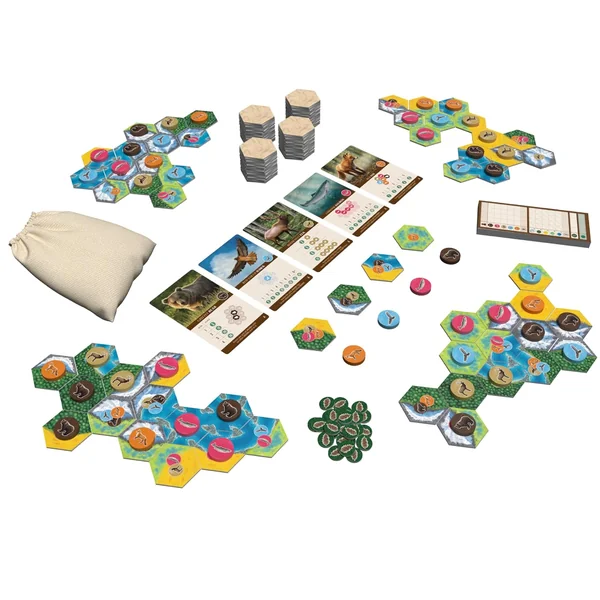
Each player builds their own landscape of hexagonal habitat tiles — mountains, forests, wetlands, rivers, prairies — and populates it with wildlife tokens: bears, salmon, elk, hawks, and foxes. Flatout Games describes it as a "dual-layer puzzle that progresses over time as more habitats and wildlife are added to each player's individual ecosystem."
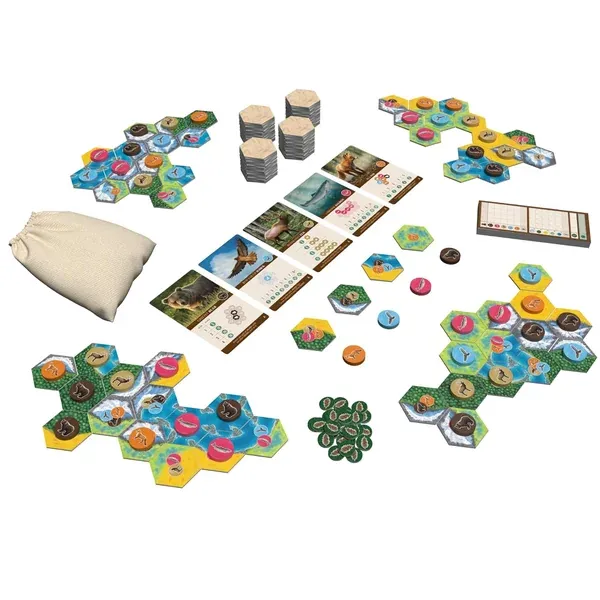
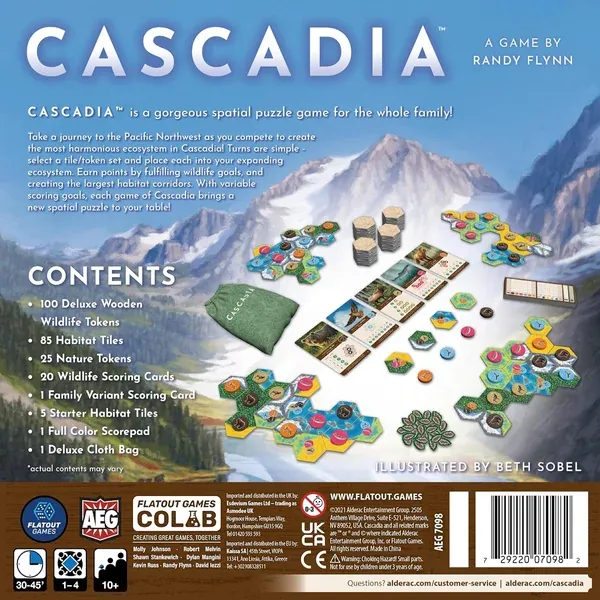
Cascadia's hexagonal habitat tiles, tokens, and player boards
The scoring runs on two axes at once, per the listing: you balance building large habitat corridors against placing wildlife in the configurations the current scoring cards reward. BGG's mechanism tags confirm the supporting cast: open drafting, pattern building, end-game bonuses, and a variable set-up.
How It Plays
The signature mechanic is the paired draft. On your turn you choose a habitat tile and wildlife token that come bundled as a fixed pair, then place both into your growing environment — Flatout's page for follow-up Cascadia: Alpine Lakes describes the shared structure: "Simply choose a habitat tile and wildlife token pair and place them into your expanding environment."
The play pattern a first-timer feels immediately: the pair you want rarely exists. The perfect tile is married to the wrong animal, so most turns are a compromise about which half of the draft you sacrifice — and that tension, not any single placement, is the game.
Scoring is described by the listing as balancing habitat corridors with wildlife configurations, with BGG tagging end-game bonuses among the mechanisms. None of our retrieved sources publish the full scoring formula, so we won't paraphrase one from memory — the box and scoring cards carry the specifics.
Complexity and Teachability
BGG's community puts the weight at 1.8 out of 5 (1,602 votes) — firmly in light territory. The listing claims a two-minute teach, and What Board Game's review backs the spirit of it, calling teaching "a simple affair."
The same review captures the trap: you sit down expecting "a quick game of this, nothing too thinky," and then "the puzzle hits you." IGN, more cautiously, frames it as "a simple game" facing a crowded field of wildlife-themed crossover hits like Wingspan.
The box says 1-4 players, and BGG's mechanism data confirms an official solo mode. BGG's player-count poll, though, lands on 2 players as the sweet spot (562 votes) — worth knowing if you're buying primarily for a couple or a duo.
Age is a similar story: the box says 10+, while BGG's community age poll suggests 8+ (148 votes). The listing also mentions a family mode for newer gamers.
Replayability and the Ecosystem
Replayability is structural: BGG lists variable set-up, and the wildlife scoring goals change from game to game, so the puzzle's targets shift even when the tiles don't. Board Game Review calls it "an absolutely delightful puzzle that always entertains me" and "one of those perfect midweek games for when you need to unwind but still give the grey cells something to do."
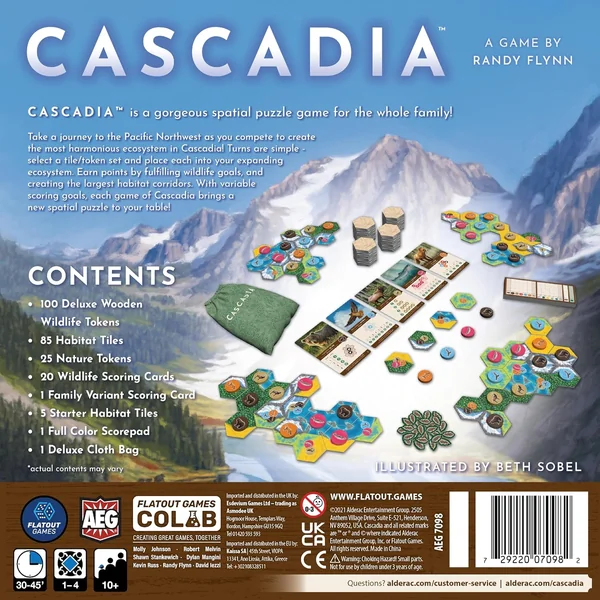
Cascadia's game components and Pacific Northwest ecosystem theme
> "An absolutely delightful puzzle that always entertains me… one of those perfect midweek games." — Board Game Review
The line has grown, per BGG's family data: Cascadia Junior for younger players, the Landmarks expansion (plus promo-card sets), and the standalone follow-up Cascadia: Alpine Lakes, which Flatout says keeps the paired-draft turn but switches to double-hexagon habitat tiles. Buyers choosing between them should note Alpine Lakes is a sibling, not a replacement — familiarity with the original carries straight over.
Honest Limitations
Interaction is mostly indirect. Because each player builds a separate ecosystem (per Flatout's own description), the draft is the main point of contact — players who want to block, attack, or trade may find the table quiet. That's a structural reading, not a reported flaw, but it's the most common mismatch for this style of game.
Weight cuts both ways. At 1.8/5 on BGG's scale, groups hunting a crunchier strategy game may find Cascadia slight, however elegant the puzzle. IGN's review, while warm, treats its simplicity as the risk factor rather than the selling point.
Verdict: Who Should Buy It
Buy Cascadia if you want an award-proven, quick-to-teach game for couples or mixed-experience groups — the BGG community ranks it #60 overall and #1 among abstract games, and Amazon buyers rate it 4.9/5 across 2,262 ratings. Two-player households especially should take note of BGG's poll.
Skip it if your group wants direct conflict or heavy strategy, or if your table is usually four competitive players who'd rather interact than build side by side. Families with younger kids might instead start with Cascadia Junior, and existing owners eyeing more of the same should look at Landmarks or Alpine Lakes before re-buying anything.


 Tap to enlarge